


Brenda and Tony Gibbs Award | 2025
Funding cutting-edge ornithology
The Brenda and Tony Gibbs Award is funded by a legacy left to the BOU to specifically fund ‘research on tracking and migration studies including the use of new technologies’.
Awards up to £20,000 are aimed at funding discovery science, technological advances, high-profile conservation and research with societal impact that delivers a step change in the understanding of the movements and migrations of birds.
2025 Award (1 of 2) | £19,970
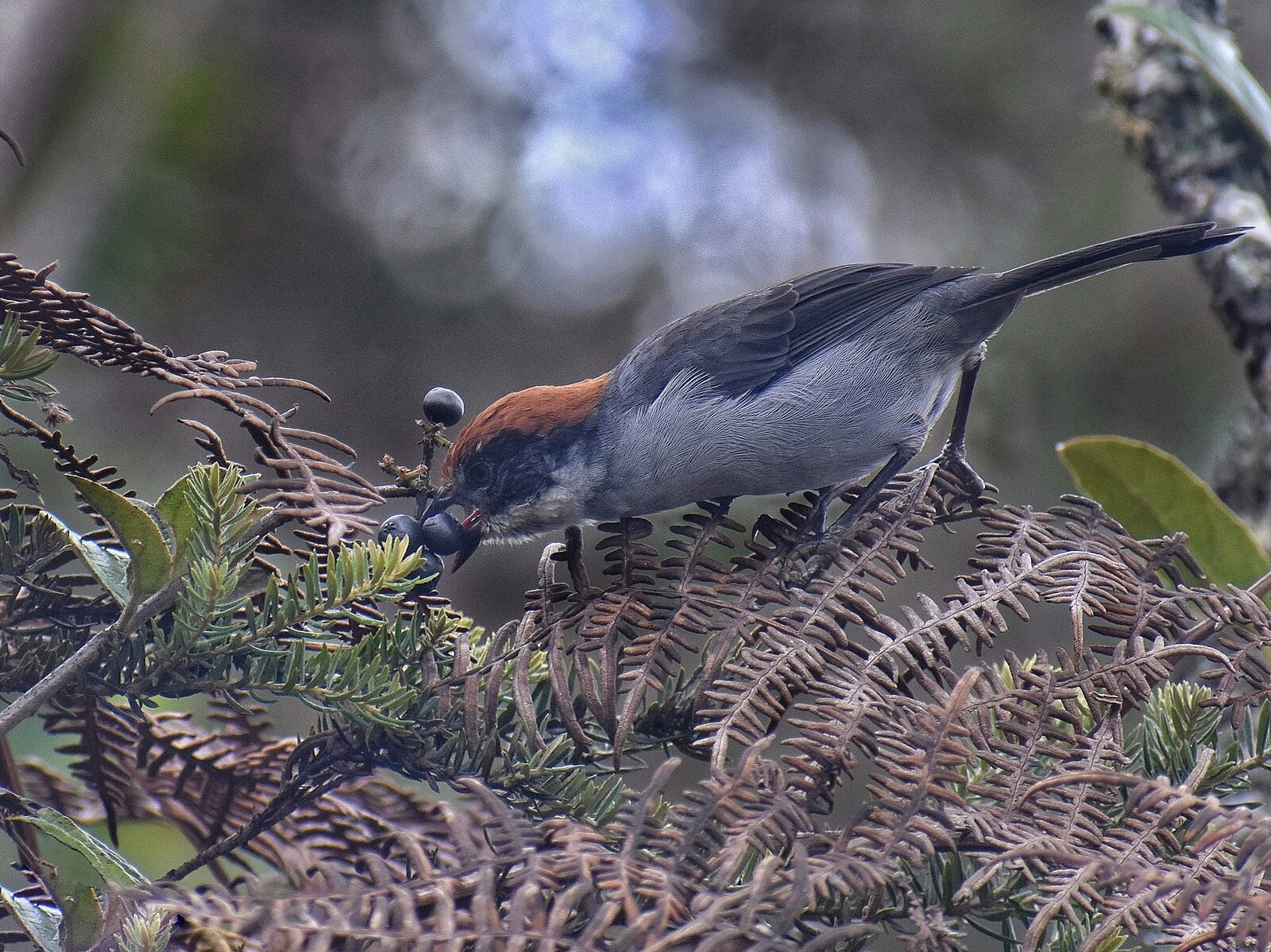
Impact of rapid habitat transformation on the resource selection and habitat use in a critically endangered species endemic to the northern Andes in Colombia
Principal Investigator
Juan Pablo Gómez, Universidad del Norte, Colombia
Team members
Sergio Chaparro Herrera, Universidad del Norte, Colombia
Juan Luis Parra, Universidad de Antioquia, Colombia
Natalia Hoyos Botero, Universidad del Norte, Colombia
Jose Vergara Paternina, Universidad del Norte, Colombia
Project background
Habitat loss is the leading cause of decline for approximately 86% of the world’s threatened bird species, according to the IUCN1. In Latin America, this threat is primarily driven by the conversion of natural vegetation into agricultural land2–4. This is especially critical for species with narrow geographic ranges and limited capacity to escape transformed landscapes5,6. The Antioquia Brush Finch (Atlapetes blancae), a critically endangered and microendemic bird, is one such species. Believed to be extinct until its rediscovery in 2018, it inhabits the rapidly changing landscapes north of Medellín, Colombia, an area with some of the highest rates of habitat transformation in the Andes7.
Despite recent advances in our understanding of its ecology, key questions remain regarding the species’ specific habitat requirements, how landscape change affects its movements, territory size, reproductive success, and population connectivity. Addressing these knowledge gaps is vital for designing productive landscapes that support both agriculture and species conservation.
Project aims
This project aims to: 1) identify key habitat features associated with foraging, reproduction, and movement in Atlapetes blancae, 2) assess how small-scale, short-term agricultural changes affect habitat use and movement patterns and 3) inform habitat design models that optimize connectivity and viability of the Antioquia Brush Finch populations.
The project will leverage high-resolution automated telemetry systems and freely available satellite imagery to study wildlife movement across dynamic agricultural landscapes8. The integration of year-round telemetry with monthly habitat classification will provide a novel, fine-grained understanding of how temporal changes in land use affect individual behavior and population-level processes9,10. This approach will reduce reliance on labor-intensive field surveys while producing actionable data for conservation planning11.
The team plan to track the movements of 14 individual Antioquia Brush Finches across two 100-hectare plots that vary in habitat fragmentation and remaining natural cover. Telemetry receivers will be installed to collect continuous GPS data over a full annual cycle, covering both breeding and non-breeding seasons.
The study will produce critical knowledge to guide habitat restoration and land-use planning in one of the most threatened Andean regions2,3. Beyond academic contributions, the project will generate actionable data to support conservation stakeholders, local communities, and policymakers working to reconcile agricultural productivity with biodiversity conservation.
References
- BirdLife International. State of the world’s birds: taking pulse of the planet. BirdLife International (2021).
- Armenteras, D., Espelta, J. M., Rodríguez, N. & Retana, J. Deforestation dynamics and drivers in different forest types in Latin America: Three decades of studies (1980–2010). Global Environmental Change 46, 139–147 (2017).
- Etter, A., McAlpine, C., Wilson, K., Phinn, S. & Possingham, H. Regional patterns of agricultural land use and deforestation in Colombia. Agriculture, Ecosystems & Environment 114, 369–386 (2006).
- Tilman, D. et al. Forecasting Agriculturally Driven Global Environmental Change. Science 292, 281–284 (2001).
- Jetz, W., Wilcove, D. S. & Dobson, A. P. Projected Impacts of Climate and Land-Use Change on the Global Diversity of Birds. PLOS Biology 5, e157 (2007).
- Betts, M. G. et al. Extinction filters mediate the global effects of habitat fragmentation on animals. Science 366, 1236–1239 (2019).
- Correa, R., Chaparro-Herrera, S., Lopera-Salazar, A. & Parra, J. L. Redescubrimiento del Gorrión-Montés Paisa Atlapetes blancae. Cotinga 41, 101–108 (2019).
- Kays, R., Crofoot, M. C., Jetz, W. & Wikelski, M. Terrestrial animal tracking as an eye on life and planet. Science 348, aaa2478 (2015).
- Tucker, M. A. et al. Moving in the Anthropocene: Global reductions in terrestrial mammalian movements. Science 359, 466–469 (2018).
- Nathan, R. et al. Big-data approaches lead to an increased understanding of the ecology of animal movement. Science 375, eabg1780 (2022).
- Unnithan Kumar, S. & Cushman, S. A. Connectivity modelling in conservation science: a comparative evaluation. Sci Rep 12, 16680 (2022).
Images
Antioquia Brush Finch Atlapetes blancae | Sebastian Serna Muñoz CC BY 4.0 Wikimedia Commons
