

Brenda and Tony Gibbs Award | 2025
Funding cutting-edge ornithology
The Brenda and Tony Gibbs Award is funded by a legacy left to the BOU to specifically fund ‘research on tracking and migration studies including the use of new technologies’.
Awards up to £20,000 are aimed at funding discovery science, technological advances, high-profile conservation and research with societal impact that delivers a step change in the understanding of the movements and migrations of birds.
2025 Award (2 of 2) | £20,000
Tracking the emergence of foraging culture in a newly forming seabird colony
Principal Investigator
Stephanie Harris, University of Liverpool, UK
Team members
Oliver Padget, University of Liverpool, UK
James Waggitt, Bangor University, UK
Marianna Chimienti, Bangor University, UK
Claire Carrington, Bangor University, UK
Olivia Hicks, Bangor University, UK
Sarah Bond, Oxford University, UK
Will Schneider, Bangor University, UK
Project background
Why some animals breed in dense colonies of unrelated individuals is difficult to explain. A major benefit to colonial living may be the availability of public foraging information1, which might enable individuals to find food more efficiently2. This reliance on colony-mates to decide where to forage is thought to contribute to the phenomenon of colony segregation in foraging ranges3, widely observed in seabirds: being socially-acquired and persistent over time, these distinct foraging behaviours can be thought of as foraging “cultures”4. While knowledge accrued over years of breeding and associations with other knowledgeable conspecifics might explain how birds make informed foraging decisions in existing colonies, little is known about how birds learn and behave in newly forming colonies, where both personal experience and public information is limited. How do individuals decide where to forage in these early stages of colony formation, in the absence of an established foraging culture?
Project aims
Observing colonisation events is extremely rare. This project aims to capitalise on the early stages of formation of a new gannet colony (Middle Mouse, Anglesey) and cutting-edge remote-download tracking devices to investigate how new seabird colonies establish their foraging culture. Pioneering individuals lack both personal familiarity with the surrounding prey landscape and informed colony-mates from which to glean information, a potential barrier to new colony formation5. Once formed, however, new colonies usually grow rapidly6, suggesting birds quickly overcome the challenges of foraging in their new surroundings. Because new colonies are at first small, birds should not need to travel far to find prey owing to low density-dependent prey depletion7. However, rapid colony growth might be accompanied by an increasing need to search for prey further away, perhaps requiring exploratory movement until a colony’s size and foraging range both stabilise.
The team will investigate whether foraging movements from a new colony are more or less exploratory than those from established colonies, yielding insight into our understanding of these colony-competition-information processes. By tracking birds, they will explore whether foraging trips from an emerging colony are less efficient (fewer dives per unit time) as a result of inexperience, and how social information propagates across the colony to result in the growing footprint of the area in which foraging occurs.
The colony at Middle Mouse formed in 2019, with up to 23 nests by 2023, presenting a rare opportunity for a natural experiment investigating the emergence of foraging culture. This opportunity is short-lived: currently, immigration is the only means by which the colony can expand and it can therefore be safely assumed that breeders did not hatch on the island and lack long-term familiarity with its surrounding waters. Here, the team will use state-of-the-art, remote download tracking technology to understand the foraging decisions of these pioneer gannets and measure information flow, and its ecological consequences, through a newly forming colony for the first time.
References
- Evans et al. (2016) Biol. Rev. 91, 658-672.
- Ward & Zahavi (1973) Ibis 115, 517-534.
- Wakefield et al. (2013) Science 341, 68.
- Aplin et al. (2019) Anim. Behav. 147, 179-187.
- Forbes & Kaiser (1994) Oikos 70, 377-384.
- Kildaw (2005) Mar. Ornith. 33, 49-58.
- Patterson et al. (2022) Curr. Biol. 32, 1-8.
Images
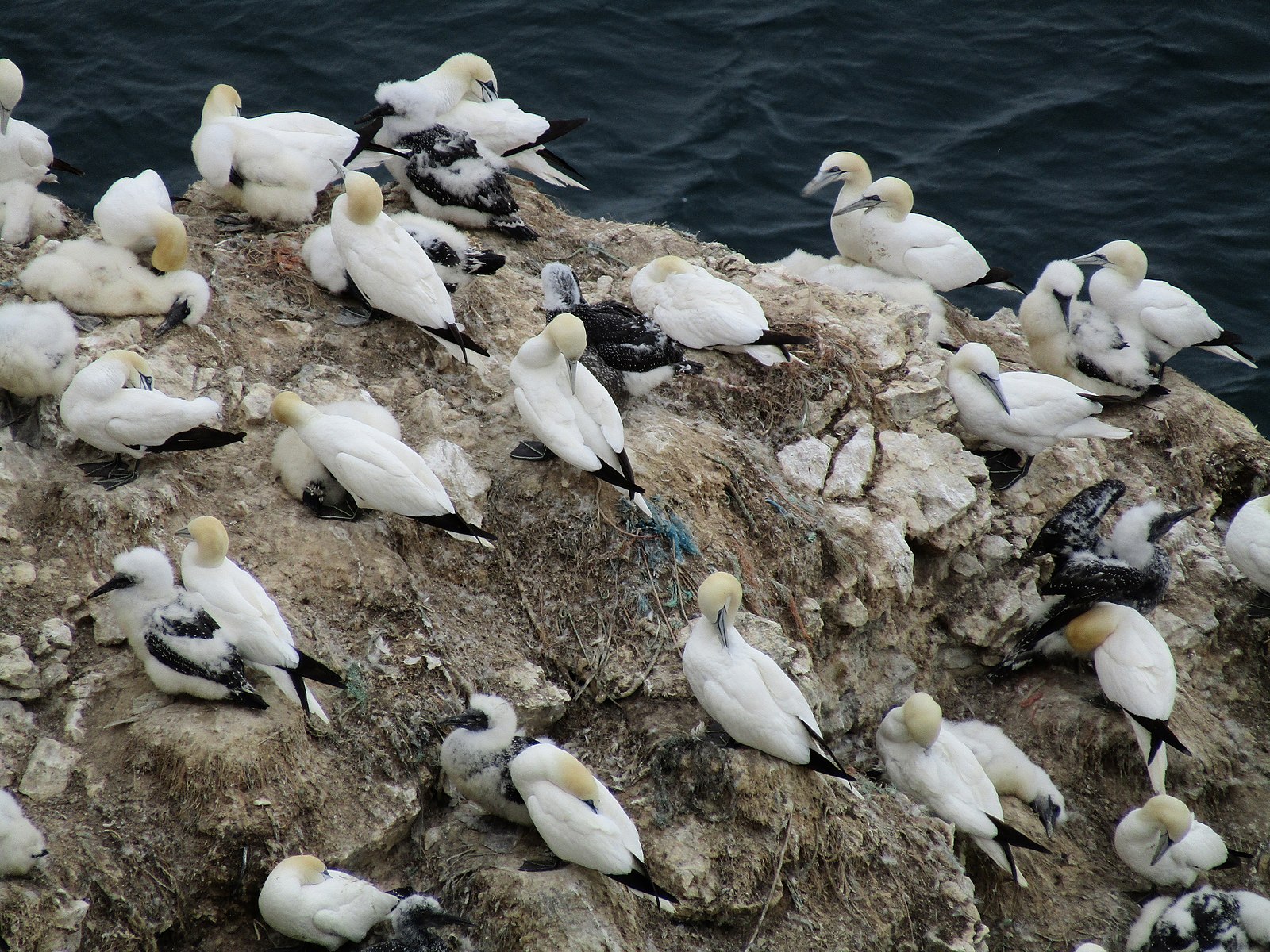
Northern Gannet Morus bassanus | Partonez CC BY-SA 4.0 Wikimedia Commons
