

Changes to the British List (26 Mar 2026)
The British Ornithologists’ Union Records Committee (BOURC) has made the following decisions with regards to the British List:
The following species has been changed from Category C1E* to Category C6E* of the British List:
 Ruddy Duck Oxyura jamaicensis jamaicensis (Gmelin, JF, 1789)
Photo (right): © Ray Scally, Old Moor, Yorkshire, 13 June 2009
Species on Category C of the British List are those that derive from translocation(s) (i.e. human-mediated movement and release) resulting in the establishment of self-sustaining population or populations within Britain, and vagrants from a self-sustaining population outside of Britain which have derived as a result of translocation(s).
Ruddy Duck Oxyura jamaicensis was included in Category C at the inception of Category C in the 6th Report of the BOURC in 1971 (Ibis 113: 420-423). In 2005 Category C was subcategorised into six subcategories C1-C6 (Ibis 147: 803-820), and Ruddy Duck Oxyura jamaicensis was included in C1: ‘Naturalized translocated species – species that have occurred only as a result of translocation(s)’.
The native range of ‘North American Ruddy Duck’ Oxyura jamaicensis jamaicensis is interior northwestern North America (southwestern Canada to Mexico) and the West Indies (AviList v2025). The colonization of Britain by Ruddy Duck occurred after the progeny of captive individuals imported from the USA and held in the zoological collection at WWT Slimbridge, Gloucestershire flew free with approximately 70 juveniles liberating themselves from there between 1952 and 1973. In Britain the first recorded breeding in the wild occurred in 1960 at Chew Valley Lake, Avon (Brit. Birds 69: 132-143).
At the time, no risk was envisioned, although by the mid-1970s the Wildfowl & Wetlands Trust (now Wetland Trust) did not ‘countenance the accidental or deliberate releasing of non-native birds into the wild’ and the British population spread rapidly and from there to continental Europe (Biol. Invasions 17: 9-12). The species spread south into the range the endangered White-headed Duck Oxyura leucocephala, where hybridisation was documented in Spain (Mol. Ecol. 16: 629-638). With the intention of protecting the population of White-headed Ducks from potential extinction by genetic introgression a feasibility study for a Ruddy Duck cull in the United Kingdom was undertaken from 1993-1995. This was followed by regional control trials in 1999-2005 and an eradication programme which commenced in 2005 (Brit. Birds 102: 680–690, Biol. Invasions 17: 9-12).
In January 2000 the Ruddy Duck population of the United Kingdom was estimated at 6,000 individuals but by 2024 the eradication programme had reduced this to an estimated 11 birds. Per Iain Henderson (in litt), the last conclusive evidence of breeding in Britain was in England in 2021 and the species is now either functionally extinct in the wild, or very close to it.
Accordingly, BOURC voted unanimously to move Ruddy Duck from C1 to C6: ‘Former naturalized species – species formerly placed in C1 whose naturalized populations are either no longer self-sustaining or are considered extinct’ where it joins Golden Pheasant Chrysolophus pictus and Lady Amherst’s Pheasant C. amherstiae. In the future should a self-sustaining population of Ruddy Duck arise again in the United Kingdom a new assessment will be made using the criteria defined for Category C1 (Ibis 164: 924-928).
The following subspecies has been added to the British List:
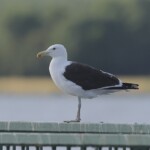 Kelp Gull Larus dominicanus vetula (Lichtenstein, MHC, 1823)
One, third-calendar-year, Grafham Water, Cambridgeshire, 1-10 August 2022 (photographed); same fourth-calendar-year, Grafham Water, Cambridgeshire, 18 June 2023 (photographed); same fifth-calendar-year, Grafham Water, Cambridgeshire, 6-7 August 2024 (photographed).
Photo (right): © Matthew Rodgers, Grafham Water, Cambridgeshire, 6 August 2024
This Kelp Gull Larus dominicanus was first discovered in 2022 and was accepted as the first record of this species for Britain (Ibis 166: 348; Brit. Birds 116: 569; Brit. Birds 117: 259-270). In 2022 the bird was in its third-calendar-year and this precluded confident identification to subspecies level. What is accepted to be the same individual returned to the same location in June 2023 and again in August 2024, now in its fifth-calendar-year year with an adult plumage aspect and was well-documented (Brit. Birds 117: 690; Brit. Birds 118: 522).
AviList 2025 recognises five subspecies of Kelp Gull: nominate dominicanus, judithae, melisandae, austrinus, and vetula (colloquially known as ‘Cape Gull’) (AviList v2025). Cape Gull is native to coastal western and southern Africa, and is the only subspecies accepted as having occurred in the Western Palearctic where it was first recorded in 1995, in France, and it first bred in 2009 in Morocco (AviList v2025, Birding World 17: 62-70; Dutch Birding 25: 327; Birding World 22: 253-256).
Within Kelp Gull populations there is substantial intrasubspecific plumage variation but the combination of plumage, structure and bare part colouration in a now adult bird allowed this individual to be confidently identified as L. d. vetula and this identification was accepted unanimously by BBRC and BOURC (African Birdlife 1: 10-11; Birding World 14: 112-125; Bull B.O.C. 122: 50-71; Durb. Mus. Nov. 12: 27-37; Zool. Stud. 51: 881-892).
A subsequent record of Cape Gull at Redcar Tarn, Keighley, Yorkshire on 26-27 April 2025 is being considered by BBRC.
Other decision:
 Pied Crow Corvus albus (Müller, PLS, 1776)
Photo (right): © Pied Crow, Mike Trew, Clevedon, Avon, 1 July 2018
One, at least second-calendar-year, Easington, Kilnsea and Spurn, Yorkshire, 13 June 2018 (photographed); same Gibraltar Point, Lincolnshire, 13 June 2018 (photographed); same Great Yarmouth, Winterton-on-Sea, Caister-on-Sea, Cromer, and East Runton, 14-23 June 2018 (photographed); same Clevedon, Avon, 26 June-1 July 2018 (photographed); same Pencarnan, Pembrokeshire, 3-8 July 2018 (photographed); same Thornwick Camp and Flamborough, Yorkshire 24 July 2018-12 March 2019 (photographed); same, at least third-calendar-year, Spurn, Yorkshire, 21 March 2019 (photographed); same Gibraltar Point, Lincolnshire, 22 March 2019; same Holland Haven, Essex, 24 March 2019; same Winchelsea, Seaford, and Litlington, Sussex, 30 March-6 April 2019 (photographed); same Cot Valley, Land’s End, St Just, and Nanjizal, Cornwall, 10-19 April 2019 (photographed); same Clovelly, Lundy, Morte Point, and Woolacombe, Devon, 22 April-29 April 2019 (photographed); same Dover, North Foreland, St Margaret’s at Cliffe, Foreness Point, Swalecliffe, Broadstairs, and North Foreland, Kent 6-21 May 2019 (photographed).
On 8 June 2018 a Pied Crow Corvus albus at sea in southeastern North Sea briefly visited a ship travelling from Russia to Britain (Alan Kirby in litt.). What is presumed to be the same bird was then discovered in Britain on 13 June 2018 in Yorkshire before it relocated to Lincolnshire, then Norfolk, Avon, and Pembrokeshire, returning to Yorkshire on 24 July where it remained until 12 March 2019. In mid March 2019 it again became itinerant, visiting Lincolnshire, Essex, Sussex, Cornwall, Devon, and Kent on 14-21 May 2019 before it relocated to the Netherlands on 22 May 2019-20 March 2020 (Dutch Birding 44: 428). This record has been considered for admission of the species to Category A or Category D of the British List.
Pied Crow is an abundant monotypic species of sub-Saharan Africa, Madagascar, Aldabra, and Comoros that is largely sedentary although in some areas seasonal movements may be dictated by rains (AviList v2025; Birds of the World).
Pied Crow was first recorded as a vagrant to the Western Palearctic in 1931 in Libya, with others in Algeria in 1961 and 1964 but with no further records until three together in Western Sahara from at least 2009 with successful breeding occurring there in at least 2010 contributing to a total of ca.11 individuals recorded between Western Sahara and Morocco by 2025 (Dutch Birding 32: 329-332; Éléments d’ Ornithologie Marocaine 2025: eom25121; Go-South Bull 14: 133-138). Breeding was also attempted in Ceuta (where Pied Crow is listed as Category D) in 2012 and Libya in 2013 but, despite a dramatic increase in birder survey effort in North Africa, breeding attempts at just three disparate locations represents scant evidence of a stepwise northward range extension (III Atlas de las aves en época de reproducción en España; Ardeola 62: 502; Ardeola 64: 227; eBird; Eléments d’ Ornithologie Marocaine 2022: eom22031; Oiseaux de Libye). In Europe Pied Crow has been recorded in several countries but in Europe it is only admitted to Category A of a national list in Gibraltar (Gibraltar Bird List; Gibraltar Bird Report 2014).
Instances of vagrancy to temperate Europe by birds of Afrotropical origin are exceptional, although ship-assisted passage is a potential means of arrival for extralimital Pied Crows. However, there are only a small number of documented records of the species actually aboard ships: at sea off Western Sahara and around the Canary Islands, and there is also possibility that these records concerned individuals known to have escaped on the Canary Islands (Alauda 74: 275-276); what is presumed to be the 2018-2019 Pied Crow in Britain seemingly joined a ship at sea.
BOURC’s policy towards ship-assisted vagrants is not to admit port-to-port or coast-to-coast transportees onto the British List and suspected ship-assisted birds should only by admitted to the List if the species is considered capable of making an unassisted crossing under favourable circumstances (Ibis 147: 246–250, Ibis 156: 236–242).
Previously Pied Crow has escaped in Britain and so it is already on Category E ‘species that have been recorded as introductions, human-assisted transportees or escapees from captivity, whose breeding populations (if any) are thought not to be self-sustaining’. Pied Crow is not uncommon in captivity in Europe and as a non-native species it is not a requirement that birds are ringed (https://www.dutchavifauna.nl/).
The BOURC did not consider the 2018-2019 Pied Crow to be a vagrant and voted unanimously to not add the species to Category A or Category D; the same decision as that made by the CDNA for the same individual in the Netherlands (Dutch Birding 44: 428).
These changes will be published as part of the BOURC’s 59th report due to be published in Ibis in January 2027. Upon publication of these changes, the British List remains at 636 species (Category A = 619; Category B = 7; Category C = 10).