

Changes to the British List (13 Aug 2026)
The British Ornithologists’ Union Records Committee (BOURC) has made the following decisions with regards to the British List:
The following species has been added to Category A of the British List:
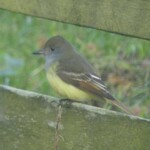 Great Crested Flycatcher Myiarchus crinitus (Linnaeus, C, 1758)
One, first-calendar-year or older, Tingwall, Mainland, Shetland, 16 October 2025, probably also present on 15 October (photographed).
Photo (right): Great Crested Flycatcher Myiarchus crinitus © Hazel Ulstad
First noticed by perceptive non-birders it was only subsequently identified as a Great Crested Flycatcher following circulation of photographs to members of the Shetland Bird Club Rarities Committee after the bird had departed.
Great Crested Flycatcher breeds in southeastern Canada to the Gulf States, and northern populations and is a long-distance migrant, most birds wintering from southern Mexico to Colombia and Venezuela (AviList v2025). Vagrants have been recorded well north and west of its breeding range in North America, as well on Bermuda, the Bahamas, Puerto Rico, and in Peru (birdsoftheworld.org; Boletín UNOP 12: 7-10).
This is the sixth species of tyrant flycatcher Tyrannidae to occur in Britain, five of which have been added to the British List since 2007: in order of appearance, Eastern Phoebe Sayornis phoebe (1987), Alder Flycatcher Empidonax alnorum (2008), Acadian Flycatcher Empidonax virescens (2015), Eastern Kingbird Tyrannus tyrannus (2016), and Yellow-bellied Flycatcher Empidonax flaviventris (2020) (Ibis 164: 860-910). This Great Crested Flycatcher also constitutes a first for the Western Palearctic, where an additional three species of tyrant flycatcher have yet to occur in Britain: Western Kingbird Tyrannus verticalis (Azores), Least Flycatcher Empidonax minimus (Iceland), and Eastern Wood Pewee Contopus virens (Azores) (Anuário Ornitol. 3-101; Birding World 435-440; Anuário Ornitol. 11: 3-55).
In autumn 2025 28 North American landbirds of 12 species were reported in Britain between 20 September and 17 November including in Shetland a Swainson’s Thrush Catharus ustulatus on Foula on 29 September-6 October and a Blackpoll Warbler Setophaga striata on Unst on 8-19 October. In Ireland the 12 North American landbirds located between 29 September and 11 October showed an unusually northwestern bias.
Great Crested Flycatcher has not previously been recorded in Britain as an introduction, human-assisted transportee or escape from captivity and there are no records of tyrant flycatchers on Category E. The only suboscine passerines known to be routinely held in captivity are Great Kiskadees Pitangus sulphuratus and therefore the possibility of it being an escape from captivity is considered negligible.
The identification as Great Crested Flycatcher was accepted unanimously as was natural vagrancy. It was not considered possible to confidently assign the bird to an age class.
Great Crested Flycatcher is monotypic and should be placed after Ring-necked Parakeet Psittacula krameri on the British List.
New first record:
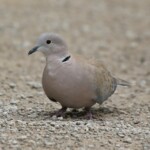 Collared Dove (Eurasian Collared Dove) Streptopelia decaocto (Frivaldszky, I, 1838)
One, male, first-calendar-year or older, Greetwell Hall, Manton Warren, Lincolnshire, 14 May 1952 until 1 January 1958 predates the previously accepted first record of this species and is therefore accepted as the first British record (Ibis 100: 299-300).
Photo (right): Collared Dove Streptopelia decaocto © Paul Chapman
Collared Dove was already established in Europe in Thrace, Turkey from at least 1547 and from ca. 1930 the species colonized almost the whole of temperate Europe (Orn. Ber. 2: 52-53; Brit. Birds 58: 105-139). By 1948 the species had reached northernmost Denmark and in 1951-1952 a documented westward leapfrog movement of 580 km from central Germany to northeastern France saw its imminent appearance in Britain anticipated (Brit. Birds 46: 153-181; Brit. Birds 46: 51-55).
The first sighting of a Collared Dove in Britain was in Lincolnshire in 1952 and this was contemporaneously considered as a British first record by BOURC. However, although the identification was accepted it was not admitted to the British List then as the Committee held concerns that the bird may have been an escape from captivity based on the species having recently been imported from India into contiguous Yorkshire, and that the Lincolnshire individual habitually chose to feed in a chicken run (Ibis 98: 154-168; Brit. Birds 46: 51-55). It was felt prudent to see if a pattern of occurrence developed and subsequently Collared Dove was added to the British List on the basis of a series of records in Norfolk commencing with two at Overstrand in April 1955, followed by rapid colonization nationwide – with an estimated British population of 795,000 pairs in 2016 (Ibis 100: 299-300; Brit. Birds 50: 239-246; Brit. Birds 113: 69-104).
The likelihood of the 1952 Lincolnshire individual being an escaped bird was well-explored at the time including correspondence with the known importer confirming that none had been lost, and a request for information regarding any other escaped Collared Doves made in newspapers, which yielded no information (Brit. Birds 46: 51-55). Subsequently Collared Dove has proved to be an exceptionally infrequent escape from captivity. That Collared Dove frequent chicken runs is now known to be common habit of this synanthropic species and therefore, with no indication that the 1952 Lincolnshire bird was an escape and an established pattern of occurrence, including vagrancy to the same location in 1957 (Brit. Birds 58: 105-139), the current Committee voted unanimously to accept the origin of the 1952 Lincolnshire record and admit it as a new first British record.
Collared Dove is monotypic.
New first Category A record:
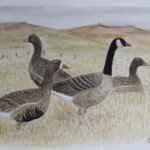 Canada Goose Branta canadensis (Linnaeus, C, 1758)
New first Category A record, at least first-calendar-year, Kilchoman, Islay, Argyll, 24 October-3 November 1986, predates the previously accepted first record of this species and is therefore accepted as the first Category A British record (Ibis 153: 227-232).
Illustration (right): Canada Goose Branta canadensis © Jimmy G Steele
Canada Goose Branta canadensis was formally added to the British List in 1949 based on naturalized populations and in 1971 was duly added to Category C at the inception of this category (Ibis 91: 508-513; Ibis 113: 420-423). At this time transatlantic vagrancy by Canada Goose since 1958 was acknowledged but this preceded both the separation of the British and Irish Lists and the split of Cackling Goose Branta hutchinsii from Canada Goose (Ibis 113: 420-423).
In 1996 vagrancy to Britain by Canada Goose sensu lato was accepted based on a bird marked in Maryland, USA in February 1992 that was later observed in North-east Scotland in November 1992-January 1993 before being killed in Perth & Kinross later the same month (Ibis 139: 197-201; Ring. Migr. 18: 113-158). In 2005 Cackling Goose was split from Canada Goose and consequently the 1992-1993 record was reconsidered (Ibis 147: 821–826). In 2011 Canada Goose was added to Category A of the British List on the basis of this record and it was felt likely that the subspecies concerned was interior ‘Todd’s Canada Goose’ (Ibis 153: 227–232).
By 2024 the British Birds Rarities Committee had accepted 65 records of vagrant Canada Geese including an individual on Islay, Argyll in 1986 (Brit. Birds 112: 547-630; Brit. Birds 118: 493-560). Islay is the principal wintering ground of ‘Greenland White-fronted Goose’ Anser albifrons flavirostris and Canada Goose has bred sympatrically with this species in Greenland since 1976 (Dansk Orn. Foren. Tidsskr. 106: 87-92). Vagrancy in geese is frequently caused by ‘abmigration’ (joining flocks of other species and migrating with them), and a Canada Goose marked in the USA has reached Iceland, and a ‘Todd’s Canada Goose’ trapped and ringed amongst ‘Greenland White-fronted Geese’ in Ireland was later recovered in the USA (Brit. Birds 116: 12–25; Ring. Migr. 18: 113–158; Irish Birds 9: 613–622).
The BOURC considered the 1986 record and voted unanimously to accept the identification, confirming that it was likely to be of the subspecies interior (and not nominate canadensis ‘Atlantic Canada Goose’, the latter being the subspecies of which the naturalized population is comprised (Ibis 164: 860-910)), and that it was an acceptable vagrant. It becomes the first Category A record of Canada Goose in Britain.
These changes will be published as part of the BOURC’s 59th report due to be published in Ibis in January 2027. Upon publication of these changes, the British List stands at 637 species (Category A = 620; Category B = 7; Category C = 10).