


Changes to the British List (14 Oct 2026)
The British Ornithologists’ Union Records Committee (BOURC) has made the following decisions with regards to the British List:
The following species has been added to Category C2 of the British List:
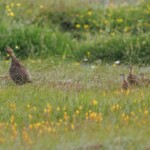 Red Grouse Lagopus scotica (Latham, J, 1787)
Red Grouse Lagopus scotica is currently on the British List in Categories A·E2*·E3.1·E3.2*·F.
Photo (right): Red Grouse Lagopus scotica © David Cooper
Historically Red Grouse did not occur in Devon, Somerset, or Shetland and the species was introduced into these recording areas during the 19th and 20th centuries. In Devon (at Dartmoor and Exmoor) and Somerset (Exmoor) Red Grouse has since declined to near-extinction or extinction (The Birds of Devon (2010)). In Shetland there has been no releases of Red Grouse since 1910 and by the 21st century the breeding population was estimated at between 100 and 200 breeding pairs, with between bird atlases in 1968-1972 and 2008-2011 gains in breeding abundance and distribution (eight additional 10km2), and winter distribution (12 additional 10km2) (The Birds of Shetland (2004); BTO Bird Atlas 2007-11).
Species on Category C of the British List are those that derive from translocation(s) (i.e. human-mediated movement and release) resulting in the establishment of self-sustaining population or populations within Britain, and vagrants from a self-sustaining population outside of Britain which have derived as a result of translocation(s). Category C is subcategorized with C2 reserved for ‘Naturalized established species – species with established populations resulting from translocation(s), but which also occur in an apparently natural state’ (Ibis 147: 803-820; Ibis 164: 924-928).
BOURC and Association of European Rarities Committees (AERC) have thresholds for Category C species (Ibis 164: 924-928):
-
- For populations that show significantly increasing population trends and clear geographic range expansion a minimum of 10 years and two generations (whichever is longer), starting from when the species first breeds in the wild in the relevant population.
- For populations that are instead either stable or fluctuating in numbers, instead a minimum of 25 years and three generations (whichever is longer) is required, starting from when the species first breeds in the wild in the relevant population.
- A minimum number of 250 wild-hatched mature individuals is required in the population.
The population of Red Grouse in Mainland Shetland meets these criteria for Category C and that the species should be added to Category C2 was accepted unanimously by the Committee. The populations in Devon and Somerset did not meet the criteria.
Category C3 is reserved for ‘Naturalized re-established species – species with populations successfully re-established in areas of former occurrence following a conservation translocation(s)’. In Cheshire & Wirral Red Grouse was reintroduced to High Moor and Piggford Moor in 2001 but the current estimated population does not meet the criteria for Category C and the species has not been added to C3 (Birds in Cheshire & Wirral (2008)).
The following species has been removed from Category C2 of the British List:
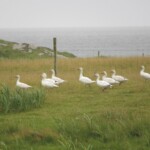 Snow Goose Anser caerulescens (Linnaeus, C, 1758)
Photo (right): Snow Goose Anser caerulescens © Gary Prescott
Species on Category C of the British List are those that derive from translocation(s) (i.e. human-mediated movement and release) resulting in the establishment of self-sustaining population or populations within Britain, and vagrants from a self-sustaining population outside of Britain which have derived as a result of translocation(s) (Ibis 164: 924-928).
In 2005 Category C was subcategorized into six subcategories C1-C6 (Ibis 147: 803-820), and Snow Goose Anser caerulescens was included in C2: ‘Naturalized established species – species with established populations resulting from translocation(s), but which also occur in an apparently natural state’ as a naturalized population in Argyll was considered self-sustaining (Ibis 148: 198-201).
In 2022 the criteria for defining self-sustaining populations was refined and includes a criterion that a minimum of 250 wild-hatched mature individuals is required in a population for it to be considered self-sustaining (Ibis 164: 924–928). The population in Argyll derived from a waterfowl collection on Mull where Snow Geese were left fully-winged in the 1950s or 1960s and peaked at 57 individuals in 1981. This population later relocated to Coll where breeding was confirmed in 1985 but only three adults remain in 2026, and successful breeding was last recorded in 2023 (Ibis 147: 803-820).
Elsewhere, former small populations of Snow Geese in Berkshire/Hampshire, Gloucestershire, and Norfolk are now extinct (Ibis 147: 803-820), a population in Yorkshire peaked at 34 individuals in 2016 but had declined to nine in 2024, and in Oxfordshire, where breeding was first confirmed in 1980, the population reached 130 in 2020 but has since declined. There is no evidence that any population of Snow Geese in Britain have interacted with each other and therefore no evidence of population connectivity.
Category C6 is reserved for ‘former naturalized species – species formerly placed in C1 whose naturalized populations are either no longer self-sustaining or are considered extinct’ (Ibis 164: 924-928) but, as no population of Snow Geese in Britain has ever approached the necessary threshold for it to be considered self-sustaining under the revised criteria, BOURC voted unanimously to remove Snow Goose from C2 but not to add it to C6.
The following species have been added to Category C5.2 of the British List:
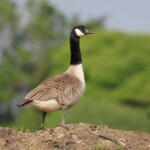 Canada Goose Branta canadensis canadensis (Linnaeus, C, 1758)
One, third-calendar-year, Dover, Kent, 17 February 1979 (ringing recovery).
Illustration (right): Canada Goose Branta canadensis canadensis © Ray Scally
Species on Category C of the British List are those that derive from translocation(s) (i.e. human-mediated movement and release) resulting in the establishment of self-sustaining population or populations within Britain, and vagrants from a self-sustaining population outside of Britain which have derived as a result of translocation(s) (Ibis 164: 924-928).
Canada Goose Branta canadensis was added to the British List in the 20th report of the BOU List Committee in 1949 (Ibis 91: 508-513) and was categorized in Category C at the inception of that category in the 6th Report of the BOURC in 1971 (Ibis 113: 420-423). In 2005 Category C was subcategorized into six subcategories C1-C6 (Ibis 147: 803-820), and Canada Goose was included in C2: ‘Naturalized established species – species with established populations resulting from translocation(s), but which also occur in an apparently natural state’ (Ibis 148: 198-201).
Established naturalized populations of Canada Goose exist in several European countries including in Sweden, where, following initial introductions from 1933, a total of almost 10,000 was estimated around 1970, and in 1995 the Fennoscandian population exceeded 30,000 birds (J. Evol. Biol. 8: 195-207). In Sweden Canada Goose is categorized as Category C (BirdLife Sverige 2026).
Subcategory C5.2 is defined as ‘A vagrant from a naturalized population – individuals from established naturalized populations outside of Britain that are a result of translocation(s) and that are outside the normal range of the species (Ibis 164: 924-928).
A Canada Goose ringed in Sweden as a pullus at Drottningholm, Stockholm on 20 July 1977 was later recorded sick at Dover, Kent on 17 February 1979. Ultimately, it returned to Sweden where it was shot dead at Horna Bay, Kristianstad on 25 February 1990 (Ring. Migr. 14: 152-200). Based on this record BOURC voted unanimously to add Canada Goose to C5.2 where it joins Egyptian Goose Alopochen aegyptiaca (Ibis 162: 263–268).
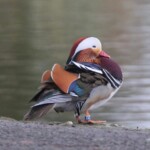 Mandarin Duck Aix galericulata (Linnaeus, C, 1758)
One, male, ninth-calendar-year, Beveridge Park, Kirkcaldy, Fife, 15-20 April 2026 (ringing recovery).
Illustration (right): Mandarin Duck Aix galericulata © Jacqui Herrington
Species on Category C of the British List are those that derive from translocation(s) (i.e. human-mediated movement and release) resulting in the establishment of self-sustaining population or populations within Britain, and vagrants from a self-sustaining population outside of Britain which have derived as a result of translocation(s) (Ibis 164: 924-928).
Mandarin Duck Aix galericulata was included in Category C at the inception of this category in the 6th Report of the BOURC in 1971 (Ibis 113: 420-423). In 2005 Category C was subcategorized into six subcategories C1-C6 (Ibis 147: 803-820), and Mandarin Duck was included in C1: ‘Naturalized introduced species – species that have occurred only as a result of introduction’ (Ibis 148: 198-201).
Established naturalized populations of Mandarin Duck exist in several European countries including in Poland, where, following initial breeding in 2001, the estimated national population in 2023 was 189 breeding pairs at 19 localities, of which 164 of the pairs were in parks in Warsaw (Ornis Polonica 66: 291-320). In Poland Mandarin Duck is categorized as Category C (Notatki Ornitologiczne 43: 177-195).
Subcategory C5.2 is defined as ‘A vagrant from a naturalized population – individuals from established naturalized populations outside of Britain that are a result of translocation(s) and that are outside the normal range of the species’ (Ibis 164: 924-928).
A Mandarin Duck ringed in Poland as a pullus at Warsaw in 2018 was later present at Beveridge Park, Kirkcaldy, Fife on 15-20 April 2026. Based on this record BOURC voted unanimously to add Mandarin Duck to C5.2.
These changes will be published as part of the BOURC’s 59th report due to be published in Ibis in January 2027. Upon publication of these changes, the British List stands at 637 species (Category A = 620; Category B = 7; Category C = 10).