


LINKED PAPER Field-based evidence of impaired sperm quality associated with conventional farming in two passerine birds. Humann-Guilleminot, S., Bailly, A., Monceau, K., Desbonnes, M., Bretagnolle, V. and Moreau, J. (2026) IBIS.VIEW
Agricultural land covers about 40 percent of the Earth’s terrestrial surface. Over recent decades, farming has intensified through larger fields, simplified landscapes and the widespread use of agrochemicals. These changes are now widely recognised as major drivers of biodiversity loss, particularly among farmland birds (Rigal et al., 2023).
Birds are affected by intensive agriculture through two main pathways. Indirectly, the loss of habitat complexity and the decline of food resources reduce survival and breeding success. Directly, exposure to agricultural chemicals can lead to toxicological effects, ranging from acute mortality to chronic sublethal impacts on physiology and reproduction. This points to possible physiological differences between birds living near conventionally managed fields and those living near organic fields.
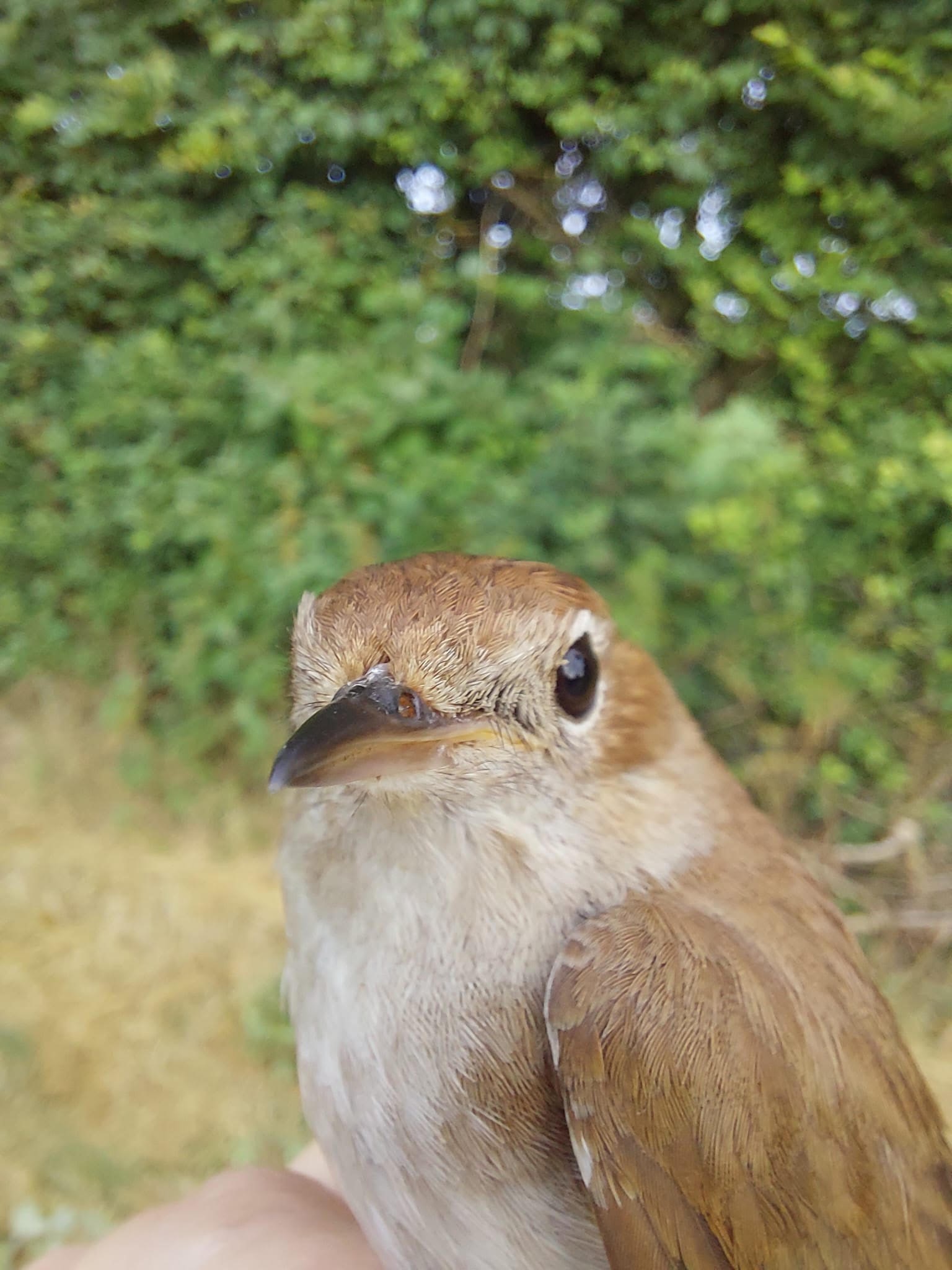 Figure 1. Common Nightingale, one of the species captured to measure the sperm quality © Audrey Bailly.
Our recent study, published in Ibis, investigated whether passerine birds living in agricultural landscapes surrounded by either organically or conventionally farmed fields differed in body mass, plumage coloration and sperm quality.
To test this, we captured passerine birds in hedgerows bordered by either organic or conventional fields (Figure 1), where between 73 and 98 percent of the surrounding buffer area was managed under one farming system or the other. The work was carried out in western France within a long-term research site where farming practices are mapped in detail at the field level. Hedgerows were similar in structure across all sites, allowing the surrounding farming system to be isolated as the main contrast.
Birds were captured during the breeding season. We measured body mass and ornamental coloration, traits known to play an important role in sexual communication and to reflect individual physiological condition. We also collected fresh sperm samples in the field (Figure 2), allowing us to measure sperm density, the proportion of abnormal sperm and variation in sperm morphology, all parameters reflecting sperm quality (Figure 3).
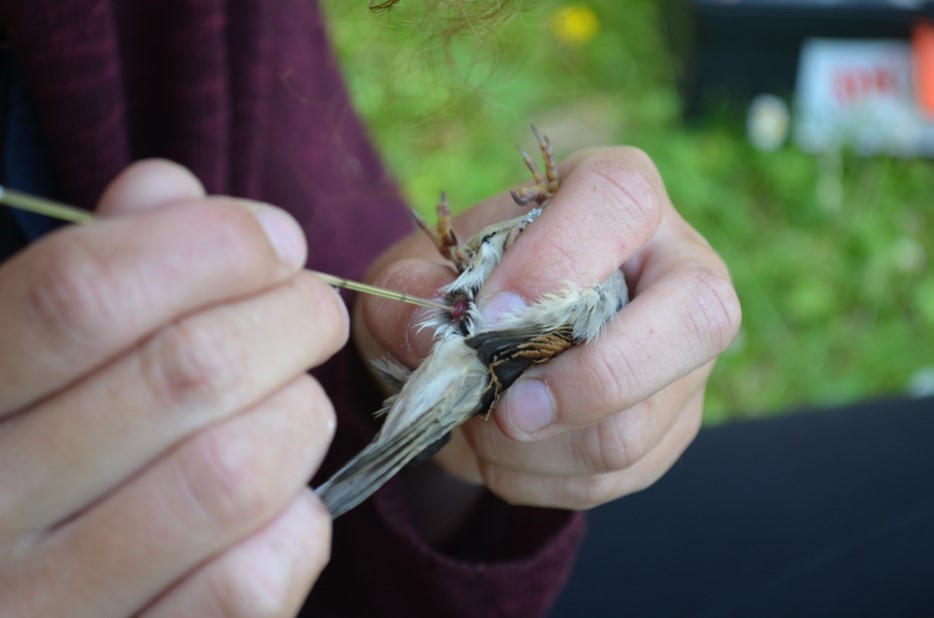 Figure 2. Sperm collection from a passerine bird.
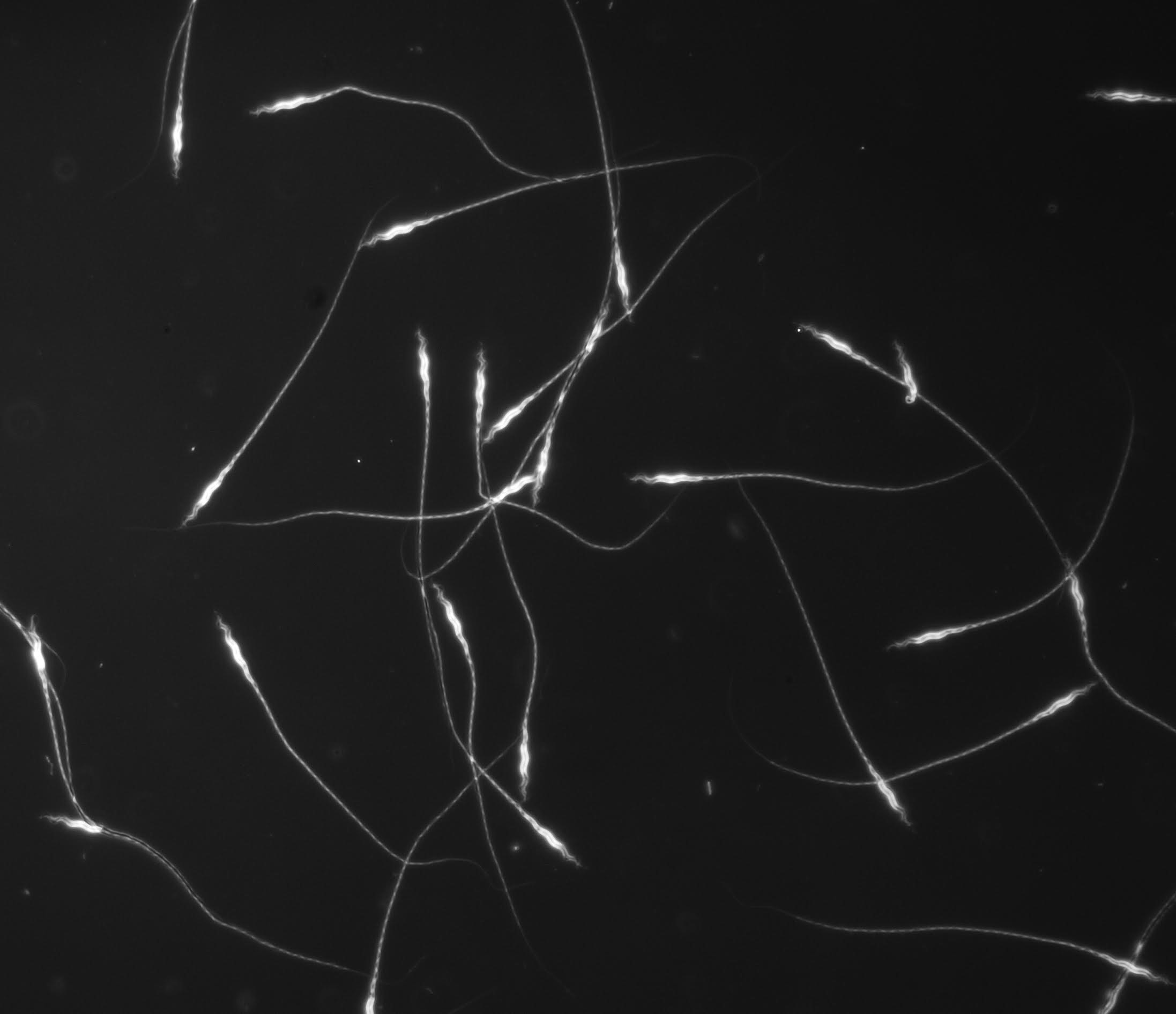 Figure 3. Spermatozoids from a passerine bird under the microscope.
Male fertility depends on the production of large numbers of morphologically normal sperm. Sperm quality is highly sensitive to nutritional stress, hormonal disruption and oxidative damage. Many pesticides used in conventional agriculture are known to interfere with endocrine systems or induce oxidative stress in vertebrates, and may therefore impact sperm quality in birds (Humann-Guilleminot et al., 2019).
No visible effects on body condition or colour
Across seven passerine species, measures of body mass did not differ between farming systems, in contrast to another study that reported lighter house sparrows in conventional farms compared to those captured in organic farms (Humann-Guilleminot et al., 2024).
Similarly, ornamental coloration based on carotenoid or melanin pigments showed no differences between farming systems.
Differences in sperm quality across agricultural habitats
When examining sperm quality across four species, our analyses revealed that two sperm parameters differed between birds living near conventional and organic farms.
In common whitethroats, males captured near conventional fields had lower sperm density. In common nightingales, males from conventional landscapes showed a higher proportion of abnormal sperm (Figure 4).
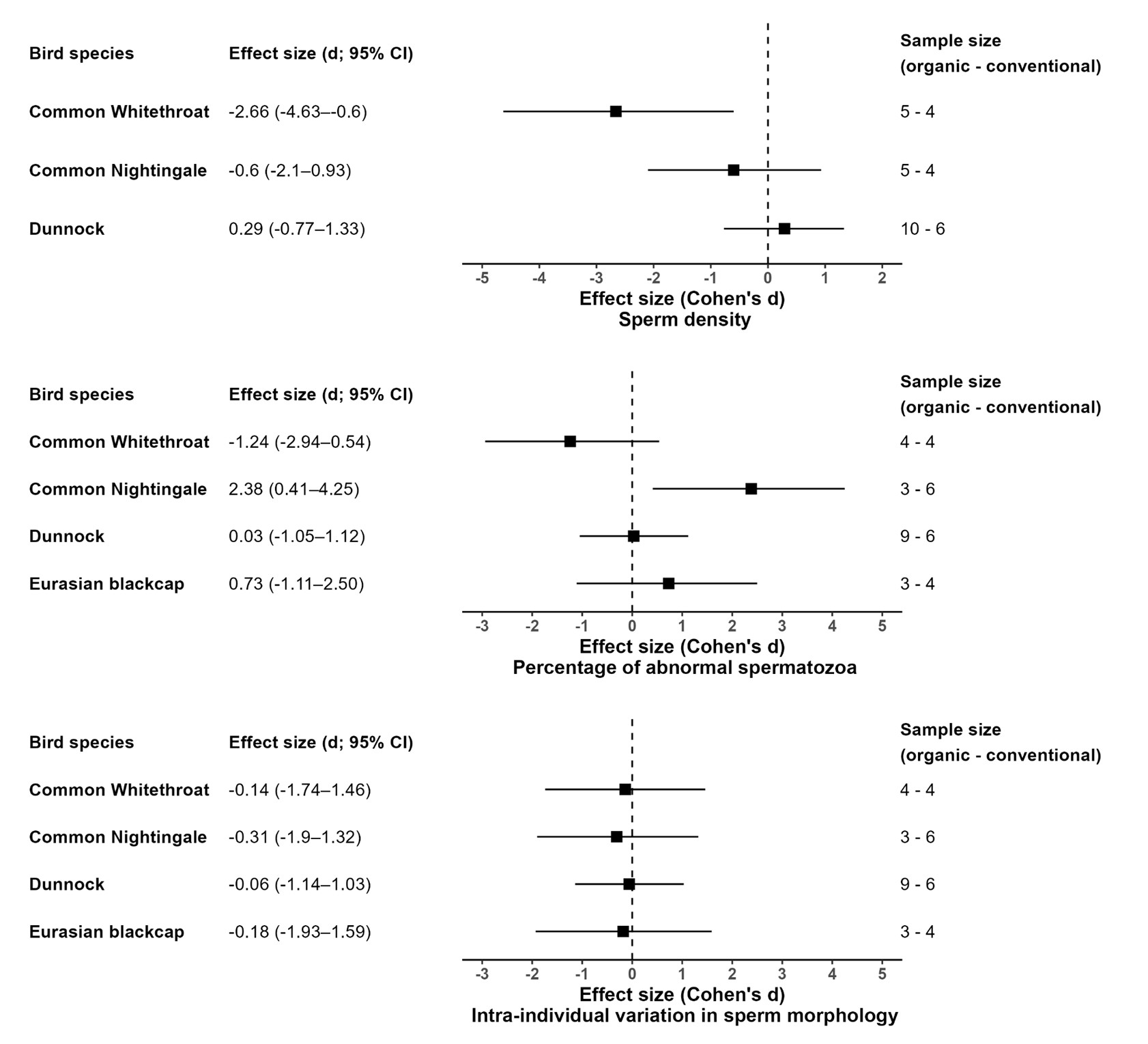 Figure 4. Differences in sperm quality between birds living near organic and conventional fields. The figure shows how sperm density, the proportion of abnormal sperm and variation in sperm morphology compare between farming systems for each species. Points represent the estimated differences, with lines showing uncertainty around these estimates. Positive values indicate higher values in organic farming, negative values indicate higher values in conventional farming.
Experimental and observational studies in vertebrates indicate that agricultural chemicals, and particularly pesticides, may act as endocrine disruptors, interfering with hormone production and regulation and thereby compromising germ cell development (Pandey et al., 2017). In addition, pesticide-induced oxidative stress can directly damage sperm cells by affecting their cellular structures and DNA, contributing to a higher proportion of abnormal sperm (Hoshi et al., 2014). Together, these effects on spermatogenesis can ultimately impair reproductive capacity.
Despite the limited sample size, our results point to a potential association between conventional farming and reduced male fecundity in birds and highlight the need for further studies on the reproductive costs of conventional agriculture in wildlife.
References
T., Warita, K., Tabuchi, Y., Yokoyama, T. & Kitagawa, H. 2014. Insight into the mechanism of reproductive dysfunction caused by neonicotinoid pesticides. Pharmaceutical Society of Japan, Tokyo.
Humann-Guilleminot, S., Binkowski, Ł.J., Gning, O., Glauser, G. & Helfenstein, F. 2024.House sparrows are heavier on organic and integrated-production farms than on conventional farms. Agriculture, Ecosystems & Environment. 363:108853.VIEW
Humann-Guilleminot, S., Tassin de Montaigu, C., Sire, J., Grünig, S., Gning, O., Glauser, G., Vallat, A. & Helfenstein, F. 2019. A sublethal dose of the neonicotinoid insecticide acetamiprid reduces sperm density in a songbird. Environmental Research. 177:108589.VIEW
Pandey, S.P., Tsutsui, K. & Mohanty, B. 2017. Endocrine disrupting pesticides impair the neuroendocrine regulation of reproductive behaviors and secondary sexual characters of red munia (Amandava amandava). Physiology & Behavior. 173:15-22.VIEW
Rigal, S., Dakos, V., Alonso, H., Auniņš, A., Benkő, Z., Brotons, L., Chodkiewicz, T., Chylarecki, P., de Carli, E., del Moral, J.C., Domşa, C., Escandell, V., Fontaine, B., Foppen, R., Gregory, R., Harris, S., Herrando, S., Husby, M., Ieronymidou, C., Jiguet, F., Kennedy, J., Klvaňová, A., Kmecl, P., Kuczyński, L., Kurlavičius, P., Kålås, J.A., Lehikoinen, A., Lindström, Å., Lorrillière, R., Moshøj, C., Nellis, R., Noble, D., Eskildsen, D.P., Paquet, J.-Y., Pélissié, M., Pladevall, C., Portolou, D., Reif, J., Schmid, H., Seaman, B., Szabo, Z.D., Szép, T., Florenzano, G.T., Teufelbauer, N., Trautmann, S., van Turnhout, C., Vermouzek, Z., Vikstrøm, T., Voříšek, P., Weiserbs, A. & Devictor, V. 2023. Farmland practices are driving bird population decline across Europe. Proceedings of the National Academy of Sciences. 120:e2216573120.VIEW
Image credit
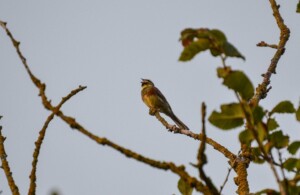
Top right and featured image: Cirl Bunting, one of the species captured to measure ornamental coloration © Ségolène Humann-Guilleminot