





Short-term effects of PIT-tagging small birds
LINKED PAPER
Tag location and risk assessment for passive integrated transponder-tagging passerines. Krista N. Oswald, Anthony A. Evlambiou, Ângela M. Ribeiro & Ben Smit. 2018. IBIS. DOI: 10.1111/ibi.12558. VIEW
Being able to accurately record body temperature in individual birds is central to many fields of zoology, especially eco-physiology. In ornithology, the majority of pre-2000s (and occasionally later years) research analysing body temperature involved either insertion of a thermocouple into a birds’ cloaca, insertion of a thermocouple into the brainstem, or surgically implanting loggers/transmitter. Recently, researchers have almost universally moved to PIT-tags to obtain measurements.
Although the above mentioned move was prompted by multiple concerns over thermocouples including stress and possibly laceration, our concern was the preferred method of implantation (intra-peritoneal) may have been just as injurious for smaller passerines. Thus, we set out to test the influence of PIT-tag location in body temperature measurements as well as in bird’s fitness. Our study’s aim was two-fold:
-
- Compare body temperature recorded by PIT-tags (Fig. 1) inserted intra-peritoneally (into the abdomen) with those inserted sub-cutaneously inter-scapulae. Our sample included 21 Zebra Finches (Taeniopygia guttata; “Finches”) alternately given intra-peritoneal (six females, five males) or sub-cutaneous (five females, five males) PIT-tags. Finches were placed in a respirometry chamber, with body temperatures recorded at three air temperatures (~ 5, 30, and 40 °C) for between 30 – 60 minutes each. We found no significant difference in body temperatures recorded between intra-peritoneal and inter-scapulae insertion at any temperature treatment. We note that two females with tags inserted intra-peritoneally died leaving final intra-peritoneal sample size as five females, five males. These regrettable occurrences helped confirm the high risk of inserting PIT-tags intra-peritoneally.
 Figure 1 PIT-tags are 12 mm long with 2.1 mm diameter with unique alpha-numeric ID codes. They are triggered electromagnetically when a PIT-tag reader is nearby, eliminating the need for a battery. They allow for precise temperatures to be recorded, and are inserted using an open-tipped 6 gauge implanter needle
-
- Short-term injury assessment of PIT-tags inserted intra-peritoneally in three passerines with different mass. Finches represented our smallest birds (~15 g), Karoo scrub-robins (Cercotrichas coryphaeus; “Scrub-robins”) [Figure 2] represented our medium-sized birds (~ 20 g), and Cape Rockjumpers (Chaetops frenatus; “Rockjumpers”) represented our large birds (~55 g). Scrub-robins and Rockjumpers were caught and PIT-tags implanted for seasonal physiological studies (Oswald et al. 2018) that occurred from July 2015 through July 2016. Sample sizes included the 21 Finches mentioned above (11 intra-peritoneal, 10 sub-cutaneous), 73 Scrub-robins (all intra-peritoneal) and 35 Rockjumpers (all intra-peritoneal). Twenty Scrub-robins were euthanized and necropsied as part of the above-mentioned separate study by AMR, allowing for post-mortem analysis.
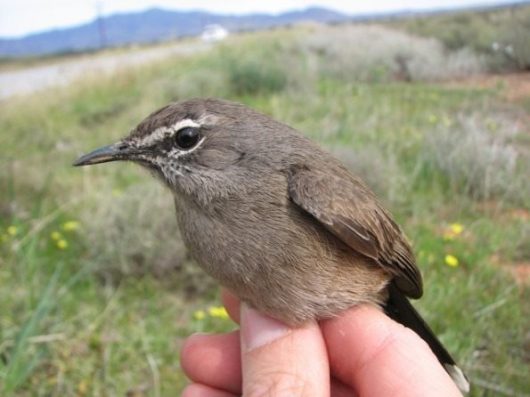 Figure 2 A researcher holds a Karoo Scrub-robin (Cercotrichas coryphaeus) in hand after processing measurements. Karoo scrub-robins represented our medium-sized birds (~20 g) for the portion of our study that dealt with comparing injury from PIT-tag insertion from different masses of birds
Our results revealed that location of PIT-tags negatively affected small bird’s fitness, while having less effect on medium-sized birds, and no recorded effect on large-sized birds.
In the small Finches, we found 18.2 % injury in intra-peritoneal PIT-tagged individuals and no injury when PIT-tags were inserted sub-cutaneously. On the contrary, only 2.7 % of Scrub-robins were injured, with no injury observed in Rockjumpers. Somewhat worryingly, two of the Scrub-robins, apparently doing well (no behavioural change and eating well while in captivity) had liver damage that was only discovered after post-mortem necropsy. Thus, we hypothesize further injury may have occurred after the birds’ release. For Rockjumpers, ad hoc observations over the year after PIT-tag implantation allowed us to have a rough estimate of longer term effects in our largest birds. Although not all territories were revisited, forays into the territories of a possible 27 tagged individuals saw 20 re-sighted and active during the next breeding season (post-August 2016; Fig. 3).
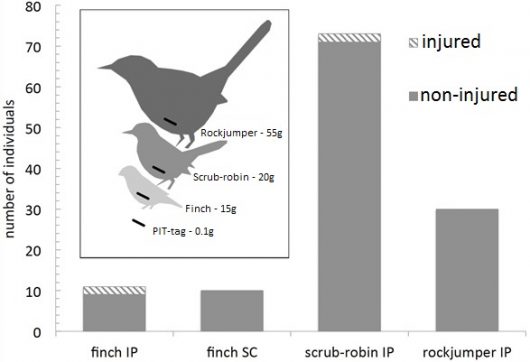 Figure 3 The number of individuals given PIT-tags either intra-peritoneally (IP) or sub-cutaneously inter- scapulae (SC) for our three birds (Finches, Scrub-robins, and Rockjumpers), along with individuals experiencing injury. Injury was found only in our smaller two mass categories, and only for the intra-peritoneal method of insertion. The inset diagram shows the relative size of the PIT-tag for each of our bird mass categories
Given the unfortunate events with Finches and the injuries in Scrub-robins and the evidence that placement of tempearture-sensing tags subcutaneously in the inter-scapular area had no effect on body temperature measurments , it is our opinion that researchers preferentially choose sub-cutaneous inter-scapulae PIT-tag insertion over intra-peritoneal when studying smaller passerines in an effort to minimize potential negative effects (Fig. 4).
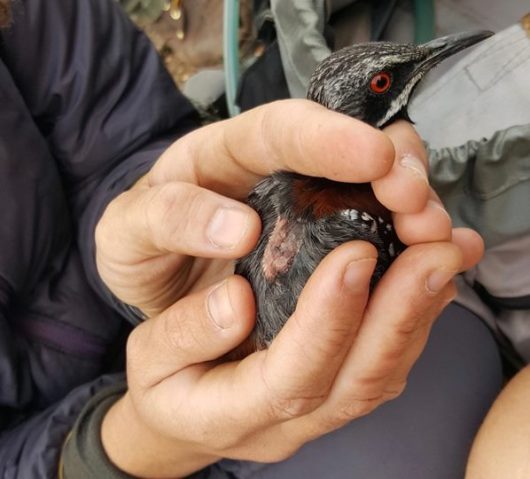 Figure 4 A male Cape Rockjumper (Chaetops frenatus) minutes after PIT-tag insertion sub-cutaneously inter-scapulae is held by a volunteer. Although we found the larger mass of Cape Rockjumpers resulted in no visible injuries to birds, we suggest that sub-cutaneous method of insertion be preferentially chosen if possible
References
Oswald, K.N., Lee, A.T.K., Smit, B. 2018. Seasonal physiological responses to heat in an alpine range-restricted bird: the Cape Rockjumper. bioRxiv DOI: 10.1101/248070. VIEW
Image credit
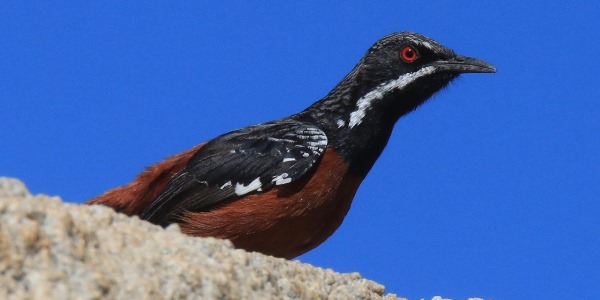
Featured image: Cape Rockjumpers (Chaetops frenatus; male pictured) are a near-threatened endemic bird of the South African Cape Fold Mountains © Krista N Oswald
Blog posts express the views of the individual author(s) and not those of the BOU.
If you want to write about your research in #theBOUblog, then please see here.