





LINKED PAPER Assessing exchange rates of individuals between biogeographical populations of East Asian goose and swan species. Zhao, Q., Meng, F., Cao, L., Fox, A.D. et al. (2026) IBIS.VIEW

Flyways are the backbone of waterbird conservation
Migratory waterbirds connect continents, countries and ecosystems. In East Asia, research and conservation for geese and swans has long been built around the flyway concept: distinct biogeographical populations that move between breeding or summering areas, moulting grounds, staging sites and winter quarters that are largely separate in time and/or space.
This framework underpins population monitoring (for example, using winter counts to track population trends) and supports international coordination of site protection and management. Yet one crucial assumption has been difficult to test directly: do individual birds frequently cross the boundaries between these populations – effectively switching flyways?
A common misunderstanding: flexibility within populations is normal
Before describing what we found, it is worth clarifying what our study did (and did not) ask. Many geese and swans show year-to-year flexibility within a population: individuals can change specific stopover sites, moulting areas, or even wintering locations within the same population range.
Our question was at a different level. We asked whether individuals move between distinct biogeographical populations that have discrete breeding ranges and migration structures – the kind of switch that would undermine the assumption that winter counts represent closed, demographically independent units.
Letting satellites follow the birds
To test this long-standing assumption, we compiled more than a decade of satellite tracking data collected across East Asia. In total, we analysed data from 619 tagged individuals from eight goose and swan species (Greylag Goose, Swan Goose, Taiga Bean Goose, Tundra Bean Goose, Greater White-fronted Goose, Lesser White-fronted Goose, Tundra Swan and Whooper Swan), representing ten biogeographical populations.
Crucially, we focused on birds tracked through multiple complete annual migration cycles, so that each individual genuinely had the opportunity to switch populations. This delivered 1,936 “potential exchange” events – a scale of evidence that has been unavailable until very recently.
A surprisingly clear answer: almost no exchange
The result was strikingly consistent. For seven of the eight species, we detected no individuals switching between biogeographical populations – neither in summering areas nor in winter quarters (Figure 1). In a few cases, birds were tracked slightly outside the currently mapped boundaries of their known breeding ranges (Figure 2), but these records point to refinements of the maps rather than genuine switching.
 Figure 1. Population boundaries and migration routes of tracked individuals for the Greylag Goose (a), Swan Goose (b), Taiga Bean Goose (c) and Tundra Bean Goose (d) in East Asia. Most individuals remained within their biogeographical population boundaries. © The authors.
 Figure 2. Population boundaries and migration routes of tracked individuals for the Greater White-fronted Goose (a), Lesser White-fronted Goose (b), Tundra Swan (c) and Whooper Swan (d) in East Asia. Routes vary within populations, but population-level overlap is limited. © The authors.
The single exception was the Greylag Goose. Among 22 tracked Greylag Geese, two individuals shifted their wintering area from the Yangtze floodplain in China to India, creating three winter-to-winter switches (Figure 3). Across all species, this amounted to just 0.15% of the 1,936 exchange opportunities.
Sometimes the strongest conclusion comes from what almost never happens.
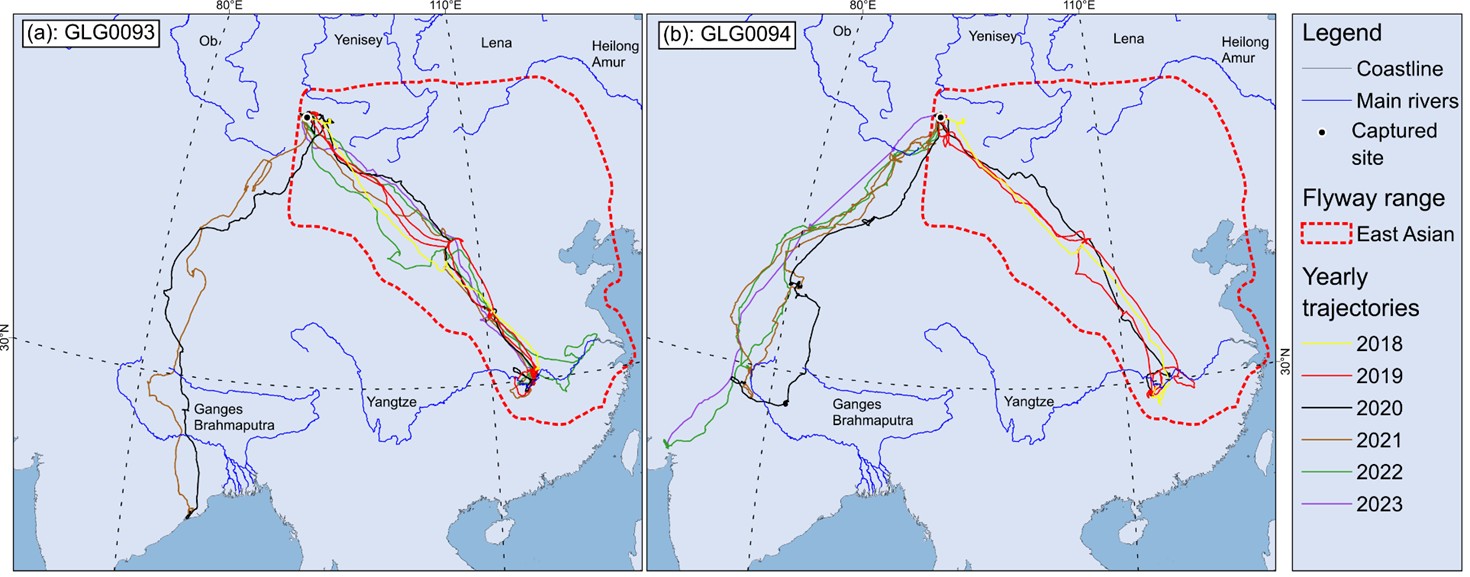 Figure 3. Annual migration routes of two tracked Greylag Geese illustrating shifts between flyways caused by changes in wintering grounds (from China to India). © The authors.
Why this matters for monitoring and management
The findings have several practical implications for how we monitor and conserve East Asian waterbirds:
- Confidence in winter monitoring: when individuals rarely switch populations, year-to-year changes in winter counts mostly reflect that population’s own breeding success, survival and habitat conditions (rather than large-scale “top-ups” by immigration/emigration from neighbouring populations).
- A stronger foundation for flyway-scale conservation: for most East Asian geese and swans, flyways are not just administrative boundaries – they correspond to biologically meaningful units with enduring individual fidelity.
- More robust ecological interpretation and modelling: high migratory connectivity allows us to link environmental change on breeding grounds, stopover wetlands or wintering sites to population responses with greater confidence.
A note on the Greylag Goose exception
The two switching Greylag Geese remained loyal to their summering provenance in Mongolia, but changed their winter quarters to India in their third winter. One bird later returned to the Yangtze floodplain, while the other remained in India for multiple winters. For this species, annual fluctuations in winter counts may therefore reflect winter immigration/emigration as well as changes in reproduction and survival.
Why we can answer this question now
Two developments made this study possible:
First, data volume and longevity. By integrating tracking data across multiple projects and years, we were able to evaluate flyway fidelity at the scale of East Asia. Much of the foundational synthesis of goose and swan populations in the region was developed through the Wildfowl Special Issue 6 community effort; our analysis adds substantial tracking data collected after those population boundaries were defined, strengthening the test.
Second, international collaboration. The results are not the product of a single team, but of a regional research community sharing data and interpretation across countries. This cooperative approach is essential when the ecological processes (and conservation responsibilities) span national borders.
Looking ahead
Our results show that flyway switching is currently extremely rare for most East Asian goose and swan populations. However, as populations recover, ranges expand, and climate and land-use change alter habitat availability, patterns of connectivity may also change. Continued tracking – especially in geographic border zones between neighbouring populations – and complementary tools such as genetics and stable isotopes will help keep flyway definitions and monitoring programmes fit for purpose.
Knowing that individuals are usually faithful to their flyway gives us confidence in how we interpret winter monitoring data. It also highlights our responsibility: protecting the chain of wetlands that supports each flyway remains the only way to secure these migrations for the future.
References
Boere, G.C. & Stroud, D.A. 2006. The flyway concept: what it is and what it isn’t.. In: Boere, G.C., Galbraith, C.A. & Stroud, D.A. (eds.), Waterbirds around the world. The Stationery Office, Edinburgh.
Cao, L., Deng, X., Meng, F. & Fox, A.D. 2020. Defining flyways, discerning population trends and assessing conservation challenges of key East Asian Anatidae species: an introduction. Wildfowl Special Issue 6:1-12.VIEW
Madsen, J., Tjornlov, R.S., Frederiksen, M., Mitchell, C. & Sigfusson, A.Th. 2014. Connectivity between flyway populations of waterbirds: assessment of rates of exchange, their causes and consequences. Journal of Applied Ecology 51:183-193.VIEW
Image credit
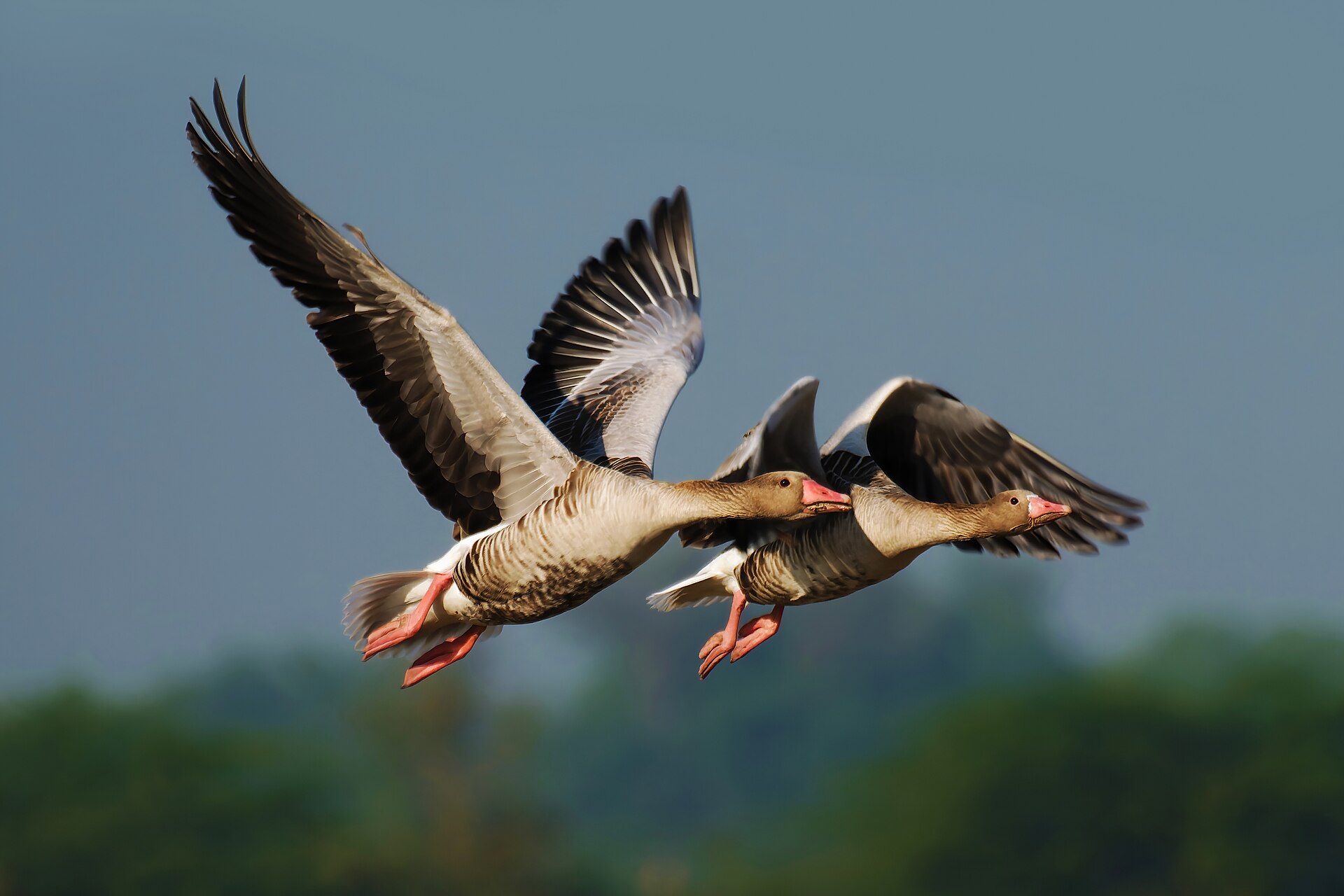
Top right and featured image: A pair of Greylag Geese migrating © Shiv’s Fotografia | CC BY-SA 4.0 Wikimedia Commons