


LINKED PAPER Acclimatization length and post-release spatial cohesion in translocated Griffon Vultures (Gyps fulvus). Cerri, J., De Rosa, D., Aresu, M., Costantino, C., Fozzi, I., Banic, D.A., Brunet, C., Echeverria, J., Pavin, L., Muzzeddu, M., Secci, D. & Berlinguer, F. (2026) IBIS.VIEW
Moving animals to new areas, a strategy known as translocation, is one of the most important tools we have to restore populations of threatened species. For large raptors such as Old-World vultures, these conservation efforts can mean the difference between local extinction and long-term recovery. Yet, even when releases are carefully planned, not all translocated individuals adapt in the same way to the new environment.
Traditionally, researchers have evaluated the success of these operations by looking at two main factors: how far released animals move and whether they survive over time. While these metrics are essential, they often overlook a key aspect of vulture ecology: their strong social nature. Griffon Vultures (Gyps fulvus), like many other vulture species, are highly gregarious birds that rely on social interactions for foraging, navigation, and settlement. Understanding how individuals adjust not only as solitary animals but also as members of a group is therefore crucial for improving conservation strategies.
One factor that may strongly influence post-release behaviour is acclimatization time. Before release, translocated vultures are typically kept in aviaries near the release site, allowing them to become familiar with the environment. However, the duration of this acclimatization period varies widely among projects, and its effects on social dynamics and space use remain poorly understood.
In our study, we explored how different acclimatization periods influenced the behaviour of Griffon Vultures reintroduced in Sardinia, Italy. Specifically, we compared birds that experienced a long acclimatization period of approximately 15 months with those that were acclimatized for a much shorter time, around 3 months. We followed four groups of released vultures and examined how their spatial behaviour evolved after release.
Rather than focusing only on individual movements, we looked at whether birds used space in synchrony with other individuals which had been released together, whether they stayed close to colonies, and how quickly they began to move between the two main breeding areas on the island. By analysing their spatial patterns over time, we uncovered how acclimatization shaped both individual and collective behaviour.
Our results revealed clear and consistent differences. Vultures that underwent longer acclimatization showed a much higher degree of spatial synchrony with their members from the same group. In other words, they were more likely to use the same areas at the same time, indicating stronger group cohesion. This suggests that extended periods spent together in the aviary may help individuals form social bonds that persist after release.
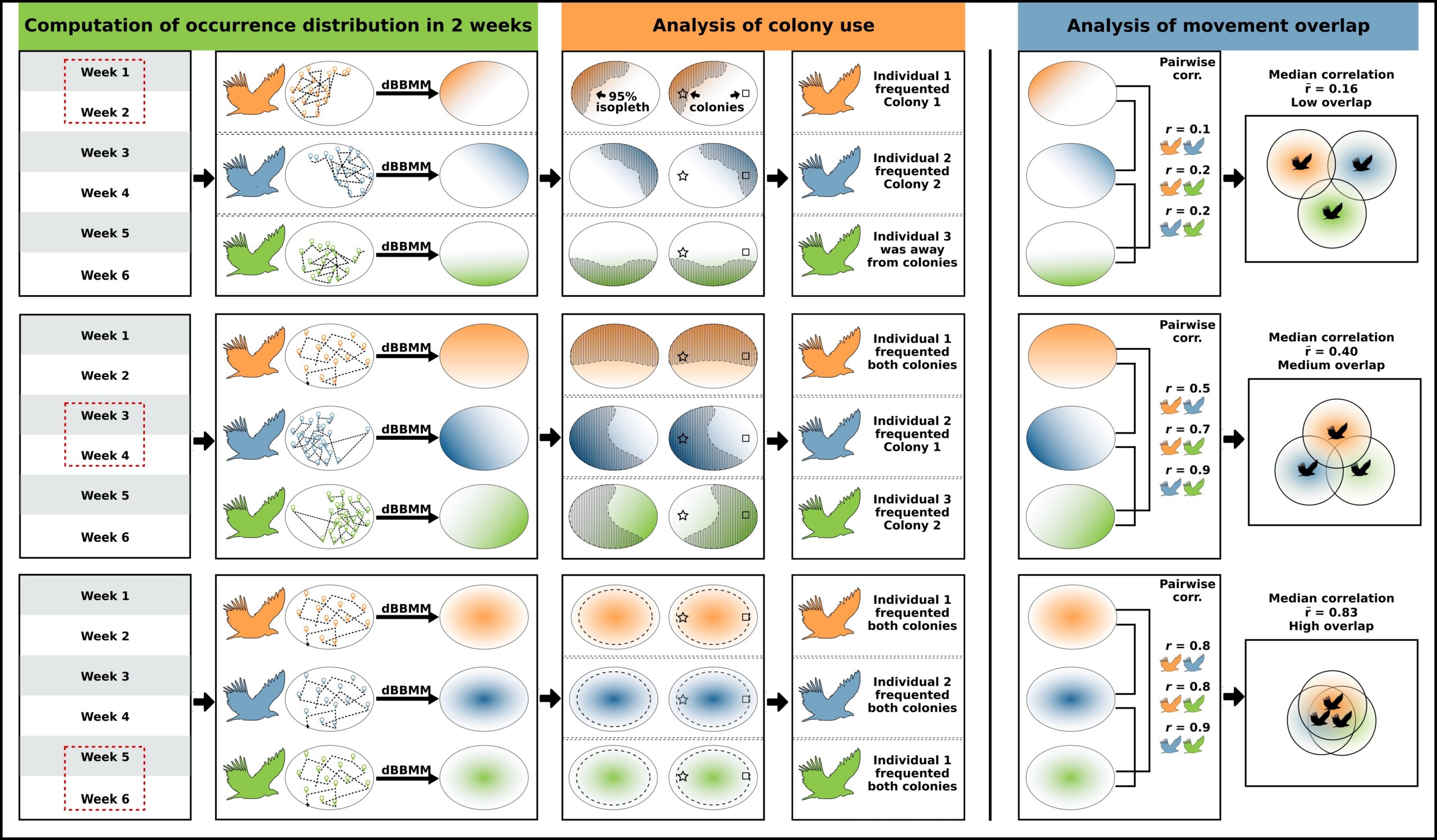 Figure 1. Overview of the three-step protocol that we used to calculate overlap in the occurrence distribution of Griffon Vultures. For each 14-days time window, from left to right: i) selection of a 2-weeks time window and estimation of the occurrence distribution of each individual, through a dynamic Brownian Bridge Movement Model (dBBMM), ii) extraction of the area within the 95% isopleth of the occurrence distribution and analysis of colony use by each griffon and iii) computation of pairwise Pearson’s correlation coefficients between all Griffon Vultures from a certain cohort and their aggregation through the median. The top row shows a cohort of Griffon Vultures with a scarce overlap in their occurrence distribution, the row in the middle a cohort with an intermediate overlap, and the bottom row a cohort with a high overlap.
Long-acclimatized vultures also adapted more quickly to the landscape. They began moving between Sardinia’s two main colonies sooner than short-acclimatized birds and were more likely to regularly use both areas. Over time, this behaviour resulted in greater connectivity between colonies, which is particularly important for population stability and long-term recovery.
Several years after release (around four to five years) these differences became even more evident. Birds that had experienced longer acclimatization were less likely to remain confined to a single colony for extended periods. They also showed a lower tendency to disperse far away from established breeding areas, suggesting a higher site fidelity.
Taken together, our findings indicate that long acclimatization periods can play a critical role in shaping post-release success in gregarious vultures. By allowing individuals to spend more time together before release, conservation programs may facilitate the formation of social bonds that enhance coordination, movement efficiency, and colony connectivity.
These results have important implications for conservation practice. In species that rely heavily on social interactions, translocation success cannot be fully understood by examining individuals alone. Instead, it is essential to consider how group dynamics influence adaptation to new environments. For Griffon Vultures and other social raptors, longer acclimatization periods, ideally exceeding one year, appear to promote stronger cohesion among released birds and may ultimately improve survival and settlement outcomes.
As conservation efforts increasingly rely on translocations to restore declining populations, integrating social behaviour into release strategies could significantly enhance their effectiveness. By recognising the importance of group cohesion, managers can design interventions that not only move animals into suitable habitats but also help them rebuild the social networks they need to thrive.
Image credit
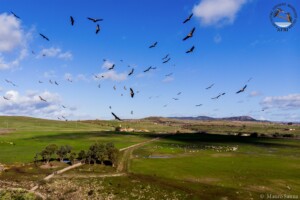
Top right and featured image: A group of Griffon Vultures in flight in Sardinia © Mauro Sanna