


LINKED PAPER Under the cover of darkness: Foraging behaviour increases on cloudy, new moon nights in a pelagic seabird. Wilkinson, D., Kane, A., Jessopp, M. & Quinn, J.L. (2026) Ibis. VIEW
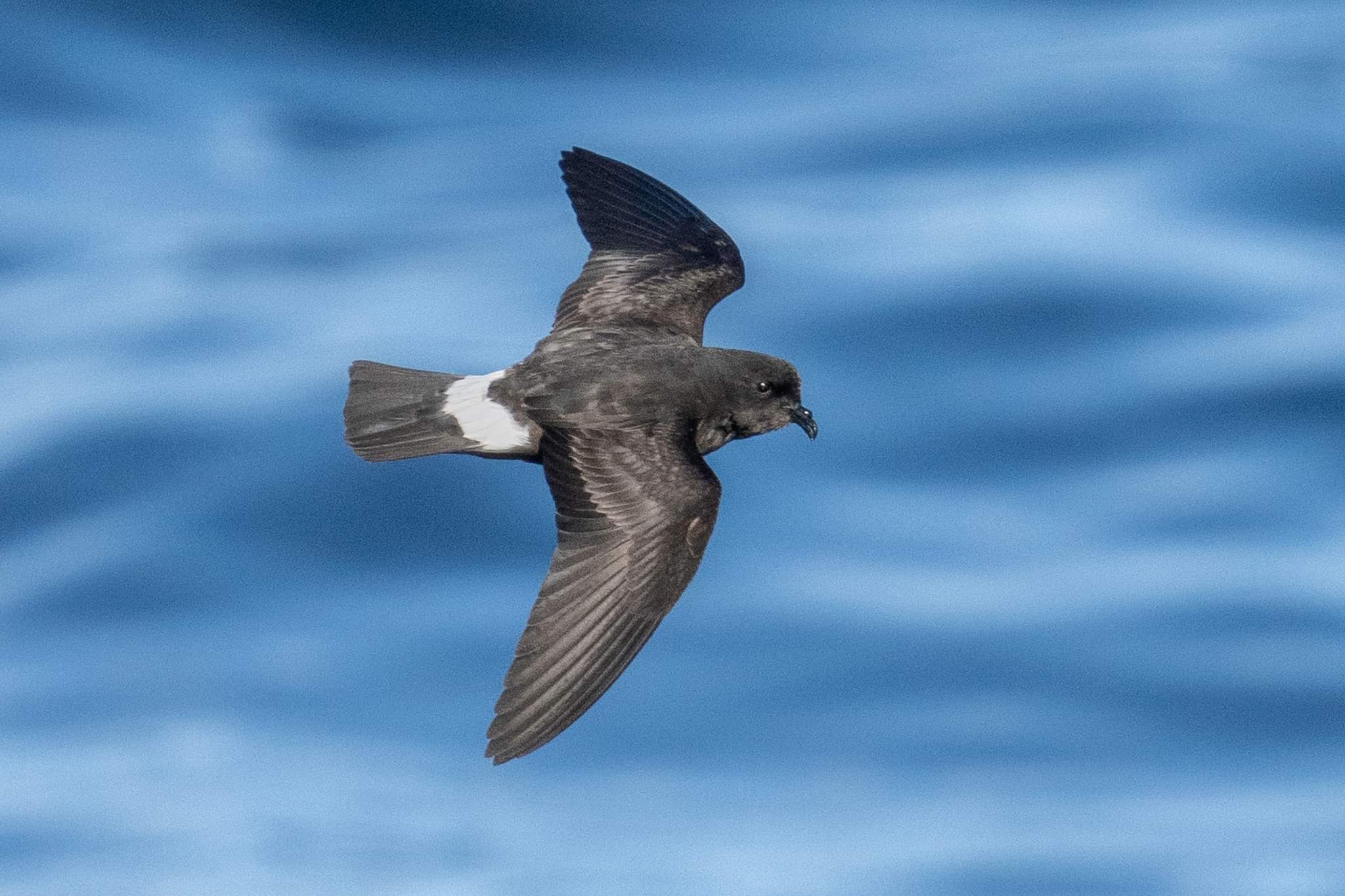
When we think of animals hunting at night, we often picture owls gliding silently over fields or bats chasing insects in the dark. But far out at sea, another remarkable nocturnal hunter is at work: the European Storm-petrel (Hydrobates pelagicus).
About the size of a sparrow, with wings like a Barn Swallow, this tiny seabird spends almost its entire life at sea, only returning to land to breed on remote islands. Unlike diving seabirds, European Storm-petrels cannot chase prey beneath the waves, so they rely on food being available right at the surface, and delicately patter across the water to pick up tiny prey items throughout the day and night.
Our new research shows that this dependence on surface prey helps explain why, unlike many other nocturnally active seabirds, European Storm-petrels are most likely to forage on the darkest nights.
Tracking tiny seabirds
Studying seabirds at sea is never easy, and storm-petrels are especially difficult to study because they are small, only return to their colony at night (to avoid predators), and nest out of sight in burrows, rock crevices, and in our case, within tightly-packed dry-stone walls (Figure 1). To better understand their behaviour, we equipped breeding adults with lightweight tracking devices that recorded both their location and their movements. By combining these data with statistical models, we could identify when and where the birds were actively foraging. We then linked these feeding events with environmental information, including moonlight, cloud cover, and ocean conditions, to investigate how the night-time environment influences their foraging behaviour.
 Figure 1. Dry-stone wall on the Magharee Islands, Ireland, in which European Storm-petrels nest. © Darren Wilkinson.
Two different feeding grounds
The tracking data revealed that European Storm-petrels foraged in two distinct habitats at night.
One was in shallow coastal waters close to the breeding colony. The other was much further offshore, near the edge of the continental shelf where the seabed drops away into much deeper water.
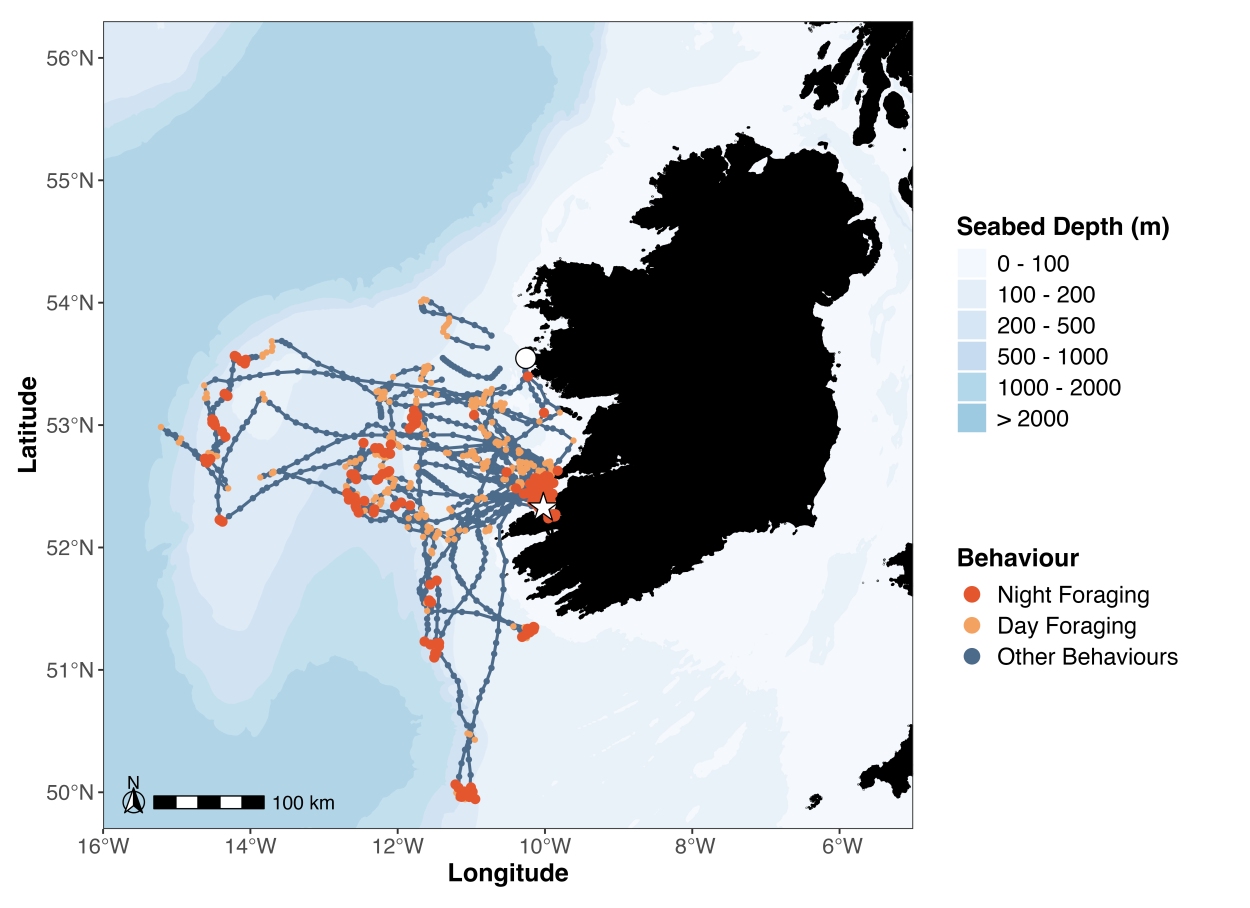 Figure 2. GPS tracks of foraging trips by breeding European Storm-petrels from two Irish colonies (white symbols), showing daytime and night-time foraging locations.
Although both areas were important feeding grounds, the birds appeared to use them for different reasons.
Near the colony, feeding activity was associated with local ocean productivity (i.e., conditions that increase the abundance of prey). Surprisingly, the amount of moonlight had little influence on whether birds foraged in these coastal waters.
Offshore, however, the picture was very different.
Why darker nights create feeding opportunities
Many nocturnal seabirds are more active during bright moonlit nights because better visibility helps them locate prey (e.g., Rubolini et al. 2015). European Storm-petrels appear to do the opposite.
Our results showed that nocturnal offshore feeding was most likely during the darkest nights, especially when cloud cover reduced the amount of moonlight reaching the ocean surface. This pattern makes sense when we consider both how storm-petrels feed and the behaviour of their prey.
Because European Storm-petrels are surface feeders, they can only capture prey that is available at, or extremely close to, the water’s surface. Their dependence on surface prey means their feeding success is closely linked to one of the ocean’s most remarkable daily events: diel vertical migration.
Every day, small marine animals including zooplankton and small fish, move up and down through the water column. During daylight they remain in deeper water, where darkness offers protection from predators. After sunset, they migrate towards the surface to feed before descending again at dawn.
The darker the night, the safer these animals are likely to feel, allowing them to move even closer to the surface. For a surface-feeding seabird like the European Storm-petrel, this creates ideal feeding conditions by bringing otherwise inaccessible prey within reach.
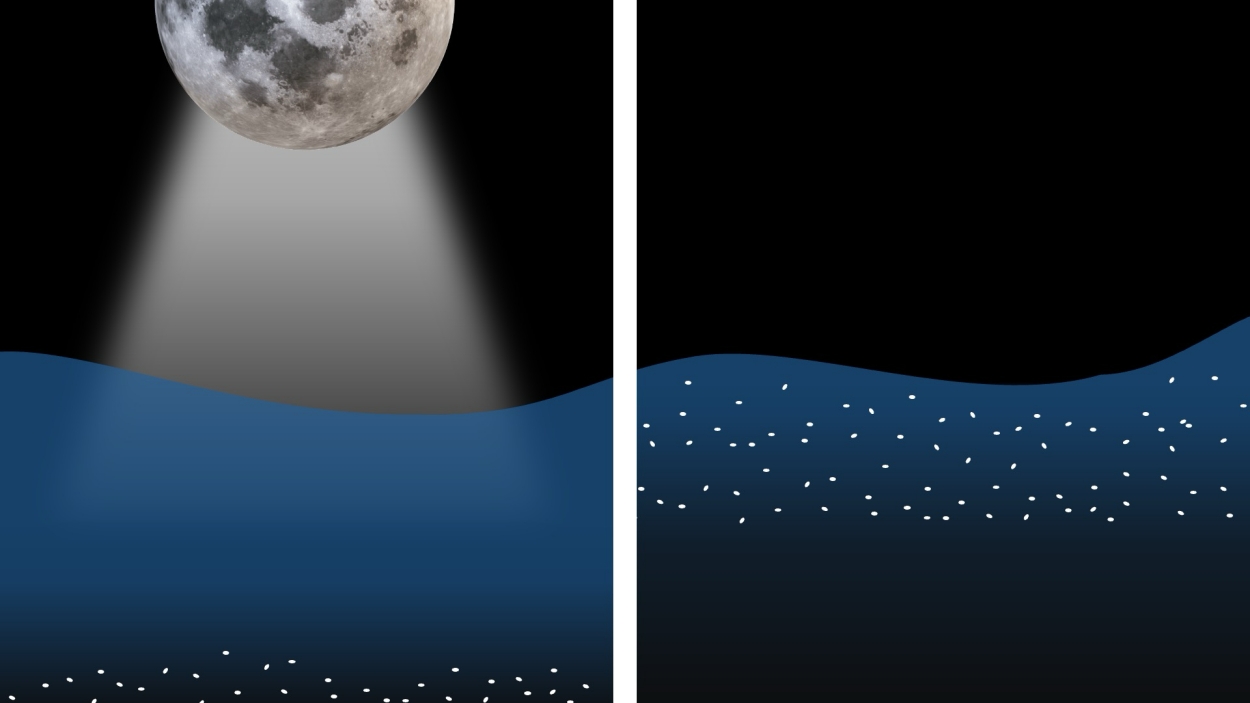 Figure 3. Distribution of vertically migrating species (white dots) in the water column on (left) bright, moonlit nights and (right) dark nights.
Finding food in the dark
Finding tiny prey on the dark ocean might seem almost impossible, but storm-petrels have evolved impressive ways of overcoming this challenge.
One of their greatest assets is an exceptional sense of smell. Previous research has shown that storm-petrels can detect odours released by plankton-rich waters (Nevitt, 2008). Rather than searching randomly, they may first use scent to locate productive feeding patches.
Once in these areas, another fascinating possibility comes into play: bioluminescence. Many vertically migrating marine organisms are bioluminescent, producing flashes of light when disturbed. These flashes may help storm-petrels detect and capture prey items, especially in the darkest conditions.
Together, these sensory adaptations may allow the European Storm-petrel to exploit feeding opportunities that would be unavailable to many other predators.
A changing night-time environment
Our findings also raise important questions about the future. Climate change is altering weather patterns across the North Atlantic, with cloud cover declining over the past decade (Goessling et al., 2025). If this trend continues, dark, overcast nights may become less common, exposing the ocean to bright moonlight more often.
For a surface-feeding seabird like the European Storm-petrel, this could have important consequences. Fewer dark nights may reduce the frequency with which vertically migrating prey rise close enough to the surface to become accessible. As a result, offshore feeding opportunities at night may become less reliable, forcing storm-petrels to depend more heavily on coastal feeding grounds.
Our study shows that even subtle changes in light conditions can influence where and when nocturnal seabirds forage. For a bird that spends its nights dancing across the ocean surface, darkness is more than a backdrop. It is a vital part of the marine environment, shaping when prey become available and ultimately determining where these remarkable seabirds can thrive.
So, can seabirds forage in the dark? For the European Storm-petrel, the answer is not only yes, but this bird may actually forage best during the night when it is at its darkest.
References
Goessling, H.F., Rackow, T. & Jung, T. 2025. Recent global temperature surge intensified by record-low planetary albedo. Science 387:68-73.VIEW
Nevitt, G.A. 2008. Sensory ecology on the high seas: the odor world of the procellariform seabirds. The Journal of Experimental Biology 211:1706-1713.VIEW
Rubolini, D., Maggini, I., Ambrosini, R., Imperio, S., Paiva, V.H., Gaibani, G., Saino, N. & Cecere, J.G. 2015. The effect of moonlight on Scopoli’s shearwater Calonectris diomedea colony attendance patterns and nocturnal foraging: a test of the foraging efficiency hypothesis. Ethology 121:284-299.VIEW
Image credit
Top right and featured image: European Storm-petrel (Hydrobates pelagicus) © Samuel Langlois.