


LINKED PAPER
Female Grass Wrens adjust brooding effort according to ambient temperature, male feeding contribution and nest placement. Jefferies, M. M., Mendoza, F. C., Llambías, P. E.. 2024. IBIS. DOI: 10.1111/ibi.13160. VIEW
Raising offspring often involves trade-offs, with individuals needing to strike a balance between their current reproductive effort (including parental care) and their future survival. One aspect of parental behaviour in altricial birds which has often been overlooked is the process of brooding, whereby adults transfer heat to nestlings. This can be energetically demanding, especially under challenging environmental conditions such as low ambient temperature, wind, or rain, and may require parents to adjust their brooding effort.
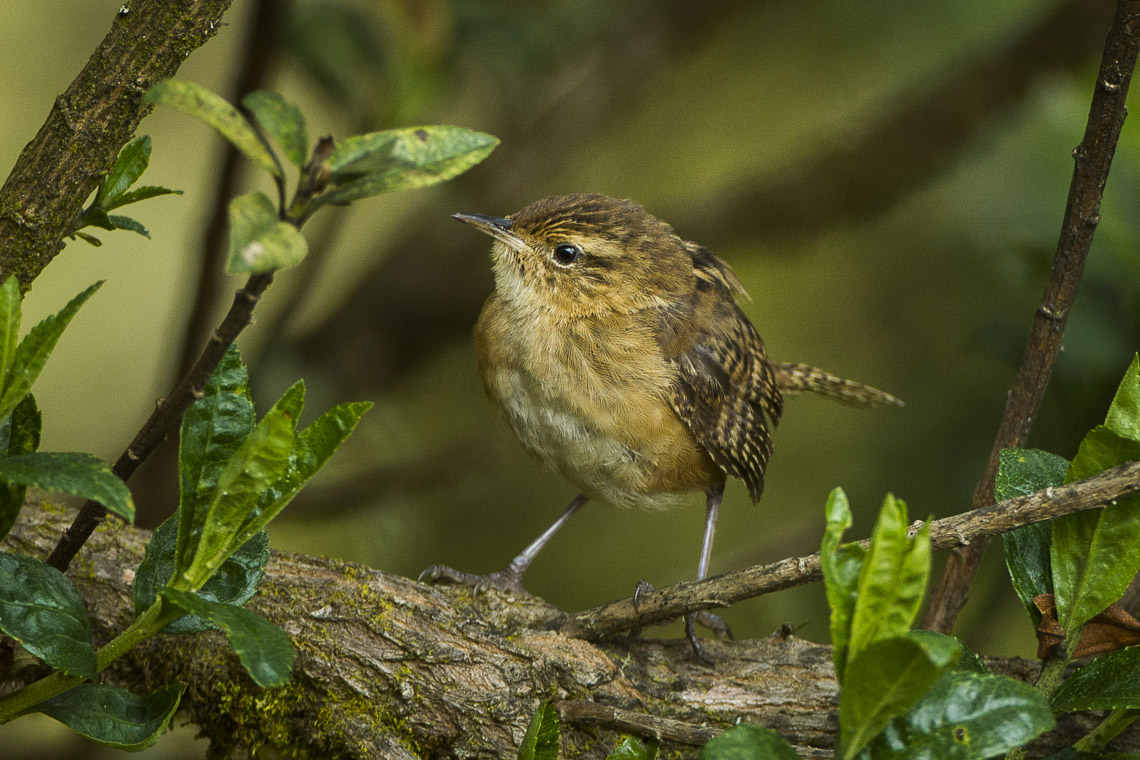
In a recent study in Ibis, María Milagros Jefferies and colleagues investigated brooding behaviour of the Grass Wren (Cistothorus platensis) in relation to a number of different conditions.
A south temperate passerine
The Grass Wren is a south temperate grassland specialist, in which both sexes collaborate in parental care but only females brood the nestlings (Llambías et al. 2018, 2019). The study population was located in a semi-desert environment in a floodplain in Mendoza Province, Argentina, with challenging environmental conditions. Nests in this location are located in the shade within grasses where the temperature can often be below freezing at the beginning of the breeding season. However, Grass Wrens build dome nests which may help to buffer environmental conditions and also reduce heat loss by reducing the air movement over the adult (Heenan 2013).
The researchers assessed how brooding effort (proportion of time spent brooding) changed with nestling age, and tested how females adjusted their brooding effort in response to variation in ambient temperature and variation in male parental care contribution. They also tested if males adjusted their feeding contribution to the nestlings in response to low mean ambient temperatures, if nest size affected insulation, if nest cover reduced solar radiation and exposure to the wind, if brooding enhances nestling body condition, and if brooding effort impacted apparent annual survival for females.
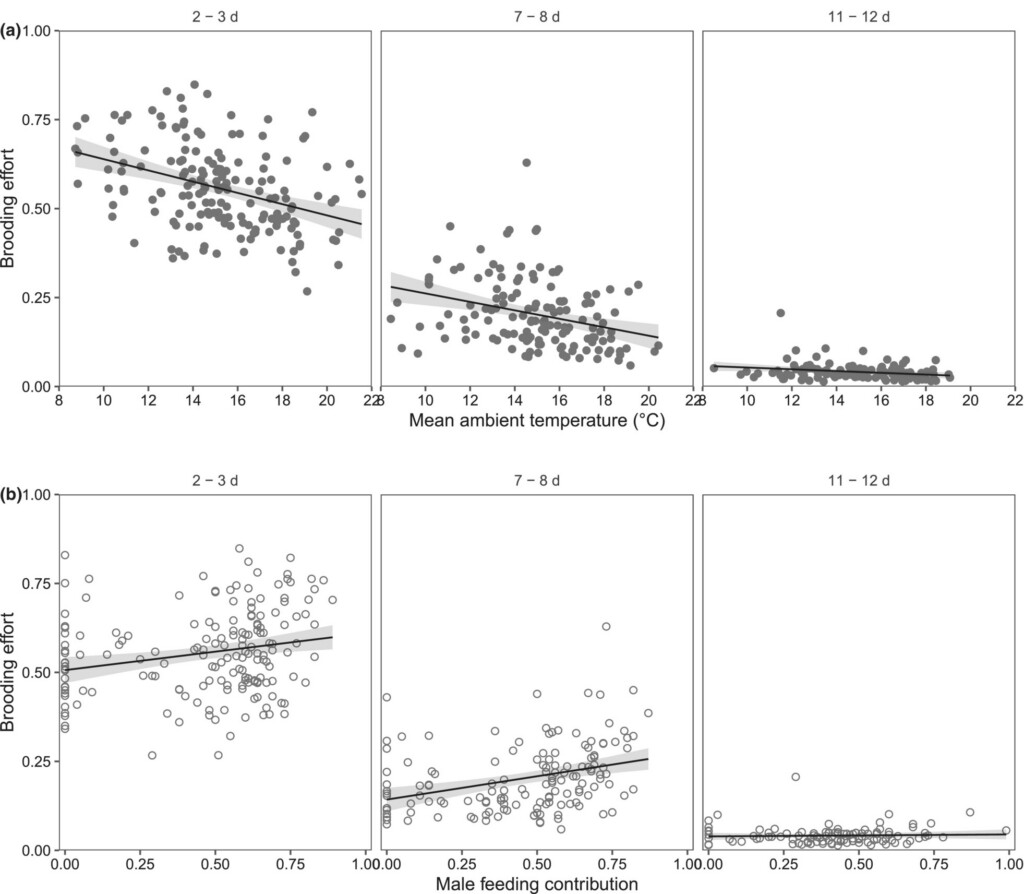
Figure 1. Relationships between Grass Wren brooding effort for three nestling age periods and (a) mean ambient temperature (white dots) and (b) male feeding contribution (filled dots). The black lines and shading represent the regression curves and 95% confidence interval predicted by GLMMs.
Brooding effort is affected by environmental and behavioural factors
This study provided the first detailed description of the brooding behaviour of a south temperate grassland specialist, the Grass Wren. The brooding effort of females decreased with nestling age, and increased at low ambient temperatures and when males contributed more to feeding the nestlings, although the relationship between brooding effort and male feeding contribution did not vary with ambient temperatures. Females also increased brooding effort at lower temperatures when the nest was located farther from the edge of plant substrate, in substrates with taller vegetation, and in more concealed nesting sites. The results did not show any effect of nest size on female brooding effort, and did not provide any evidence about the expected positive effect of brooding behaviour on nestling body condition before fledging. The brooding index also did not explain female apparent annual survival.
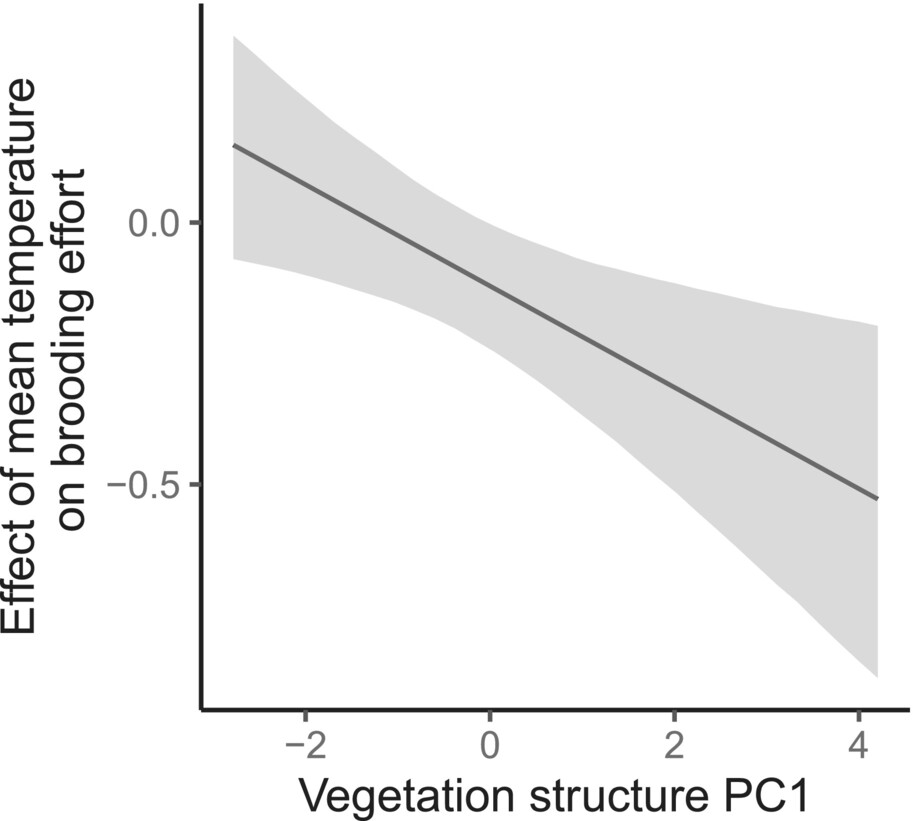
Figure 2. Interaction between vegetation structure around nest placement principal components and ambient temperature on Grass Wren brooding effort for 2- to 3-day-old nestlings. Black lines represent the mean estimate and grey ribbons the 95% confidence interval predicted by GLMM.
The finding that female Grass Wrens increased brooding effort in response to low ambient temperatures is expected given that suboptimal temperatures can have negative effects on nestlings (Rodríguez & Barba 2016). As these temperatures likely increased the metabolic costs of brooding for females, it is interpreted that when under adverse weather conditions female Grass Wrens seem to favour nestling development at the expense of their own self-maintenance. When males delivered more food to nestlings females displayed greater brooding effort, as they did not need to reduce their time brooding to search for food. Similar results have been found in other north and south temperate passerines with biparental care, such as House Wrens (Johnson & Kermott 1993).
The results did not show an effect of brooding index on nestling body condition near fledging or on female apparent adult survival, despite the latter apparently being low in the study site. However, continuous recording of brooding patterns during the nestling stage (rather than three ~4.5 hr recording sessions as applied in this study) may be necessary to fully explore the compromise between females’ self-maintenance and brooding behaviour.
Overall, the results showed that ambient temperature, male feeding contribution, and nest placement were all important determinants of female brooding behaviour in the Grass Wren. The researchers suggested future studies could further investigate the role of nest architecture and nest placement in brooding effort through experimentally removing the internal nest lining materials.
References
Heenan, C.B. (2013). An overview of the factors influencing the morphology and thermal properties of avian nests. Avian Biology Research 6: 104-118. VIEW
Johnson, L.S. & Kermott, L.H. (1993). Why is reduced male parental assistance detrimental to the reproductive success of secondary female House Wrens? Animal Behaviour 46: 1111–1120. VIEW
Llambías, P.E., Garrido, P.S., Jefferies, M.M. & Fernández, G.J. (2018). Social mating system, male parental care contribution and life history traits of a southern Sedge Wren (Cistothorus platensis platensis) population: a comparison with northern Sedge Wrens (Cistothorus platensis stellaris). Journal of Ornithology 159: 221–231. VIEW
Llambías, P.E., Jefferies, M.M., Garrido, P.S. & Fernández, G.J. (2019). Social mating system divergence between north and south temperate wrens. In Behavioral ecology of neotropical birds: 1–20. Springer Nature Switzerland AG: Cham. VIEW
Rodríguez, S. & Barba, E. (2016). Effects of cool nest microclimates on nestling development: an experimental study with Mediterranean Great Tits Parus major. Ardeola 63: 251–260. VIEW
Image credits
Top right: Grass Wren (Cistothorus platensis) | Francesco Veronesi | CC BY-SA 2.0 Wikimedia Commons
Blog posts express the views of the individual author(s) and not those of the BOU.
If you want to write about your research in #theBOUblog, then please see here