



LINKED PAPER How much sampling is enough? Four decades of understorey bird mist-netting across Amazonia define the minimum effort to uncover species assemblage structure. Maia-Braga, P.L., Bueno, S.A., Davies, R.G., Maximiano, M.F.A., Haugaasen, T., Anciães, M., Blake, J.G., Loiselle, B.A., Borges, S.H., Menger, J., Dantas, S., Melinski, R.D., de Abreu, F.H.T, Boss, R.L. & Peres, C.A. (2025) IBIS.VIEW

The robust characterisation of biological diversity in hyperdiverse tropical ecosystems, such as the Amazon rainforest, remains a central methodological challenge. Among the techniques employed, the use of understorey mist nets stands out as a standardised method for bird sampling, minimising observer bias and enabling the collection of morphometric and physiological data. However, the absence of a clear and widely validated sampling protocol, particularly regarding the minimum effort required, has compromised comparability between studies, especially for macroecological research which frequently uses data compiled from diverse sources to understand large-scale patterns.
 Figure 1. Fieldwork for the Amazon, Biodiversity and Carbon – ABC Expeditions project, conducting bird sampling with mist nets in the Brazilian Amazon © Pilar L. Maia-Braga and Marina Maximiano/ABC Expeditions Project.
A recent study, synthesising data from 312 sample sites distributed across the Pan-Amazon over four decades, sought to address this gap. From a massive compilation of 48,758 individual captures, belonging to 348 understorey bird species, the research employed coverage-based rarefaction and extrapolation curves to determine the required effort (i.e., number of individuals) for a representative characterisation of local assemblages. Sample coverage is used to measure the completeness of a sample and can be interpreted as the proportion of the total number of individuals in an assemblage that belong to the species represented in the sample. For example, a sample coverage of 0.62 indicates that 62% of individuals belong to species that were detected by the sample.
The results demonstrated that to achieve a sample coverage of 0.9, considered an optimal balance between efficiency and sampling completeness, it is necessary to capture, on average, 129 individuals per sampling unit in a typical Amazonian understorey assemblage, which has an estimated mean richness of 38 species. However, local species richness is highly variable across Amazonia, and therefore sample sizes were suggested for different richness levels. While assemblages with fewer than 15 species require approximately 41 individuals to reach the target coverage, exceptionally rich sites, with more than 60 understorey species, demand an average sample of 234 individuals. In terms of operational effort, the authors estimate that accumulating the minimum number of captures requires approximately 830 net-hours per site, a parameter that can be adjusted according to study logistics.
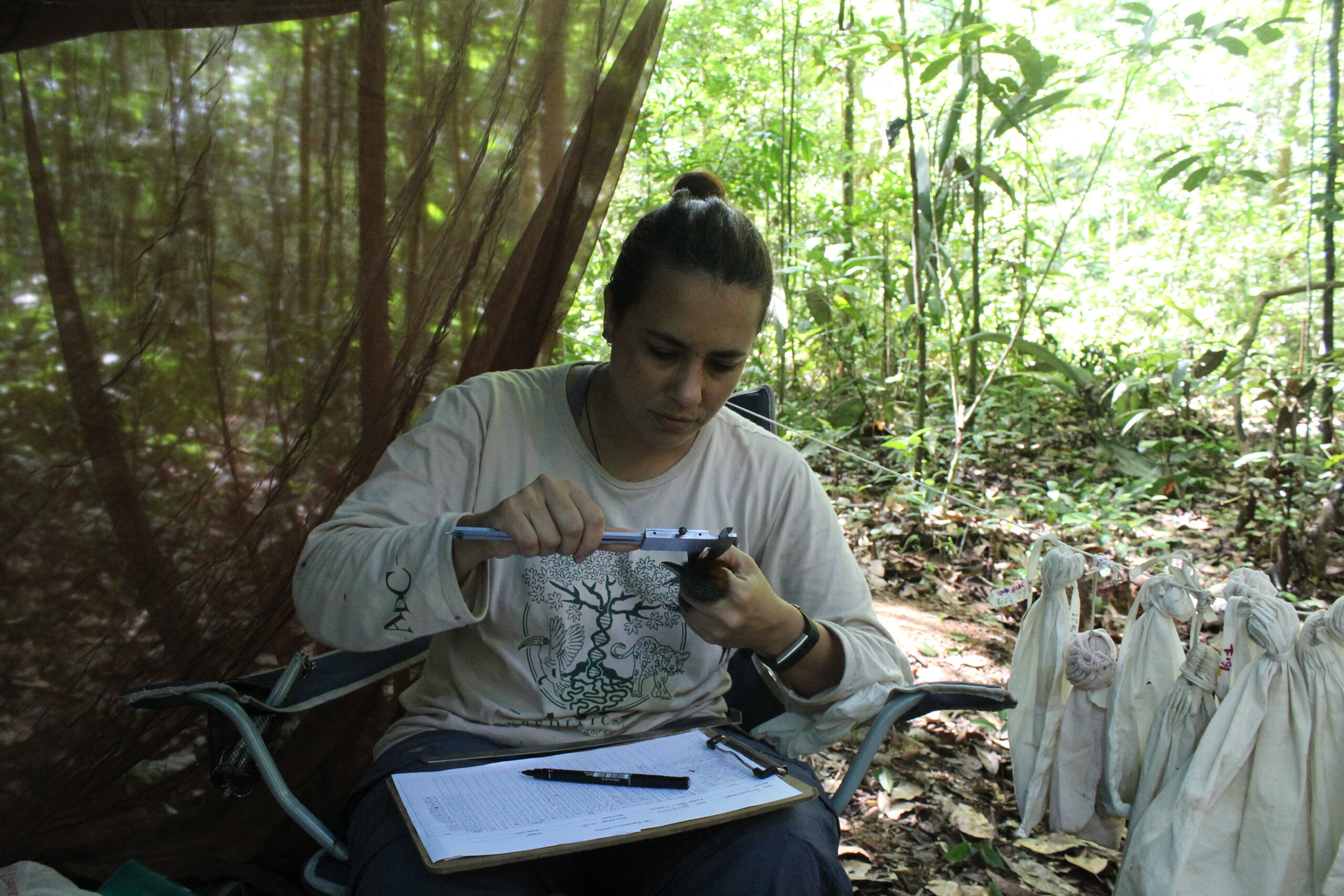 Figure 2. Processing of birds captured in mist nets, including body measurements, blood collection, and specimen identification © Pilar L. Maia-Braga and Marina Maximiano/ABC Expeditions Project.
Temporal analysis of the data, from a standardised subset of 44 sites, revealed critical patterns for sampling design. The first day of net operation was significantly more productive, accounting for 45% of individual captures and 83% of recorded species, a phenomenon attributed to local saturation and net avoidance by individuals after initial exposure. Regarding the daily period, the morning hours (06:00–12:00) concentrated 70% of individuals and 63% of species. However, continuous operation until dusk captured an additional 29% of individuals and nearly 4% of species exclusive to the afternoon, indicating that studies requiring robust abundance data or the detection of low-activity species should consider the full-day period.
 Figure 3. Typical insectivorous understorey birds frequently sampled with mist-nets across Amazonian forests. (a) Willisornis poecilinotus, (b) Myrmoderus ferrugineus, (c) Isleria hauxwelli, (d) Xenops minutus, (e) Pithys albifrons and (f) Glyphorynchus spirurus © Pilar L. Maia-Braga and Marina Maximiano/ABC Expeditions Project.
Beyond sampling effort, the study provided an ecological profile of assemblages sampled by mist nets. The typical bird captured is a small-bodied insectivore, classified as fairly common, with an insessorial lifestyle (remaining perched) and narrow habitat breadth, frequently using only one type of vegetation formation. Specialised trophic guilds, such as obligate army-ant followers, were well-represented, reinforcing the method’s efficacy for groups that actively forage in the lower stratum. The predominance of specialist species with restricted distribution underscores the vulnerability of these assemblages to environmental changes.
In conclusion, this study establishes fundamental quantitative parameters for standardising ornithological studies in the Amazonian understorey. The recommendation of a minimum effort based on sample coverage, adjusted for expected richness, and the understanding of the temporal dynamics of captures provide a framework for optimising sampling design. The adoption of these guidelines has the potential to enhance comparability between future studies, enabling more reliable biogeographic syntheses and strengthening the foundations for community ecology and conservation research in the Neotropical region. The proposed standardisation thus represents not only a methodological advancement but a necessary step for the integration of data at a macroecological scale and for the understanding of understorey bird diversity patterns across Amazonia.
Image credit
Top right and featured image: Couple of Tropical Royal Flycatcher (Onychorhynchus coronatus) captured in mist nets. Female on the left and male on the right © Pilar L. Maia-Braga