




LINKED PAPER Asian Koels do not lay eggs matching the host eggs’ phenotype. Nahid, M.I., Abernathy, V.E., Ranke, P.S. & Liang, W.(2025) IBIS.VIEW
In the world of avian brood parasitism, cuckoos and their hosts are locked in an evolutionary arms race. Hosts evolve to recognise and reject foreign eggs, while cuckoos evolve eggs that mimic those of their hosts (Davies, 2000). But what if the host doesn’t bother to reject? Does the cuckoo still bother to match?
Our recent study, published in Ibis, set out to test the “egg-matching hypothesis” in a system where the host shows little interest in rejection: the Asian Koel (Eudynamys scolopaceus) and one of its most common hosts, the Common Myna (Acridotheres tristis), in Bangladesh.
The egg-matching hypothesis suggests that female cuckoos should lay their eggs in nests where host eggs look similar to their own (Davies, 2000; Yang et al., 2016). This would help avoid detection and rejection by choosy hosts (Honza et al., 2014). To human eyes, Asian Koel eggs look very different from Common Myna eggs. Myna eggs are an immaculate blue, while koel eggs are larger, have a grey bluish to greenish ground colour with frequent brown or black spots. Despite this striking contrast, in our study area, Common Mynas rarely reject foreign eggs, they’re what we call “acceptor” hosts (Begum et al., 2012). This raised a key question: do Asian Koels even try to match their eggs to those of their hosts?
To find out, we combined careful field experiments with avian modern visual modeling. We set up paired nestboxes in trees, one easily accessible to koels, the other with a smaller entrance only mynas could enter. Inside some boxes we placed real myna nests; in others, we placed dummy nests with quail eggs that looked nothing like myna or koel eggs.
The results were clear: koels showed no preference! They parasitized dummy nests with quail eggs just as often as real myna nests, as long as the box was accessible and a myna was nesting nearby. In fact, they sometimes even laid in empty dummy nests! This suggests that koels are not using egg appearance to choose where to lay, instead, they seem to cue in on host activity (see Nahid et al., 2024).
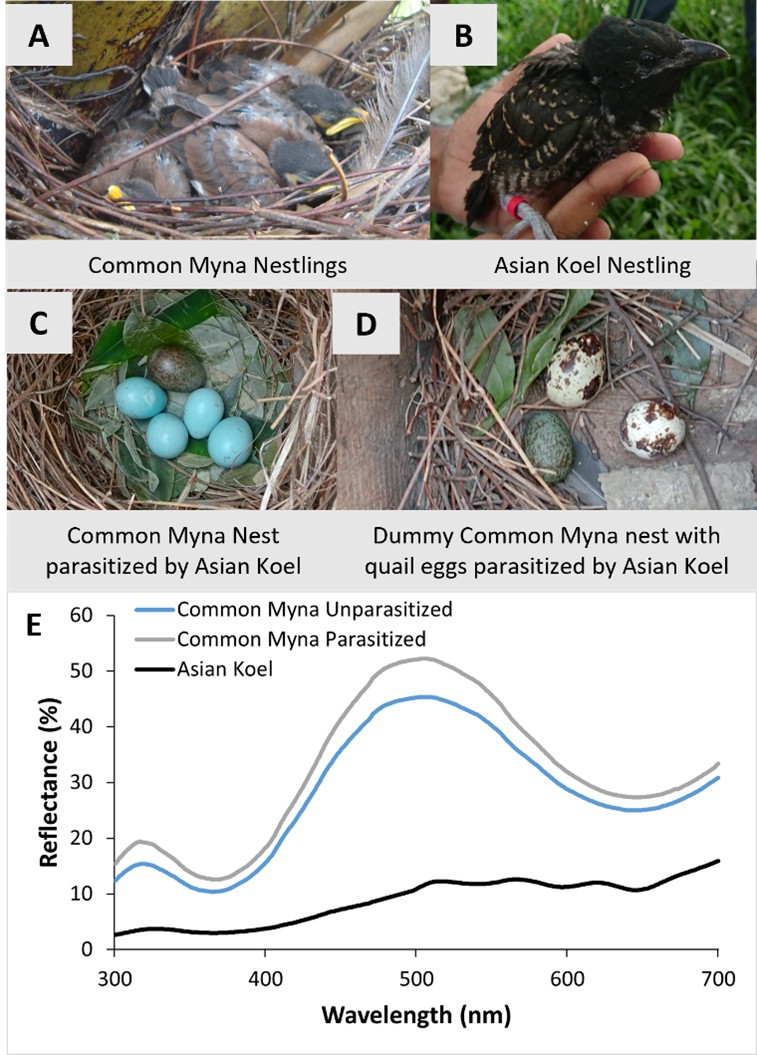 Figure 1. (A) Photos of Common Myna nestlings and (B) Asian Koel nestling. Photos of examples of parasitized nests from our field experiment: (C) true common myna nest with myna eggs and one koel egg and (D) dummy nest with two quail eggs and one koel egg. (E) Average spectral reflectance for Common Myna eggs from unparasitised nests (CM-UP), Common Myna eggs from parasitised nests (CM-P) and Asian Koel eggs laid in Common Myna nests (AK). Spectral reflectance of quail eggs could not be measured. Myna eggs from parasitised nests were not closer in colour to koel eggs; in fact, eggs from unparasitised nests were more similar to koel eggs.
We also compared the color, size, and shape of koel eggs with myna eggs from parasitized and unparasitized nests. Using avian visual modelling, we confirmed that koel eggs look very different from myna eggs, and that myna eggs from parasitised nests were no more similar to koel eggs than those from unparasitised nests.
 Figure 2. Results from the JND analysis using a VS visual system showing the spread of average chromatic (A), and achromatic (B) JNDs ± 95% CI bars for each set of group comparisons. “P-AK” = Common Myna eggs from parasitised nests compared to Asian Koel eggs, “UP-AK” = common myna eggs from unparasitised nests compared to Asian Koel eggs, “UP-P” = Common Myna eggs from unparasitised nests compared to Common Myna eggs from parasitised nests. An asterisk indicates a significant difference between groups (Kruskal-Wallis, Steel-Dwass post-hoc tests, P < 0.03).
So why don’t koels care about matching? In this system, there’s likely little need. Because mynas don’t reject foreign eggs, there’s no evolutionary pressure for koels to evolve mimicry or to carefully select matching nests. Instead, koels appear to be using a simpler, more reliable cue: the presence of an active host.
This finding challenges the assumption that all brood parasites are under strong selection to match their eggs to their hosts’. It also highlights how host behavior shapes parasite strategy when the host doesn’t fight back, the parasite can afford to be less precise. Our study adds an important twist to the coevolutionary story of brood parasitism and reminds us that in nature, not every arms race is equally armed.
References
Begum, S., Moksnes, A., Røskaft, E. & Stokke, B.G. 2012. Responses of potential hosts of Asian cuckoos to experimental parasitism. Ibis 154:363-371.VIEW
Davies, N.B. 2000. Cuckoos, Cowbirds and Other Cheats. T & A D Poyser, London.
Honza, M., Sulc, M., Jelinek, V., Pozgayova, M. & Prochazka, P. 2014. Brood parasites lay eggs matching the appearance of host clutches. Proceedings of the Royal Society B: Biological Sciences 281:20132665.VIEW
Nahid, M.I., Ranke, P.S. & Liang, W. 2024. Asian koel rapidly locates host breeding in novel nest sites. Ecology and Evolution 14:e11345.VIEW
Yang, C. et al. 2016. How cuckoos find and choose host nests for parasitism. Behavioral Ecology 28:859–865.VIEW
Image credit
Top right and featured image: Asian Koel © Tisha Mukherjee | CC BY-SA 4.0 Wikimedia Commons.
Figure 1: Photos A, C & D © M.I. Nahid. Photo B © V.E. Abernathy.