


LINKED PAPER Exploring the exploration: implications of leaving or remaining at the natal site during the early stages of independence in a partially migratory bird. Rodrigues, M. S., Rocha, A. D., Silva, J. P., Carrapato, C., Ramos, J. A., Araújo, P. M. & Alves, J. A. (2026) Ibis. VIEW
Animals migrate to take advantage of favourable conditions that vary across time and space. But how does it work for partial migratory species, where some individuals migrate while others remain resident? If both breeding and non-breeding areas offer suitable and even possibly advantageous conditions, should individuals become migrants or not? The answer may depend on the species, its environmental context, and many other intrinsic and extrinsic factors. For example, it may be due to an individual characteristic genetically inherited and/or acquired, it may be related to the birth order with respect to the clutch or within the season, or it may depend on local conditions such as water availability during that specific summer. Furthermore, for some species, this characteristic is fixed, so when an individual migrates in the first year it will continue migrating in the following years. And it is through this “inflexibility” of adults, that young individuals gain importance, as they have the opportunity to behave differently. Indeed, it has been shown in other migratory species that young individuals are the ones responsible for changes in phenology or distribution (Gill et al., 2014, 2019; Verhoeven et al., 2018; Kravchenko et al., 2020; Gunnarsson et al., 2024). Exploring and understanding these aspects is important for conservation as changes in migratory behaviour may lead to distribution shifts with implications for conservation strategies of such species.
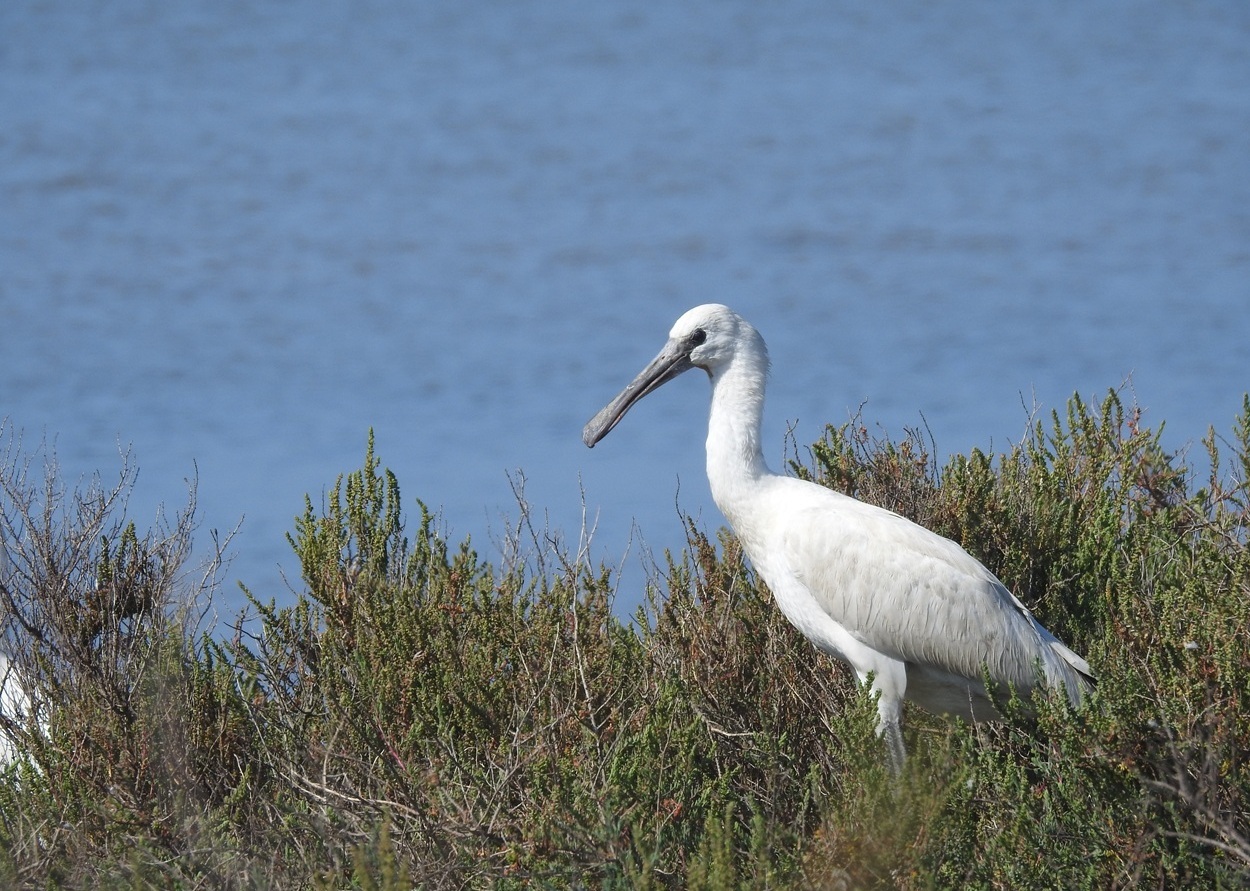
Eurasian Spoonbill (Platalea leucorodia) serves as a great model to tackle these questions, as the species is currently increasing its breeding and wintering range. One of the reasons for such expansion is its change from a fully migratory species to a partial migrant in recent decades. Moreover, spoonbills are highly natal philopatric, meaning that they usually breed in the same colony where they were born. However, despite being relatively small, natal dispersal is higher than adult dispersal. This means that it is relatively more common for a first-time breeder to breed in a colony other than their natal colony, than for an adult to breed in a different colony from the one it has used in previous years. Thus, suggesting that the colonisation of new breeding areas is likely mostly driven by first-time breeders.
We explored potential differences in behaviour and movement traits of juvenile spoonbills born in Portuguese wetlands, where the population is partially migratory. To do so, we equipped juvenile spoonbills with solar-powered satellite GPS tags that also contained accelerometers before fledging. These devices would then inform us of not only the location but also the behaviour of the juveniles. We divided them into two groups, based on their movements in the following months: stayers – that remain in the vicinity of their natal colony – and leavers – that leave and spend part of their wintering season elsewhere.
Do juvenile stayers and leavers behave similarly?
We started by comparing behavioural and movement traits of both groups when all individuals were still in the vicinity of the natal colony, potentially suggesting personality differences. But the only difference detected was that leavers seemed to preen a little more than stayers. Besides that, juveniles of both groups seemed to behave in the same way.
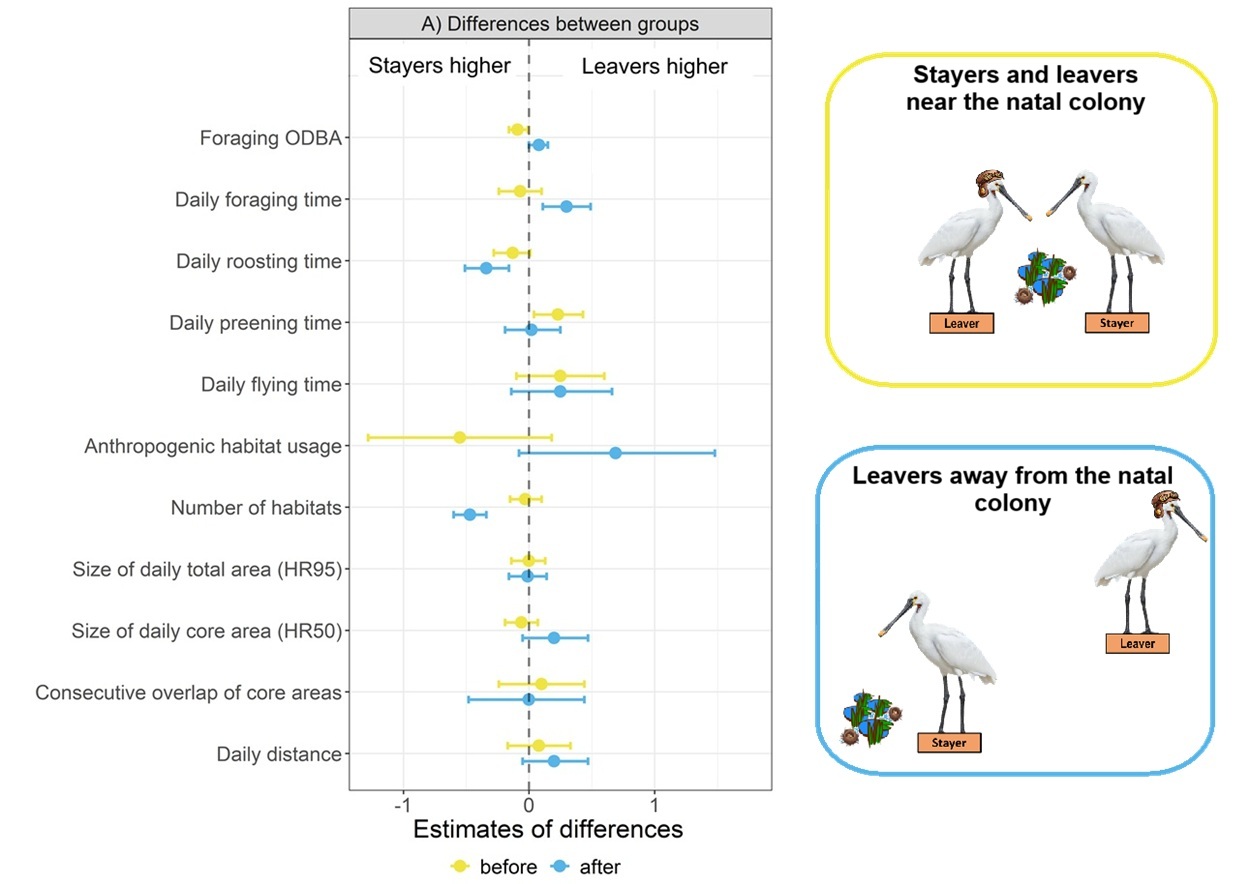 Figure 1. Estimates (circles) and 95% confidence intervals of differences in behaviour and movement tracks between juvenile spoonbill stayers and leavers: when all juveniles are still near the natal colony (yellow) and when leavers have reached the new areas (blue). Confidence intervals crossing the grey dotted line at 0 indicate no statistically significant difference between the two groups, i.e. we cannot be sure if there is a real difference. Adapted from Rodrigues et al. (2026).
However, when we compared the stayers that remained in the natal colony with the leavers when these had reached their “new” (and unknown) areas, it was very apparent that leavers spent more time foraging than stayers, while roosting less. In addition, leavers also used fewer habitat types in the new areas than the stayers near the natal colony. Hence, while juveniles of both groups behaved similarly when near the natal colony, presenting no indication of a predisposed behaviour that would suggest residency (or otherwise), they did differ in behaviour and movement traits when leavers reached a new area. It is thus likely that environmental conditions, including social context, may influence these metrics. In highly gregarious species, like spoonbills, individuals that follow migratory adults (parents or not) are more likely to displace to other localities.
Why do leavers behave differently upon reaching new areas?
We considered two non-mutually exclusive hypotheses: 1) the change was a direct consequence of travelling, such as energetic costs; 2) the change was caused by being in an unfamiliar area, likely with a different habitat composition and quality from the natal colony area.
To test this, we compared the behaviour of leavers before and after they left the natal colony, at the individual level. We found that leavers increased their foraging time and energy, while decreasing their daily roosting and preening times. The total number of habitat types they used also decreased, whilst their use of anthropogenic areas increased. We investigated whether these changes stabilised after juveniles had spent one month in the new area – which would indicate that changes may have been a consequence of travelling costs, with individuals recovering from such effort. However, we found no evidence of stabilisation. Moreover, we investigated if longer displacements implied greater changes in the analysed traits, but again found that this was not the case. Taken together, these results suggest that the differences found after moving instead appear to be a consequence of unfamiliarity with the new areas.
The reasons why juveniles behave differently upon reaching unfamiliar areas remain unclear. However, it continues to be crucial to better understand how they explore these areas and eventually become acquainted with them. It is also important for us to understand the possible effects of displacement on survival and how these effects carry over to other life stages, especially as habitats continue to change at a fast pace.
While our study was limited to a relatively short period of life, we hope that the continued advancement of tracking technology will allow further exploration of this crucial live stage, ideally also into adulthood.
References
Gill, J. A., Alves, J. A., Sutherland, W. J., Appleton, G. F., Potts, P. M. & Gunnarsson, T. G. 2014. Why is timing of bird migration advancing when individuals are not? Proceedings of the Royal Society B: Biological Sciences 281:20132161.VIEW
Gill, J. A., Alves, J. A. & Gunnarsson, T. G. 2019. Mechanisms driving phenological and range change in migratory species. Philosophical Transactions of the Royal Society B 374:20180047.VIEW
Gunnarsson, T. G., Alves, J. A., Gilroy, J. J., Þórisson, B., Sutherland, W. J., Potts, P. M. & Gill, J. A. 2024. Movement of juvenile migratory birds from settlement to adulthood across the non‐breeding range. Journal of Animal Ecology.VIEW
Kravchenko, K., Vlaschenko, A., Lehnert, L., Courtiol, A. & Voigt, C. 2020. Generational shift in the migratory common noctule bat: first-year males lead the way to hibernacula at higher latitudes. Biology letters 16:20200351.VIEW
Verhoeven, M. A., Loonstra, A. J., Hooijmeijer, J. C., Masero, J. A., Piersma, T. & Senner, N. R. 2018. Generational shift in spring staging site use by a long-distance migratory bird. Biology letters 14:20170663.VIEW
Image credit
Top right and featured image:Juvenile Eurasian Spoonbill (Platalea leucorodia) © Hugo Ferreira.