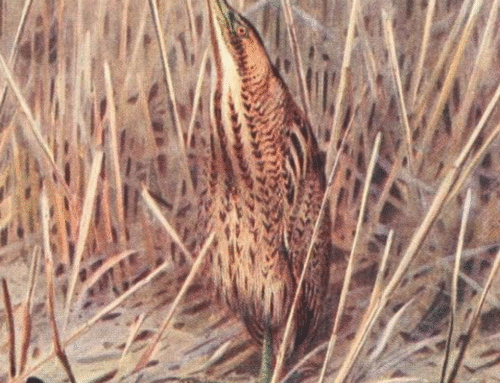



As a teenager in the 1960s, I volunteered to help with the nascent Ontario Nest Records Scheme (ONRS) housed at the Royal Ontario Museum (ROM) in Toronto. The ONRS had begun life at the ROM in 1950s, based on the BTO’s very successful scheme begun in 1939. But the ONRS made little progress until it was put in the hands of Dr George Peck in 1966. Peck was a local veterinarian with a passion for nidiology (the study of birds’ nests and eggs). Like many boys of my, his, and previous generations, Peck had delighted in collecting birds’ eggs, even though it had been illegal to do so in both Europe and North America since the early 20th century. As he grew up, Peck began to appreciate that egg-collecting was destructive so he turned his attention to photographing rather than collecting, and to documenting details about every nest he found.

My job with ONRS was to make out nest record cards for the specimens from Ontario in the museum’s collections and in the field notebooks of staff who found nests during collecting trips. For years, Peck and I and other friends would go out into the field on weekends and holidays to find bird nests in southern Ontario, always carrying a deck of blank ONRS cards to fill out. By the 1970s, the ONRS was receiving about 5000 nest record cards every year from naturalists all over Ontario. In 1983 and 1987, Peck and Ross James used the ONRS records to compile and publish the first book summarizing the breeding ranges and nidiology of Ontario’s birds.
With the advent of eBird, in particular, there is a lot of interest these days on the values of citizen science to ornithology. The BTO’s nest record scheme, for example, now receives more than 35,000 records per year from more than 700 naturalists scattered over the British Isles. That scheme alone has contributed data to more than 250 scientific papers over the years, and serves as an essential historical repository of data on clutch sizes, phenologies, and breeding success.
In a previous essay on this blog, I highlighted the work of Eagle Clark in obtaining migration data from lighthouses throughout the British Isles. Clark’s studies, the Christmas Bird Count, and the establishment of bird observatories are all early examples of the valuable contributions of citizen science. But earlier attempts, in the late 1800s, to gather data on birds from widely scattered ‘citizens’ were largely a flop. In May 1885, for example, the German Ornithologists’ Society (Allgemeine Deutsche Ornithologische Gesellschaft) sent out an “appeal to all German ornithologists to help fill in gaps in knowledge of German birds” (Stresemann 1975). Over the next decade, ornithological societies in England (1877), Austria-Hungary (1882), and the United States (1883) established committees to coordinate the gathering of information about migration. By 1900 all of those committees had disbanded with only a ‘dreary mass of material’ being accumulated.
While exploring the origins of citizen science in ornithology, I came across an apparently little-known but wildly successful example of citizen science spear-headed in the early 1880s by a young school teacher, Wells Woodbridge Cooke [1858-1916]. I say ‘little known’ because Wells’s name appears in only one of the dozen books that I have on the history of ornithology in general, and bird migration in particular.
Cooke grew up in Wisconsin (USA) and began collecting bird specimens when he was only 12 years old. Upon graduating from university in 1882, he taught for 6 years at what were then called midwest ‘Indian Schools’ where the children of native Americans were taught, often far from their families. While teaching, he always maintained a strong interest in birds and particularly migration, writing several scientific papers on the subject. During the winter of 1881/82, he sent letters to several ornithologists in the state of Iowa asking them for their records of winter resident birds and the arrival dates of spring migrants. He put each of those records onto a file card. He continued to collect those cards for the rest of his life from an ever-expanding number of correspondents who either filled out cards by hand or typewriter, or sent records to Cooke to put on cards himself. By 1915 he had more than a million such cards in his collection.
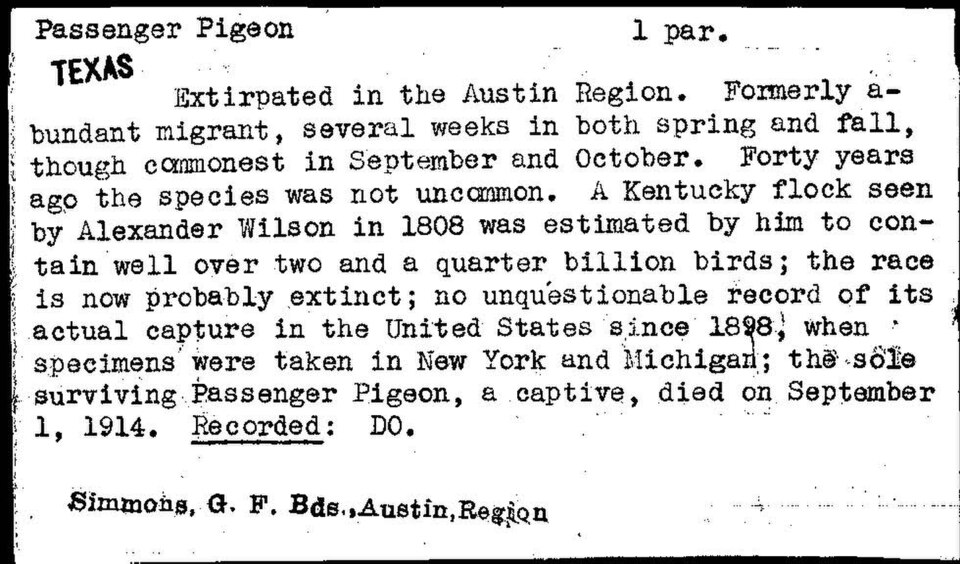
In 1901, Cooke landed a job at the Biological Survey of the US Department of Agriculture, focussing his research on the distribution and migrations of birds, using his file cards as a database. In all, he published more than 400 papers on birds and at least eight monographs on bird migration. Six of those monographs focussed on specific bird groups discussing the ‘Distribution and migration of North American…’: warblers (1904), ducks, geese, and swans (1906), shorebirds (1910 & 1912), herons (1913), rails (1914), and gulls (1915). Stresemann (1975) says that Cooke resolved a controversy among European ornithologists about migratory routes, but that is a complex story for another day.
Cooke’s first monograph, Report on Bird Migration in the Mississippi Valley in the years 1884 and 1885, was claimed by C. Hart Merriam to be “the most valuable contribution ever made to the subject of Bird Migration.” Hyperbole? Yes, but probably well deserved. In it, Cooke compiled the observations of 170 correspondents on his file cards. The result was a systematic description of the breeding ranges and migrations of 560 bird species that passed through the Mississippi Valley in 1884 and 1885. He also analyzed and speculated on the general influences of topography, altitude and weather on migration, the progression of waves of migration, and the migratory flight speeds (averaging 23 miles or 37 km per hour) of a number of species. In 1815, he expanded that analysis in his Bird Migration monograph, providing useful and surprisingly accurate maps of the breeding and wintering ranges of several species, isopleths show migration fronts, and both analyses and speculations to address a wide variety of migration questions. He may well have been the first to show the remarkable distance between the breeding and wintering ranges of Arctic Terns, a topic still of great interest a century later (Engevang et al. 2010, Redfern et al. 2026).

Cooke’s cards, and an additional five million accumulated after his death, are now housed at the North American Bird Phenology Program (NABPP), maintained by the Federal government until 1970 but since then housed at the US Geological Survey. This is a unique database of bird records from 1880 through 1945 that can be used to document some of the effects of climate change on bird populations. In a review of Cooke’s Bird Migration, ‘W.S’ felt it important ’…to call attention to an unfortunate tendency in most publications on this subject in America, i.e. that of publishing ultimate results or theories without presenting the detailed data upon which they are based.’ That problem was only really solved in 2010 with the creation of online digital data repositories. Given that eBird records only go back to 2002, it would be a worthwhile project to digitize and make readily available all the data on cards in the NABPP, the collection that Cooke pioneered.
Further Reading
Cooke, W.W. 1888. Report on Bird Migration in the Mississippi Valley in the years 1884 and 1885. (Edited and Revised by Dr. C. Hart Merriam.) Bulletin No. 2, U.S. Department of Agriculture, Division of EconomicOrnithology. Washington, D.C: Government Printing Office. VIEW
Cooke, W.W. 1915. Bird Migration. Bulletin No. 185. U.S. Dept. of Agriculture. Washington, D.C: Government Printing Office. VIEW
Egevang, C., Stenhouse, I.J., Phillips, R.A., Petersen, A., Fox, J.W. & Silk, J.R.D. 2010. Tracking of Arctic terns Sterna paradisaea reveals longest animal migration. Proc. Natl. Acad. Sci. U.S.A. 107: 2078–2081. VIEW
Peck, G.K. & James, R.D. 1983 & 1987. Breeding birds of Ontario: nidiology and distribution. Vols 1 & 2. Toronto: Life Sciences Miscellaneous Publications, Royal Ontario Museum. VIEW
Redfern, C.P.F., Steel, D. & Morrison, P.G. 2026. Natal philopatry, dispersal and age of first breeding in relation to size and sex of Arctic Terns (Sterna paradisaea). Ibis 168: 79–94. VIEW
Stresemann, E. 1975. Ornithology from Aristotle to the present. Harvard University Press, Cambridge, MA. VIEW
Image Credits
ONRS cover and card from the author’s collection (shown climbing to a Bald Eagle’s nest)
Passenger Pigeon card from Wikimedia Commons, in the public domain
Maps and illustration from Cooke 1915, in the public domain