


LINKED PAPER
Shading by vegetation facilitates cryptic reproductive behaviour in a tropical songbird. Biagolini-Jr, C., Diniz, P., Macedo, R. H., Webster, M. S. 2024. IBIS. DOI: 10.1111/ibi.13363. VIEW
Research has shown that cryptic reproductive behaviours are more common in birds than previously thought. In other words, some birds are very good at being sneaky. But how much does the surrounding habitat aid or inhibit such behaviour? Few studies have examined whether habitat characteristics can influence cryptic reproductive behaviours, despite vegetation complexity being a known habitat parameter directly linked to mate-guarding and intrusion detection (Mays & Ritchison 2004).
In a recent Ibis study, Carlos Biagolini-Jr. and colleagues investigated whether shading and vegetation aggregation increases extrapair cryptic reproductive behaviours in a free-living population of Blue-black Grassquits (Volatinia jacarina) across four breeding seasons in Brasilia, Brazil.
A suitable study species
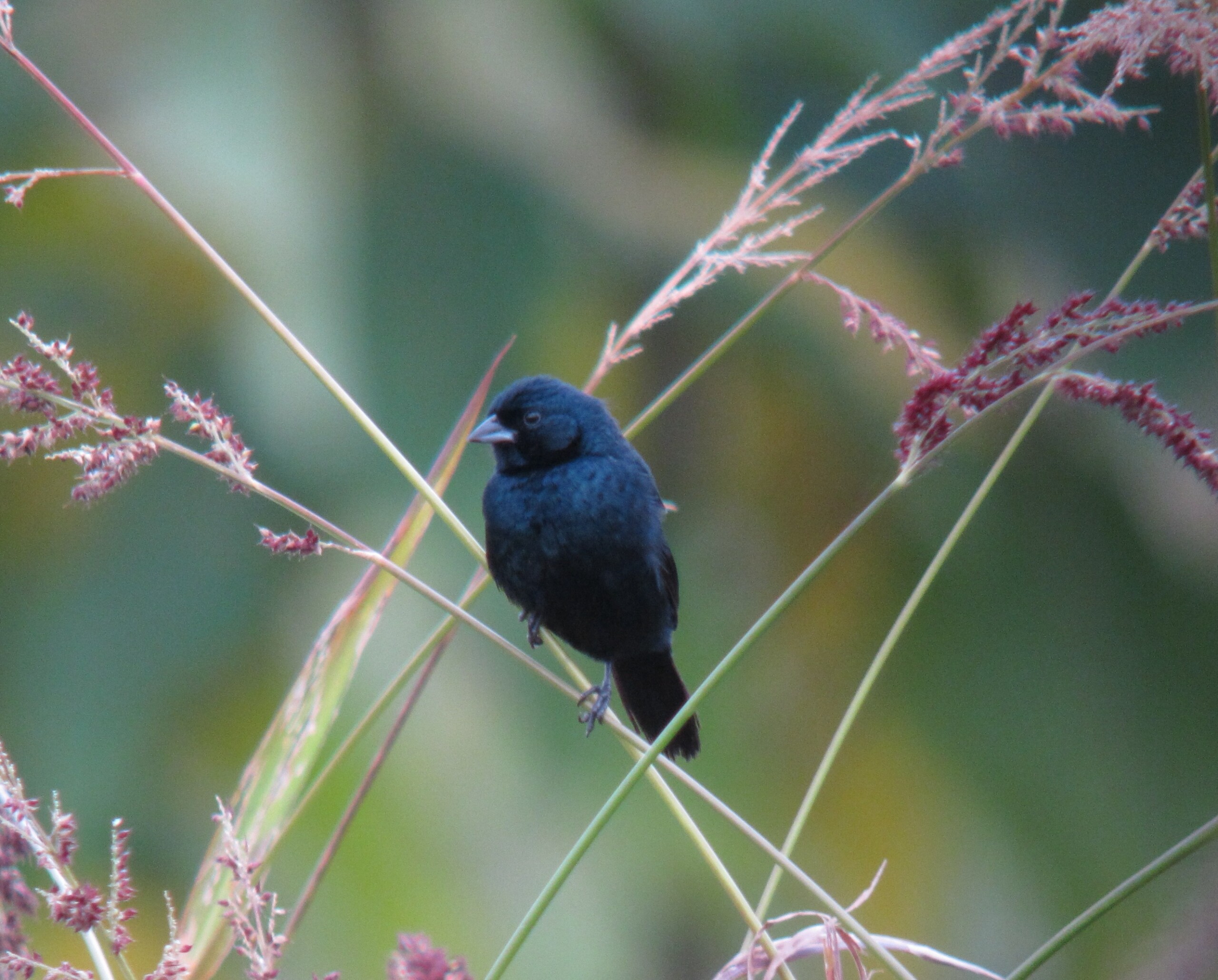
Blue-black Grassquits are a socially monogamous species found in Neotropical grasslands in which cryptic reproductive behaviour is known to be common (Manica et al. 2016) and in which vegetation complexity is related to courtship behaviours.
The researchers used offspring genetic relatedness to determine whether extrapair paternity (EPP, the presence of broods with half-siblings) and intraspecific brood parasitism (IBP, the occurrence of broods with unrelated offspring) were associated with vegetation structure complexity. Vegetation complexity was based on two habitat parameters: shadow intensity (a static measure of the proportion of sunlight captured by the vegetation) and vegetation aggregation (a standardised estimation of vegetation elements concentrated within a vegetation profile obtained through a photograph).
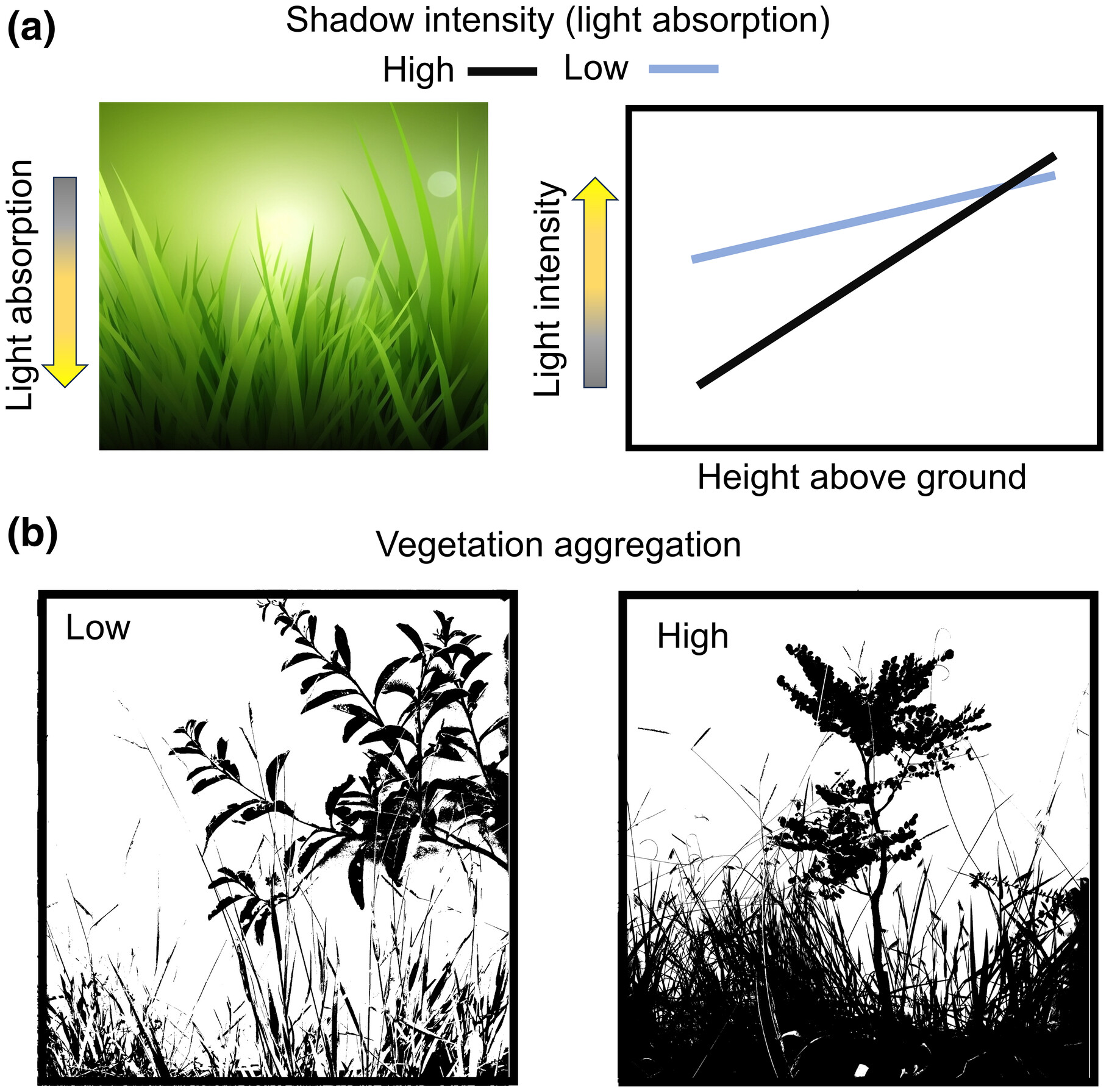
Figure 1. Vegetation complexity measurements. Shadow intensity (a) was computed for each nest as the average slope of linear regressions of light intensity (in lux) and height above the ground in 12 spots around the nest. Higher values of shadow intensity suggest higher absorption of light by the vegetation surrounding the nest. Vegetation aggregation (b) was computed on binary-transformed photographs of vertical profiles of vegetation taken in five spots around each nest. Vegetation aggregation was computed as the average proportion of same-colour pixels around each image pixel. The grasses image used in (a) is freely available at https://slidesdocs.com/.
IBP is associated with habitat shadowing
The results showed that while IBP occurrence was associated with habitat shadowing, it was not associated with vegetation aggregation, and the occurrence of EPP was not associated with either habitat parameter.
In more shaded territories, the shadows may provide concealment for egg-dumping females as well as hindering hosts’ ability to recognise and reject parasitic eggs (Rothstein 1975, Honza et al. 2014). During the breeding season, male Blue-black Grassquits use exposed vegetation perches from which to initiate their multimodal leaping courtship displays (Carvalho et al. 2007), which are used by females in mate choice (Manica et al. 2016). Males have been shown to increase their leap duration in areas where the lower vegetation layer offers shading (Biagolini-Jr et al. 2021), suggesting that high-quality males which can conduct longer displays are more likely to occupy more shadowed territories. Brood parasites may use these displays to find nests more easily, or they may be selecting the nests of higher-quality males to preferentially parasitise (Parejo & Avilés 2007). Experimental manipulation of shadow intensity would help to elucidate whether habitat shade or male quality are determinants of host selection by brood parasites in this species.
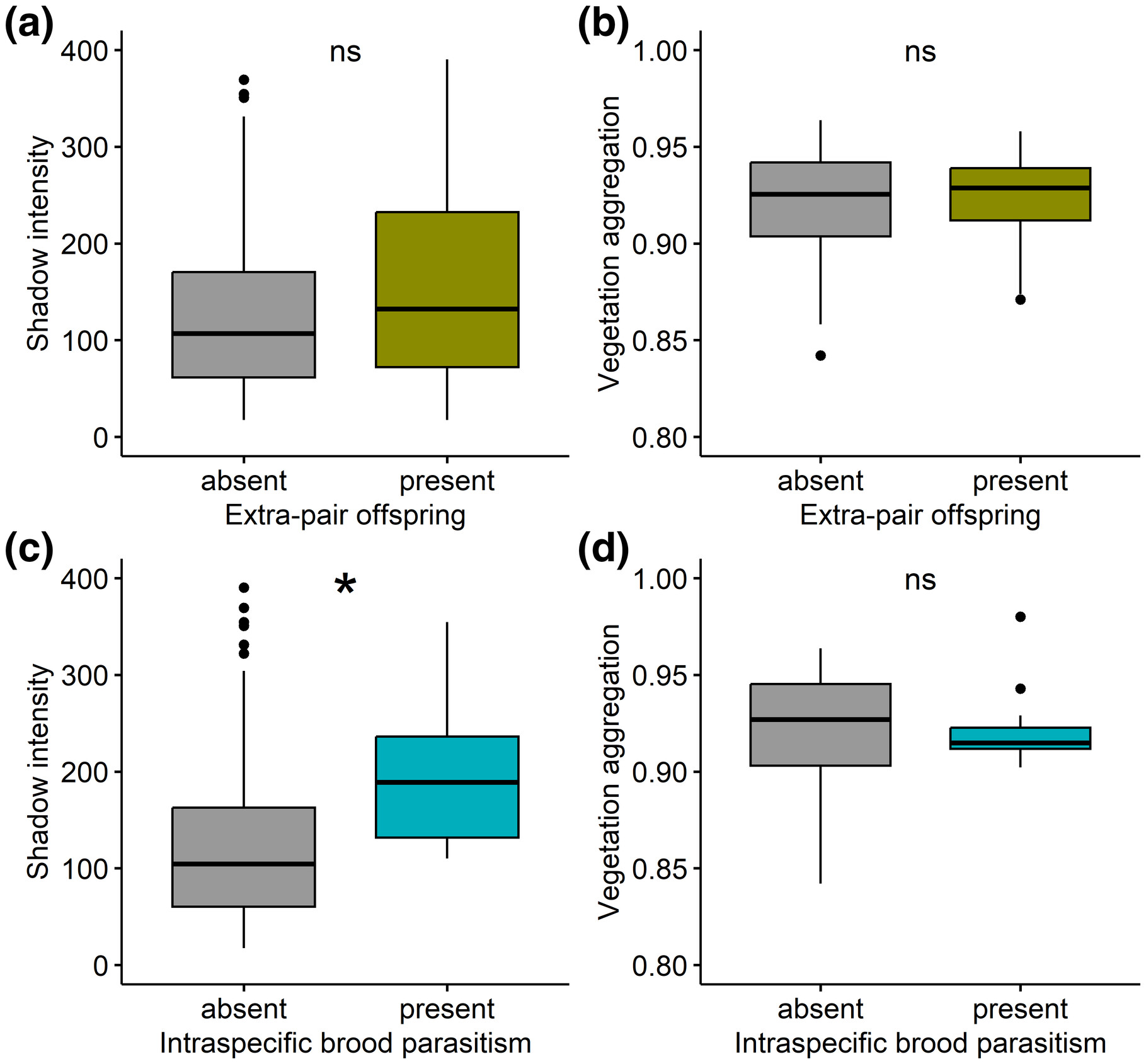
Figure 2. Variation in shadow intensity and vegetation aggregation among nests that differed in the occurrence of extrapair paternity (EPP) (a, b) and intraspecific brood parasitism (IBP) (c, d). We consider the absence of EPP and IBP in those nests with full siblings (grey boxes), the occurrence of EPP in nests with half-siblings (dark yellow boxes) and the occurrence of IBP in nests with unrelated offspring (green boxes). Shadow intensity was considered the average slope of linear regressions of light intensity (in lux) and height above the ground in 12 spots around the nest. Vegetation aggregation was considered the average proportion of same-colour pixels of a photographed vegetation image to estimate the vegetation elements (leaves and branches) concentrated within a vegetation profile.
In conclusion, the findings of this study support the idea that habitat characteristics can influence cryptic reproductive behaviours, with intraspecific brood parasitism being more frequently observed in shadowed territories. Global patterns of vegetation effects on bird reproduction are currently poorly described, and future research could expand on the findings of this study to explore how habitat components can limit communication and examine the influence of habitat shadowing on survival and breeding success.
References
Biagolini-Jr, C., Silva-Jr, E.F., Silva, C.H.A. & Macedo, R.H. (2021). Food, shadow and fire influence a tropical bird’s display. Behavioral Ecology and Sociobiology 75: 79. VIEW
Carvalho, C.B.V., Macedo, R.H. & Graves, J.A. (2007). Reproduction of Blue-black Grassquits in central Brazil. Brazilian Journal of Biology 67: 275–281. VIEW
Honza, M., Šulc, M. & Cherry, M.I. (2014). Does nest luminosity play a role in recognition of parasitic eggs in domed nests? A case study of the red bishop. Naturwissenschaften 101: 1009–1015. VIEW
Manica, L.T., Graves, J.A., Podos, J. & Macedo, R.H. (2016). Multimodal flight display of a Neotropical songbird predicts social pairing but not extrapair mating success. Behavioral Ecology and Sociobiology 70: 2039–2052. VIEW
Mays, H.L. & Ritchison, G. (2004). The effect of vegetation density on male mate guarding and extra-territorial forays in the Yellow-breasted Chat (Icteria virens). Naturwissenschaften 91: 195–198. VIEW
Parejo, D. & Avilés, J.M. (2007). Do avian brood parasites eavesdrop on heterospecific sexual signals revealing host quality? A review of the evidence. Animal Cognition 10: 81–88. VIEW
Rothstein, S.I. (1975). Mechanisms of avian egg-recognition: Do birds know their own eggs? Animal Behaviour 23: 268–278. VIEW
Image credits
Top right: Male Blue-Black Grassquit (Volatinia jacarina) | Félix Uribe | CC BY-SA 2.0 Wikimedia Commons
Blog posts express the views of the individual author(s) and not those of the BOU.
If you want to write about your research in #theBOUblog, then please see here