






Introducing Concessionary membership
Members are central to the BOU and make us who we are. Their support enables the BOU to bring people together, share ornithological knowledge, support research and create opportunities across our community. We want that community to be inclusive and accessible, so that everyone with an interest in ornithology can take part. We have worked hard to make this possible with our existing Early Career Researcher (ECR) and Low- and Middle-Income Country (LMIC) membership categories.
Nevertheless, our membership fees still have the potential to limit access, as with many learned societies in ecology and evolution (Lagisz et al., 2025). By learning from our members, we have realised that our Ordinary membership fee can be a real barrier for people who are not eligible for ECR or LMIC membership. This is why we have introduced a new Concessionary membership category to address that gap. It may be particularly helpful for, but is not limited to, people on short-term contracts, those between roles, and those not currently in employment.
For a c. 50% lower annual fee than Ordinary membership, Concessionary membership offers the same benefits as other BOU membership types, including access to IBIS online, member conference rates and the BOU Small Ornithological Grant scheme.
Eligibility is self-declared and reviewed annually when membership is renewed. We are operating this category on a trust basis, because we want the process to be straightforward, respectful and proportionate.
Why is this needed?
Financial circumstances are not fixed, and neither are research careers. We realise that people can move between employment, short-term contracts, caring responsibilities, ill health, retraining and other life circumstances at any point of their lives. Out of our 1164 currently active BOU members, 25% fall into the ECR category, and a further 6% into the LMIC category (while most of our members are ordinary members – 52%). Members are from a total of 84 different countries across all membership categories combined. No two people’s journeys are the same and these circumstances don’t diminish someone’s interest in, or commitment to, ornithology. We also hope that this new membership option helps our members remain connected to the BOU community during periods of transition, rather than requiring them to step away.
We know that our global community of members faces unequal access to resources, networks and opportunities. This mirrors what scientists experience globally – a large-scale study of 8.2 million scientists found persistent social stratification across scientific careers, with resources and opportunities contributing to unequal trajectories and outcomes (Akbaritabar, Castro Torres & Larivière, 2024). In this context, what might seem like a relatively modest cost of a membership can compound other barriers to belonging and participation.
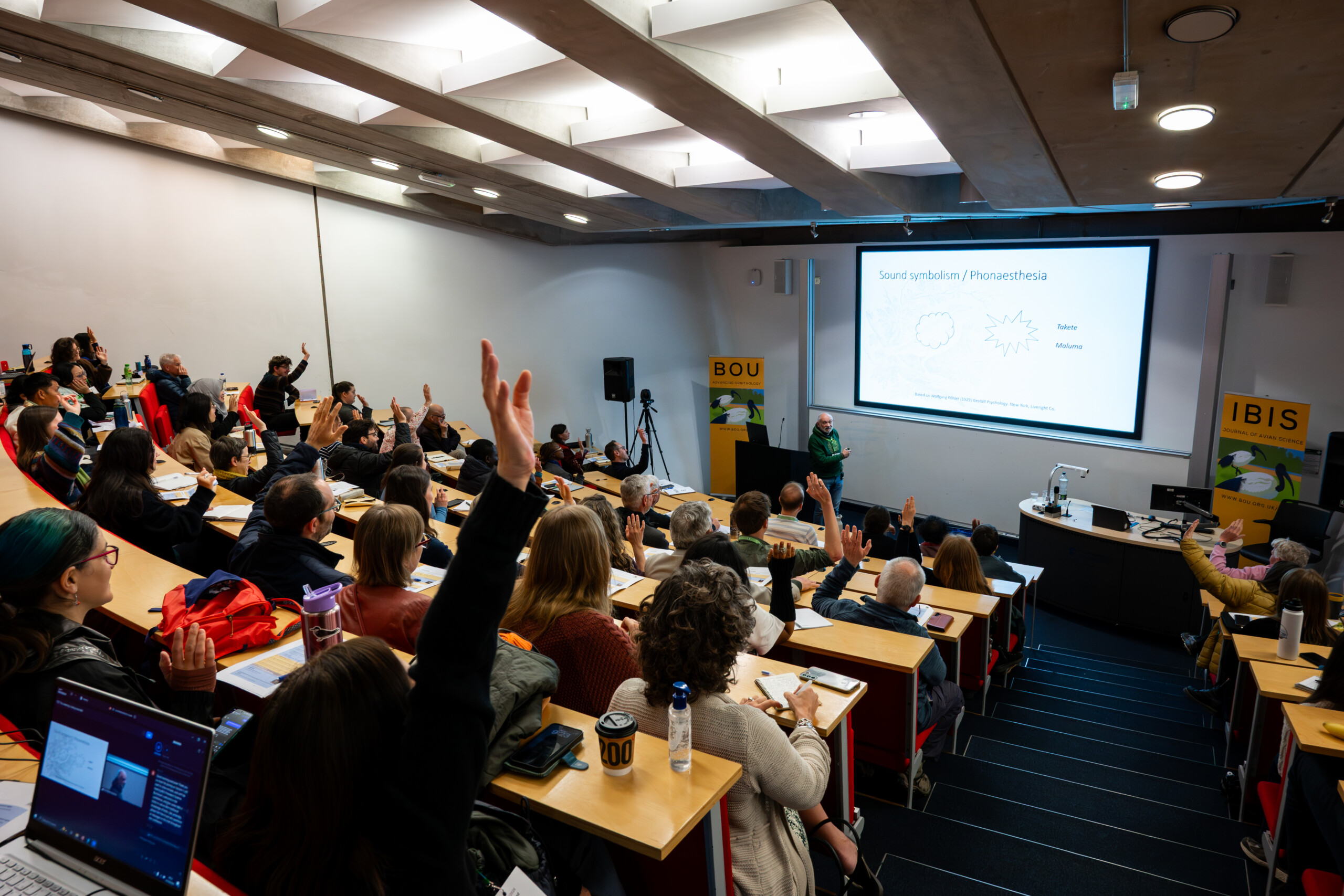 Figure 1. Audience participation during a presentation at BOU2026 conference, held at the University of Nottingham earlier this year © River Stewart (BOU social media support officer).
BOU’s Equality and Diversity Working Group
The Concessionary membership category was developed by the BOU’s Equality and Diversity Working Group (EDWG). The EDWG aims to address inequalities in ornithology, helping to broaden access to BOU’s activities, regardless of a person’s background or circumstance. The group works across all BOU activities to identify barriers that can prevent people from participating fully in ornithology and to develop practical and meaningful ways of increasing equality, whilst promoting diversity.
If you would like to know more about the BOU’s equality and diversity work, visit our Equality & Diversity page or reach out to a member of the Equality and Diversity Working Group.
References
Akbaritabar, A., Castro Torres, A. F. & Larivière, V. 2024. A global perspective on social stratification in science. Humanities and Social Sciences Communications 11:914.VIEW
Lagisz, M. et al. 2025. Priced out of belonging? Insufficient concessions on membership fees across international societies in ecology and evolution. Proceedings of the Royal Society B 292(2040):20241430.VIEW
If you are interested in contributing to the #BOUdiversityBlog, please get in touch with us via this form which ensures anonymity for those who seek it.
Featured image credit: CCO PD pixabay.com