




LINKED PAPER Environmental correlates of spatio-temporal patterns of colour variation in a bird of prey: the Common Buzzard (Buteo buteo). Delhey, K., Kappers, E.F., Valcu, M., Both, C. & Kempenaers, B. (2026) IBIS.VIEW

As its name suggests, the Common Buzzard is one of Europe’s most familiar birds of prey, often spotted perched on fence posts scanning for mice and worms, or performing spectacular loop dives over fields to attract mates. In French, it goes by an equally revealing name: buse variable, or the ‘variable buzzard’, inspired by plumage so diverse that some individuals have been mistaken for different species. For years, nature enthusiasts across Europe have been logging buzzard sightings online – and those records have now enabled us, together with international collaborators, to build the first continent-wide picture of buzzard colour – and map how it is changing.
Throughout the animal kingdom, colour serves many purposes, from camouflage to thermoregulation to courtship – and even within a single species, differences can be more than feather deep. Some ecological theories predict distinct patterns of colouration, such as darker birds in forests for camouflage and in colder regions for solar heat absorption. Across birds these rules broadly hold but whether they also explain colour variation in buzzards was not known.
Our findings published in Ibis reveal that lighter birds tend to be found in north and central Europe, whereas darker birds are more common in Brittany and Iberia. The intermediates – neither especially dark nor light – are most abundant in south-east Europe and the British Isles, a geographic mosaic only loosely linked to the environmental factors studied.
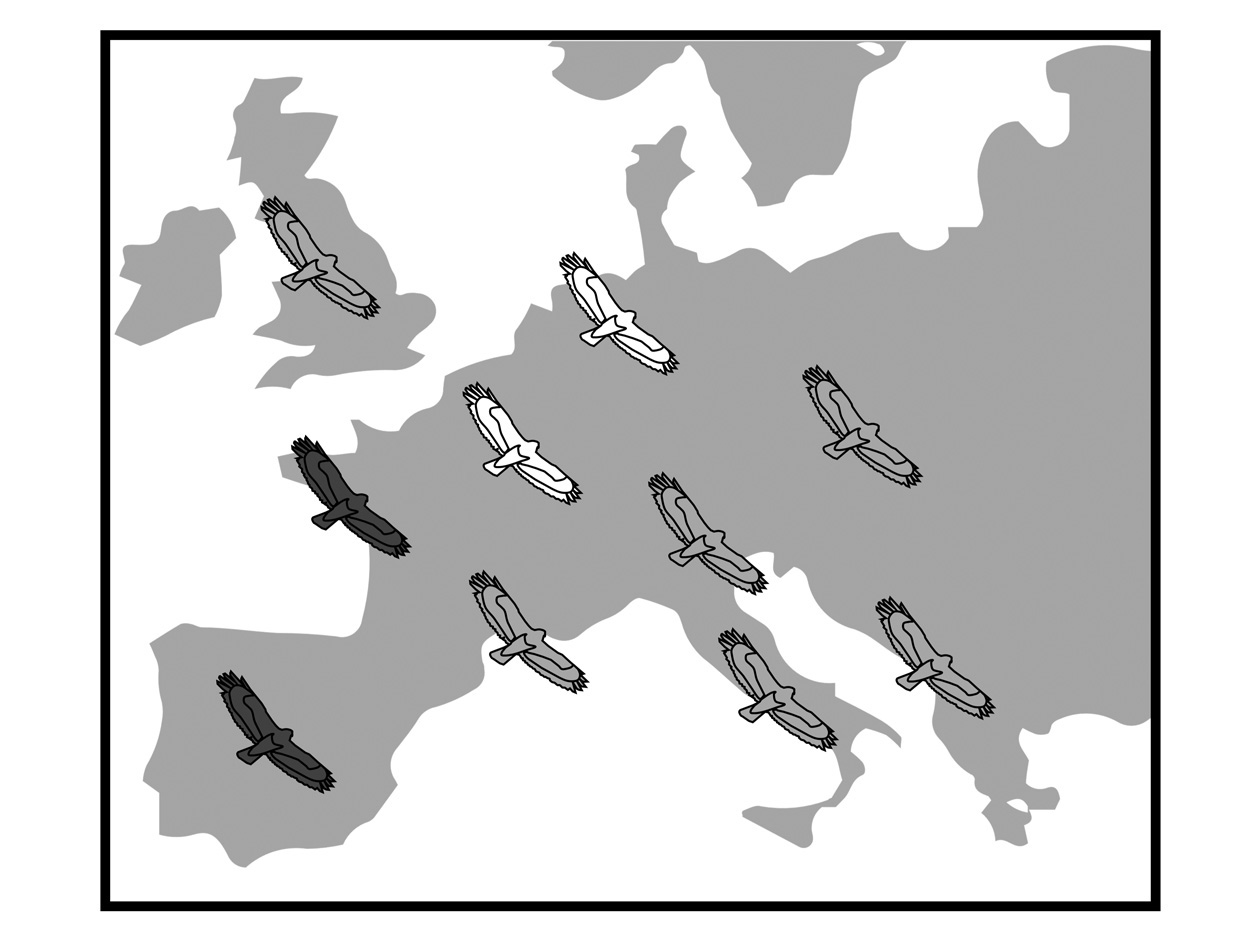 Figure 1. A dataset with almost 100,000 observations from the population shows the geographical variation in dark, light or intermediate plumage colouration of the Common Buzzard in Europe © MPI for Biological Intelligence / Kaspar Delhey.
Strikingly, the ecological theories tested explained very little of the colour variation in Common Buzzards. For instance, lighter birds tended to be more dominant in colder regions and not in warmer ones. Common Buzzard colour is strongly inherited, so these patterns could instead reflect how buzzards recolonised Europe after the last Ice Age, or be related to ecological factors not yet identified, or both. As one of Europe’s most widespread and colour-variable bird, the buzzard is a powerful model for understanding how such diversity is maintained and lost in wild populations, and observations made by citizen scientists have provided an incredible resource in which to explore these questions.
The work brought together citizen observations from multiple sources, including through a dedicated portal developed by researchers Elena Kappers and Bart Kempenaers in which observers could score buzzard colour on a seven-point scale from light to dark. We also ranked the colour of thousands more buzzard photographs contributed by the public to online nature platforms such as iNaturalist, Observation.org and Ornitho.it, assembling a dataset of nearly 100,000 observations stretching back more than two decades to the start of the millennium. We then matched sightings against satellite data on climate, vegetation and soil, and built statistical and spatial models to interpret the results.
Crucially, the approach enabled us to track how colouration is changing over time. Earlier local studies had shown that intermediate-coloured buzzards tend to be fitter, surviving better and producing more offspring than birds at either colour extreme. Analysis of the Europe-wide data mirrors these findings. By 2022 intermediate-coloured buzzards made up a significantly larger share of Europe’s population than in 2000, while the proportions of dark and light birds shrunk by 22 and 14 per cent respectively – showing that the variety that inspired the bird’s French name has been fading.
We found some links between environmental changes such as loss of forest cover, but these explained only part of the picture. If this loss of colour diversity also reflects a loss of underlying genetic variation, it could compromise the species’ ability to adapt to future environmental changes. Unravelling the historical, genetic and environmental factors behind the loss of colour diversity, and how colouration impacts fitness, must now be a priority – with genomics and museum specimens offering opportunities to explore both the species’ deep history and the genetic consequences of the diversity loss we are seeing today. What excites us most is what citizen science makes possible – a superb collaboration that has allowed us to explore questions that would otherwise be beyond reach.
Image credit
Top right and featured image: Common buzzard © MPI for Biological Intelligence / Kaspar Delhey.