


LINKED PAPER Parallel evolution of island syndromes coincides with limited parallel genetic differentiation in a passerine bird. Jezierski, M.T., Dunn, J.C., Chagas, C.R.F, & Smith, W.J. (2026) Evolutionary Journal of the Linnean Society. VIEW
It is much easier for new species to evolve on islands. If you manage to get to one in the first place, you are (obviously!) less likely to breed with individuals from your source population. As well as this, islands are typically isolated, and smaller than mainlands. Therefore, they usually host fewer species, and ecological groups present on the mainland may be missing. For example, an island-dwelling individual could experience lower predation than its mainland cousins, and may have to tolerate more limited resources. Adaptation to insular environments, coupled with reduced gene exchange, represents an ideal recipe for speciation. Some island organisms become as extravagantly distinct as the Dodo or Galapagos Giant Tortoise. But that doesn’t just happen to unfamiliar species in far-flung bucket-list holiday destinations. It’s also the case with our familiar Eurasian Wrens (Troglodytes troglodytes) in the British Isles.
The Wren is the UK’s most abundant bird, famous for its loud song and upright tail. Wrens are found across much of Eurasia, and have ~30 recognised subspecies, many of which occur on islands. In northwest Europe, we have endemic subspecies in Iceland and the Faroes, as well as five endemic subspecies in the British Isles. These include the mainland ‘British’ Wren (ssp. indigenus, of Great Britain, Ireland, and most of their associated islands); the Hebridean Wren (ssp. hebridensis) of the Outer Hebrides; the St Kilda Wren (ssp. hirtensis); the Shetland Wren (ssp. zetlandicus); and the Fair Isle Wren (ssp. fridariensis). These are thought to differ from the nominate subspecies troglodytes, found on the adjacent European continent. The island subspecies are thought to be restricted to their eponymous areas, where they live in environments quite different to what we might normally associate with Wrens – these are birds of cliff faces, seaweed-strewn boulder beaches, and vast open moorlands.
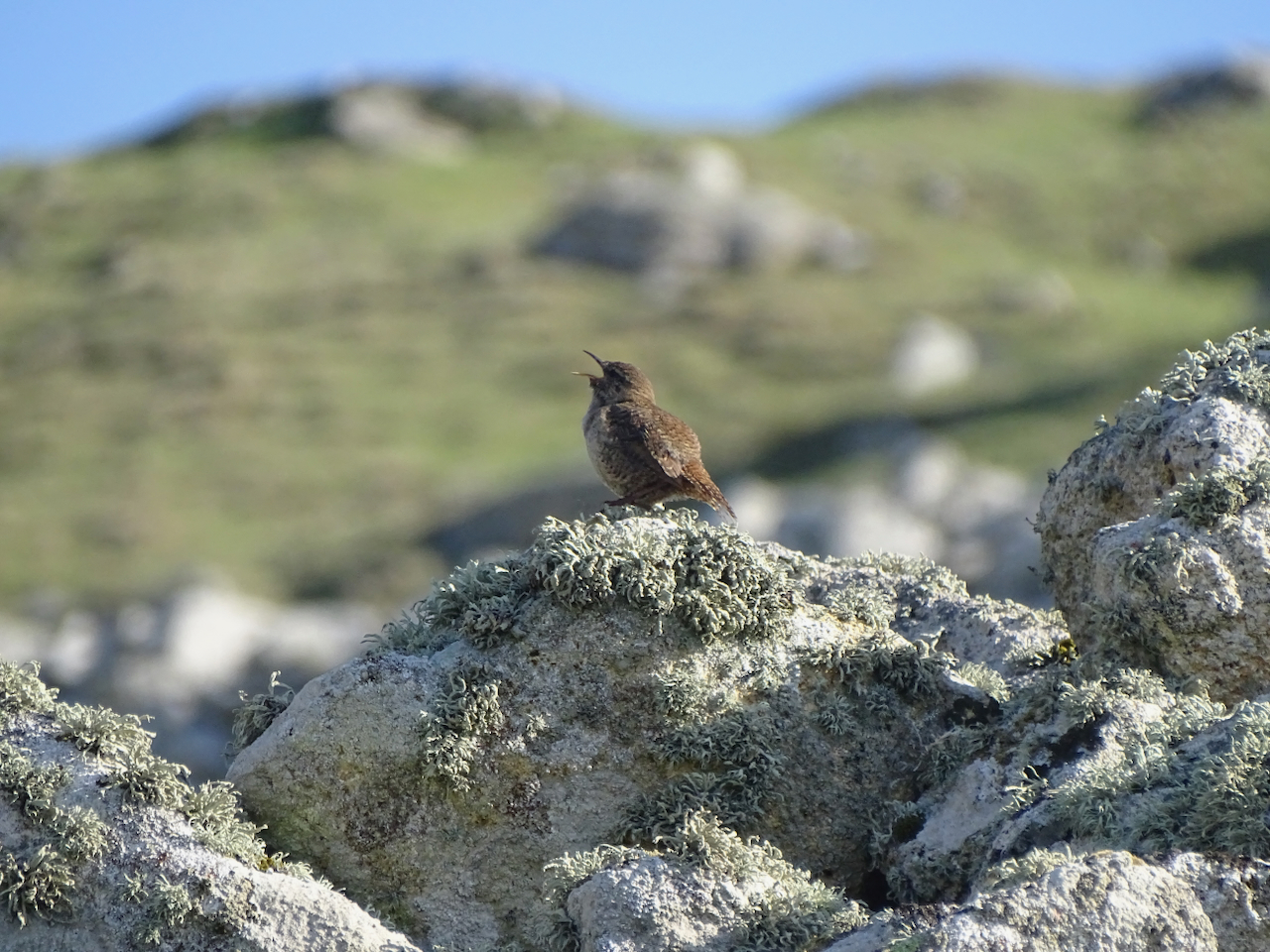 Figure 1. SA singing St Kilda Wren on Hirta, in May 2022. The songs of St Kilda Wrens are distinct from those of other Wrens in the British Isles. They are more repetitive, spanning lower frequency ranges, and incorporate frequent use of buzzing sounds. The recordings used in our study are available here.
The original taxonomic separation of the Wrens of the Scottish islands was based on more than geography. Island Wrens are larger, and their plumage has slightly different colours. For example, they are very grey on St Kilda, and a deep chestnut on Shetland. The relationships among Wren populations have previously been explored through genetic analyses, using a handful of genetic markers at a time. In 2014, Shannon et al. suggested that Hebridean and Fair Isle Wrens may be each other’s closest relatives, whilst the St Kilda Wren could be closely related to the Icelandic race, far across the North Sea. Complex biogeography seems to be a special trait of Wrens. The wren family (Troglodytidae) were originally birds of the New World, with the Eurasian Wren being the only Palearctic representative. ‘Our’ Eurasian Wren has relatively recently been separated from its Nearctic cousin, the Winter Wren (Troglodytes hiemalis), which in turn has been split into the Winter Wren and the Pacific Wren (Troglodytes pacificus).
All these discoveries were made possible thanks to DNA data, as phenotypic variation in Wrens is semi-cryptic, and potentially confounded by varying latitude and island evolution. However, prior studies had used only parts of the genetic information. To resolve the relationships amongst the Wrens of the British Isles, we used whole-genome sequencing, which allows us to recover hundreds of thousands to millions of individual variations in the DNA of each sampled bird. This provides unparalleled resolution with which to uncover relationships between populations, as well as to test for signals of gene flow or adaptation. We additionally collected morphological and vocal data. We sampled birds across locations representing each of the endemic subspecies in the British Isles. Our genetic sampling covered sites across three English and one Scottish mainland regions, as well as St Kilda, the Outer Hebrides, Mainland Shetland, and Fair Isle.
We have discovered that the Wrens of the Scottish islands form a single lineage, within which Outer Hebridean birds split first, followed by St Kilda, and then a sister group of Shetland and Fair Isle Wrens. Within these two lineages, both St Kilda and Shetland Wrens are most distinct from the other sampled subspecies, and show no evidence of recent gene flow.
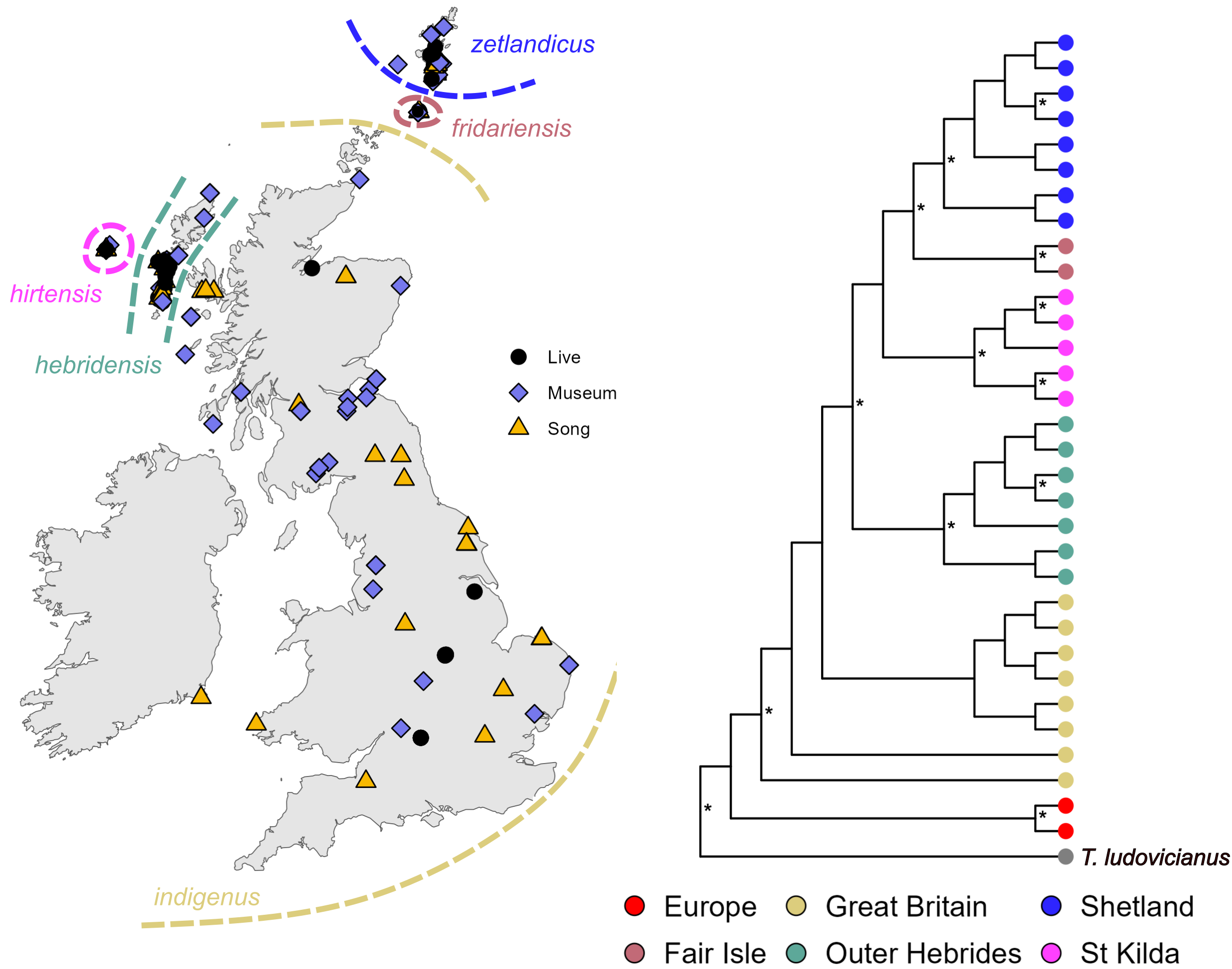 Figure 2. A map of the distribution of the British Isles’ Wren subspecies, based on Shannon et al., 2014 and Cramp, et al. 1988; and a phylogeny of the Wrens in the British Isles, as obtained in this study. On the map, the various shapes correspond to sampling locations of birds where live birds were measured (and some DNA-sequenced), provenance of museum specimens, or sound recording locations. In the phylogeny, subspecies are colour-coded as on the map, with additional samples from continental Europe (Lithuania). A ‘*’ symbol refers to branches of the phylogenetic tree with very high confidence based on the available whole-genome sequencing data. Carolina Wren (Thryothorus ludovicianus) used as an outgroup.
In our morphological analyses, which we based on 117 skins from the collection of National Museums Scotland, we found that the St Kilda and Shetland Wrens are significantly larger than expected for the latitude they are found at, an effect we believe represents the ‘island rule’ – a tendency of island organisms to become larger if their mainland ancestor was small, or smaller if their mainland ancestor was large. As the ancestor of the island Wrens is tiny, the St Kilda and Shetland Wrens have, on average, become 4g larger. If this does not sound like a lot, that’s ~140% of a typical ‘mainland’ Wren from Scotland. Even more so, the largest St Kilda Wrens (at 16g) can be twice the size of smaller Wrens (at ~8g) you can find in e.g. the south of England.
In terms of vocalisations, the St Kilda Wren is the most distinct subspecies, with more repetitive songs that are less variable in their frequency range. However, all island subspecies have more repeatable songs than the mainland form, and notably always include a ‘buzz’ element, which we did not detect in our sample of Wrens from Great Britain. Recording we have collected as part of this study are available here.
What do our results tell us about patterns of Wren evolution on islands? We found that the Shetland and St Kilda Wrens both show ‘island gigantism’, and have started to sing differently – both from each other, and their mainland Britain relative. Genetically however, St Kilda and Shetland birds are more distinct from one another, than either is from birds from Great Britain. The signatures of adaptation in their genomes are also not especially similar, suggesting they are not using similar ‘genetic solutions’ to the common problems on their similarly storm-battered islands. Therefore, what we documented in our study is an in-depth insight into ‘parallel evolution’ on islands – where similar solutions are arrived at from a similar starting point, but achieved independently, and apparently not through the use of same genetic pathways.
Our analysis also suggests that St Kilda and Shetland Wrens are likely to be on their way to speciating, having become phenotypically distinct and genetically separated. However, Wren biogeography is tricky. Our study has not sampled all of their neighbours, and the next stages must critically involve more continental European samples, as well as Icelandic and Faroese birds.
Funding
In 2022, Michał was awarded an Ornithological Research grant of £1,500 for a project titled “The spectacular diversification of the British wrens” when he was a PhD student at the Centre University of Oxford, UK.
References
Shannon, T. J., McGowan, R. Y., Zonfrillo, B., Piertney, S., & Collinson, J. M. 2014. A genetic screen of the island races of Wren Troglodytes troglodytes in the North-east Atlantic. Bird Study 61(2):135-142.VIEW
Imfeld, T. S., Barker, F. K., Vázquez-Miranda, H., Chaves, J. A., Escalante, P., Spellman, G. M., & Klicka, J. 2024. Diversification and dispersal in the Americas revealed by new phylogenies of the wrens and allies (Passeriformes: Certhioidea). Ornithology 141(2).VIEW
Drovetski, S. V., Zink, R. M., Rohwer, S., Fadeev, I. V., Nesterov, E. V., Karagodin, I., Koblik, E. A., & Red’kin, Y. A. 2004. Complex biogeographic history of a Holarctic passerine. Proceedings of the Royal Society of London. Series B: Biological Sciences 271(1538):545-551.VIEW
Toews, D. P. L., & Irwin, D. E. 2008. Cryptic speciation in a Holarctic passerine revealed by genetic and bioacoustic analyses. Molecular Ecology 17(11):2691-2705.VIEW
Jezierski, M. T., Smith, W. J., & Clegg, S. M. 2023. The island syndrome in birds. Journal of Biogeography:1-16.VIEW
Image credit
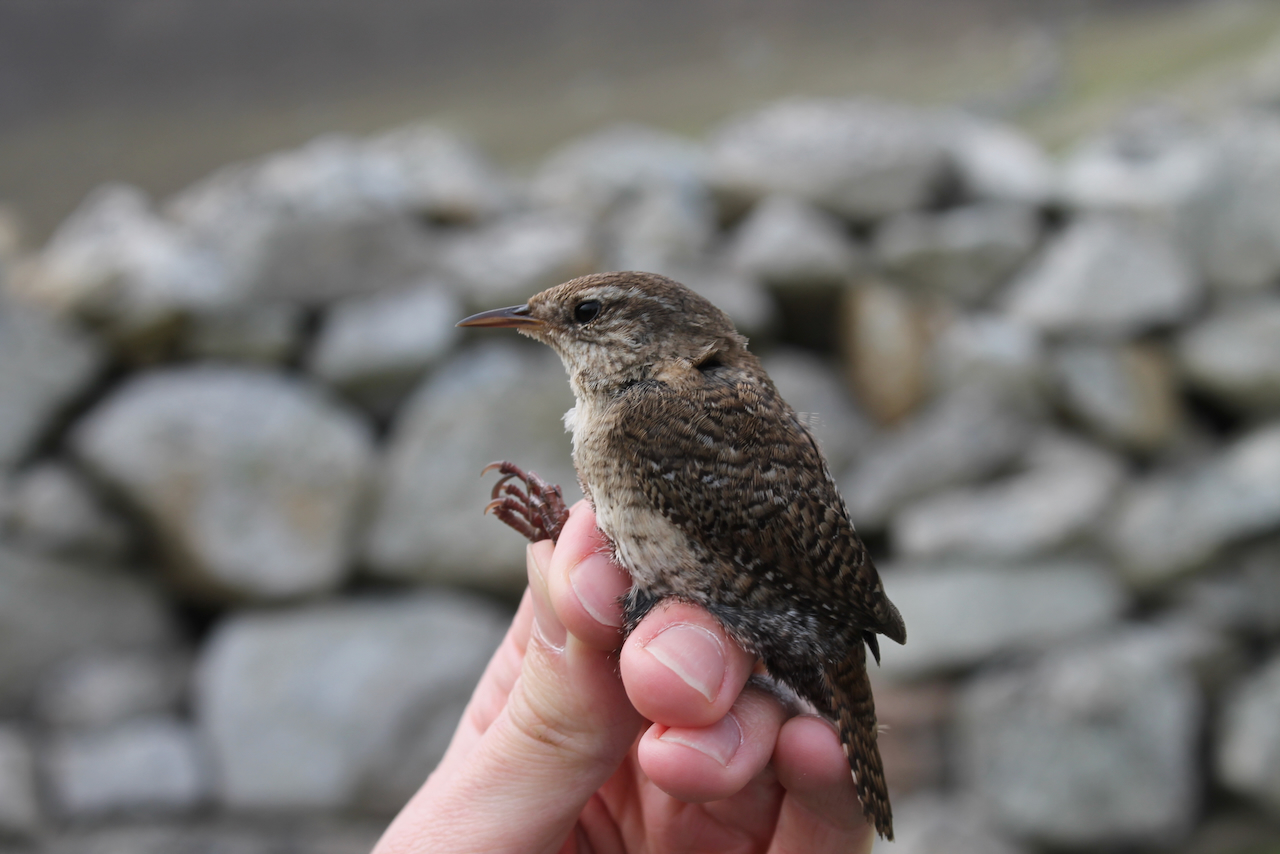
Top right and featured image: St Kilda Wren caught during the fieldwork in 2022 © Michal Jezierski.