


I was pleased to participate in the 13th Australasian Ornithological Congress (AOC) at Perth, Australia, made possible through generous funding from the BOU. The congress brought together researchers, conservation practitioners, and students, providing a valuable forum for sharing current research and exchanging ideas. Attending the 13th AOC was an intellectually rewarding experience, offering insights that will meaningfully inform my ongoing work in ornithology and conservation. Even before the sessions began, conversations over sundowners at the pre-conference icebreaker hinted at the diversity of perspectives and experiences that the event would bring. Although vultures are not part of Australia’s avifauna, I was pleasantly surprised by how many researchers were curious about the ecology and conservation of these remarkable scavengers. This created a sense of connection even before my talk, and it reminded me that the global challenges facing birds rarely stop at regional or political boundaries.
In my presentation, Climate change and habitat dynamics: implications for resident vultures, I highlighted the essential ecological role vultures play as obligate scavengers and drew attention to the conservation status and habitat distribution of the world’s fifteen resident vulture species. I explained how I used a large set of citizen science records alongside environmental information to explore how present day suitable habitat for these species may change under future climate conditions. I then shared key findings, showing that while eight species are projected to expand their range and gain climatically suitable areas over the next 50 years, five may lose habitat and two are expected to remain largely stable in their range. Importantly, I stressed that gains in suitable climate space do not automatically translate into conservation success, particularly where future habitats are likely to be heavily affected by human activities. Furthermore, I highlighted how the current Protected Area Network may be inadequate to protect the habitat of these wide-ranging species.
The positive engagement that followed my talk was highly motivating. These conversations reaffirmed how interconnected global research efforts must become, particularly as the ranges of many vulture species span multiple countries – and thus any effective conservation strategy will require coordinated, transnational action. It was heartening to see that the topic resonated with scientists whose own study systems differ greatly from mine.
The conference itself was a rich and stimulating gathering. The plenary lectures offered broad perspectives on ecology, conservation, and the role of local knowledge systems, each speaker bringing insights that felt relevant regardless of one’s study species. I found myself wishing I could be in several rooms at once, as parallel sessions competed for attention with talks on seabird conservation, migration ecology, and the role of traditional indigenous knowledge. The poster sessions were engaging, with presenters offering concise, enthusiastic pitches that encouraged deeper discussions at their stands.
One of the highlights of the conference was stepping outside the lecture halls to appreciate Western Australia’s natural heritage. Even though the species I encountered differed entirely from the ones I am familiar with, the outing was a refreshing reminder of the beauty and diversity that make ornithology such a compelling field. The coastal scenery and the calls of species I had only read about underscored the importance of regional conservation efforts, each responding to its own environmental pressures. Beyond the formal sessions, Perth itself provided a wonderful backdrop for unwinding after long conference hours. The Swan River, Elizabeth Quay, and Kings Park were some highlights, alongside the city’s well-connected and accessible public transport which made it easy to travel and discover new parts of the city.
As I look back on my experience at the AOC, I am deeply grateful to the BOU for making my participation possible. Their support enabled me to share my work with an international audience, gain valuable feedback, and form connections that I hope will develop into future collaborations. I return home with renewed enthusiasm for my research on vulture conservation, enriched by new perspectives and a broader appreciation of how global the challenges and solutions truly are. Overall, the experience was both rewarding and motivating, reinforcing the value of collaborative science in addressing complex conservation challenges facing vultures worldwide.
 Figure 1. Radhika Jha during her presentation at the 13th Australasian Ornithology Conference, Perth © Kaushalendra Kumar Jha.
Image credit
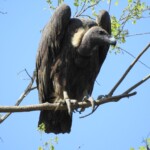
Top right & featured image: A White-rumped Vulture from north India © Radhika Jha.