


LINKED PAPER Can you really change your stripes? Stable wing ornamentation suggests limited condition-dependent signalling in female common eiders. Jónsson, J.E., Knudsen, E., Fletcher, J.A., Magnúsdóttir, E., Ásgeirsson, Á. and Carroll, J.N. (2026) IBIS.VIEW

The study investigated whether white wing stripe ornamentation in female Common Eiders is a fixed trait or varies annually and also considered its relation to individual quality and survival. Previous studies documented changes to the wing stripes following experimentally induced physiological challenges.
Measurements of wing stripes included feather counts and digital calliper measurements from 295 birds, caught and banded between 2013–2024 in Landey, Breiðafjörður, West Iceland.
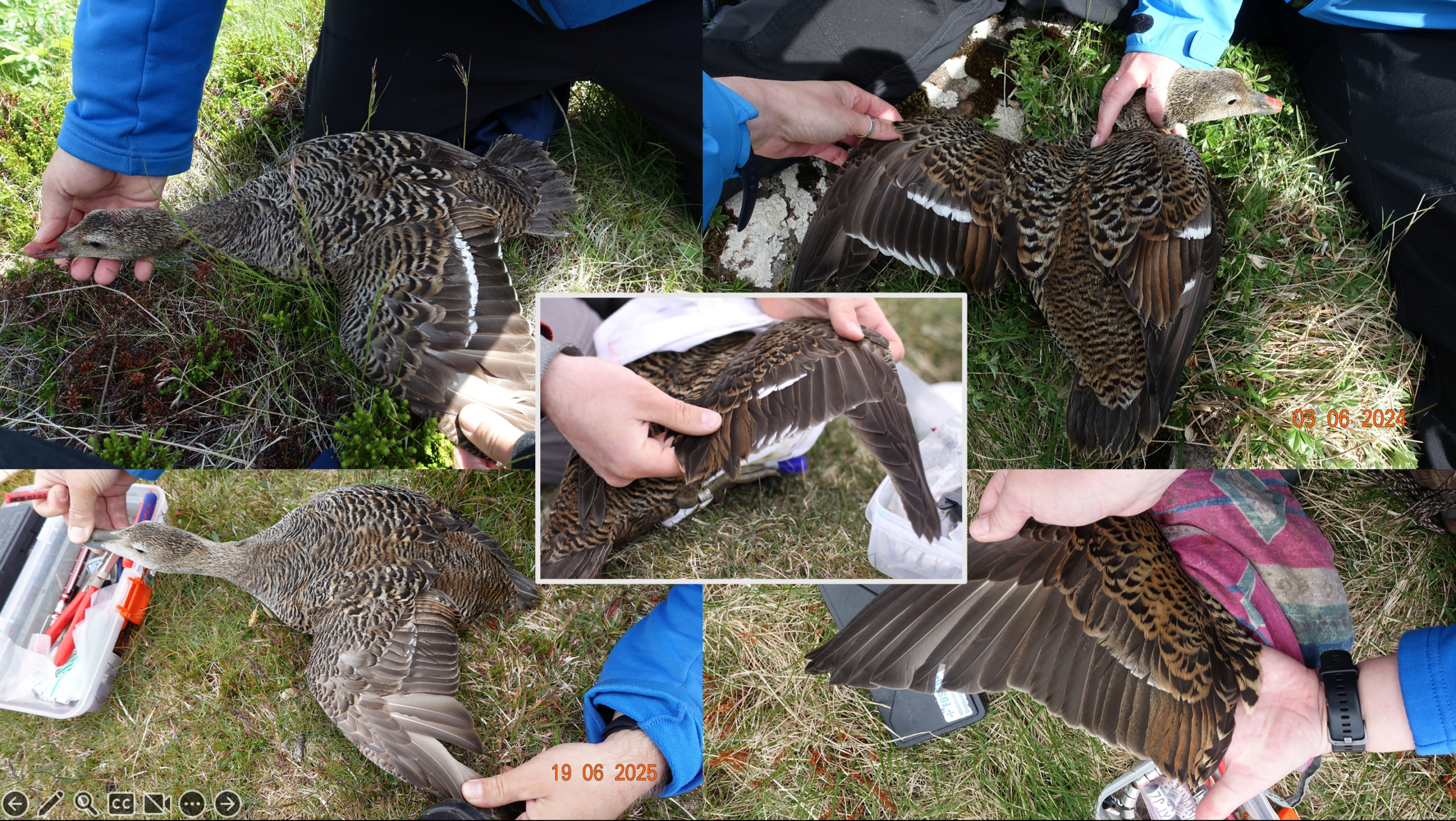 Figure 1. Wing stripes of Common Eiders (Somateria mollissima) in Landey, Iceland, illustrating variation from almost no wing stripes (bottom left and right), intermediate (four to six feathers with spots, inset) to almost fully striped (8–10 feathers with white spots) (top left and right). © Jón Einar Jónsson.
A statistical method, principal components analysis, was used to combine these measurements into a single score that summarised wing stripe size and feather coverage. This score was then used to examine variation in wing stripes, how they relate to individual variation in clutch size, body condition, nest initiation date, survival and site loyalty, and to test whether individual females had consistent wing stripe patterns over time.
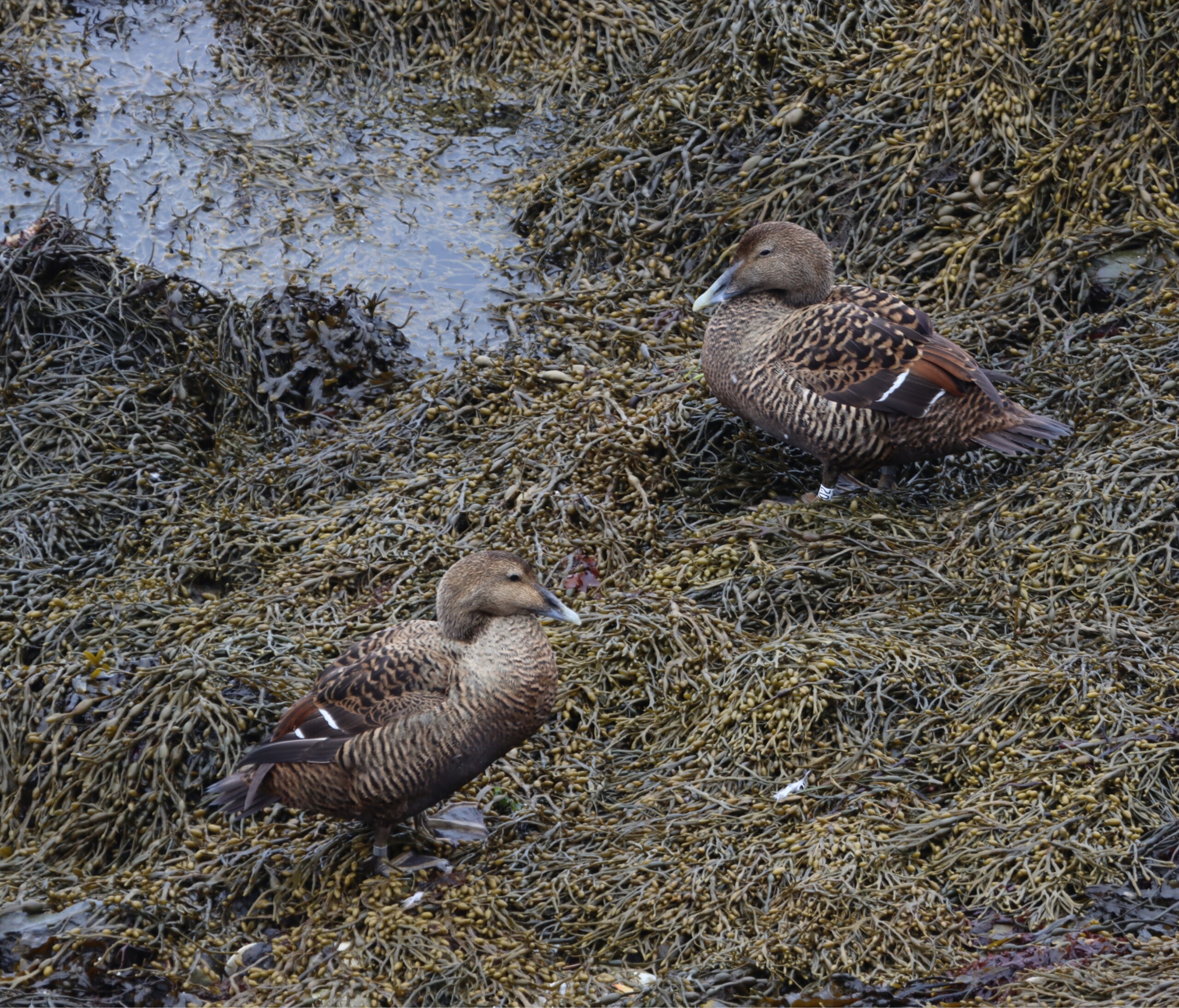
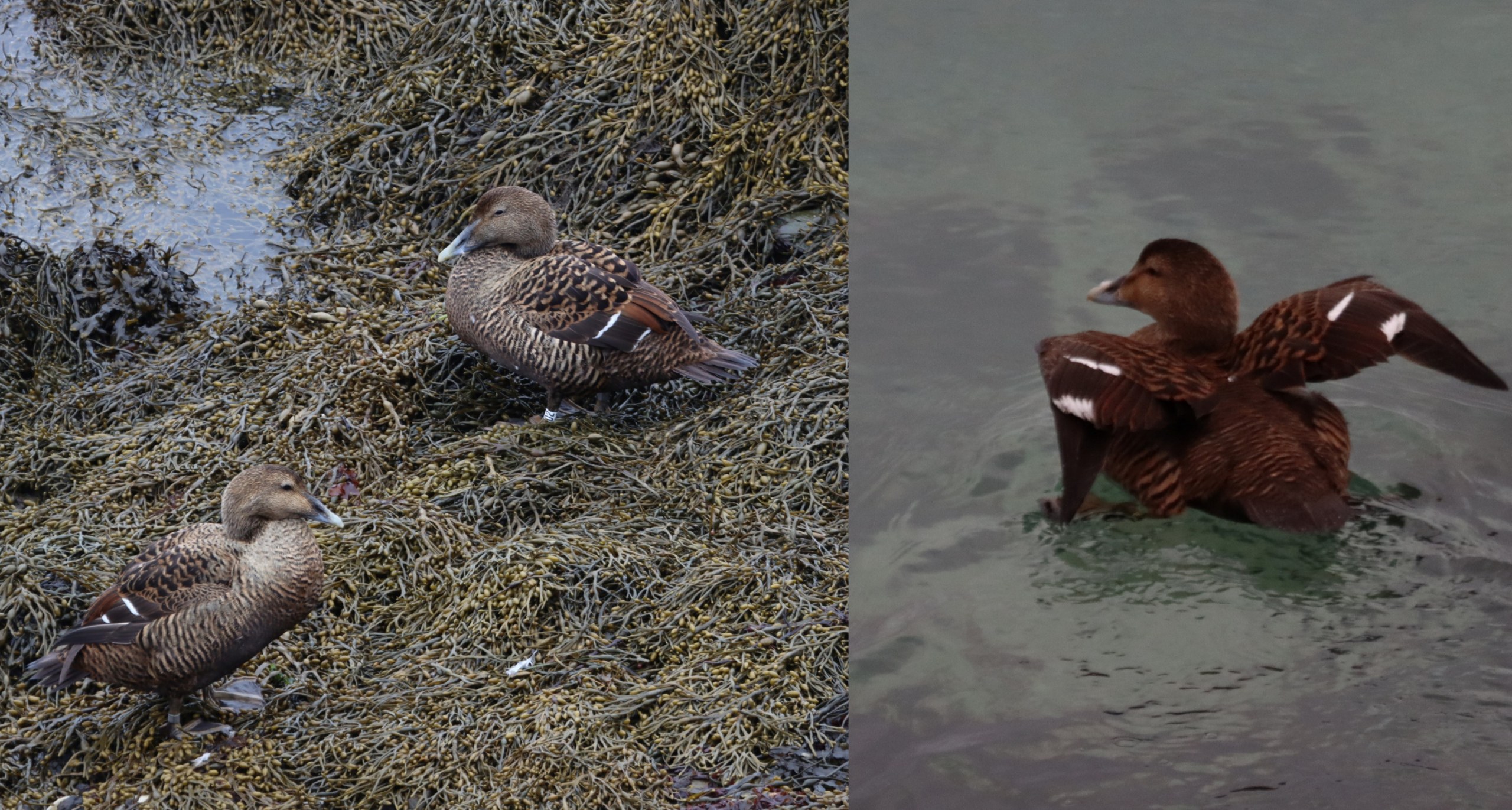 Figure 2. Wing stripes shown by wintering female Common Eider in Stykkishólmur, Iceland: two females resting on a rockweed bed (left), and a female in wintering plumage doing wing-flapping to highlight wing stripes (right). © Jón Einar Jónsson.
Wing stripe dimensions in females was a consistent, repeatable trait across years, indicating limited condition-dependent variation. Wing stripe dimensions did not differ among females with different capture histories, i.e. among frequently encountered birds (site-faithful), those that were rarely encountered or transients (those banded and never encountered again). Wing stripe dimensions were not related to survival probabilities or capture likelihood in the mark-recapture analysis. Wing stripe dimensions were not associated with variation in clutch size, nest initiation date, or body condition. Clutch size varied among islands but not among years. Body condition and nest initiation date showed annual variation but were similar among islands.
Wing stripes in Common Eiders are found 1-10 feathers per row, upper and lower, often asymmetrical. Approx. 20% of individuals have symmetrical wing stripes; 44% have relatively symmetrical stripes with a difference of one feather between the upper and lower wing stripe. The majority of females (92%) had five or more feathers in the upper wing stripe, and 84% in the lower wing stripe.
 Figure 3. A common eider drake and two females roosting on a rockweed bed in Stykkishólmur, West Iceland. © Jón Einar Jónsson.
Larger species, like Common Eiders, tend to have more contrasting wing patterns. Wing stripes are visible from various angles and during different behaviours, including swimming and diving. Size of wing stripes may be optimized to balance visibility and predator detection risk. Wing stripes might function similarly to position lights during flight or diving to prevent collisions, thus helping underwater detection of females, aiding in social interactions and partner location. Observations show wing stripes are especially conspicuous during winter in low-light conditions, thus possibly aiding in social and partner recognition. In cooperative breeders like Common Eiders, wing stripes could aid in nest ownership and brood coalition formation. Wing stripes likely represent phenotypic variation rather than current health or condition under natural conditions.
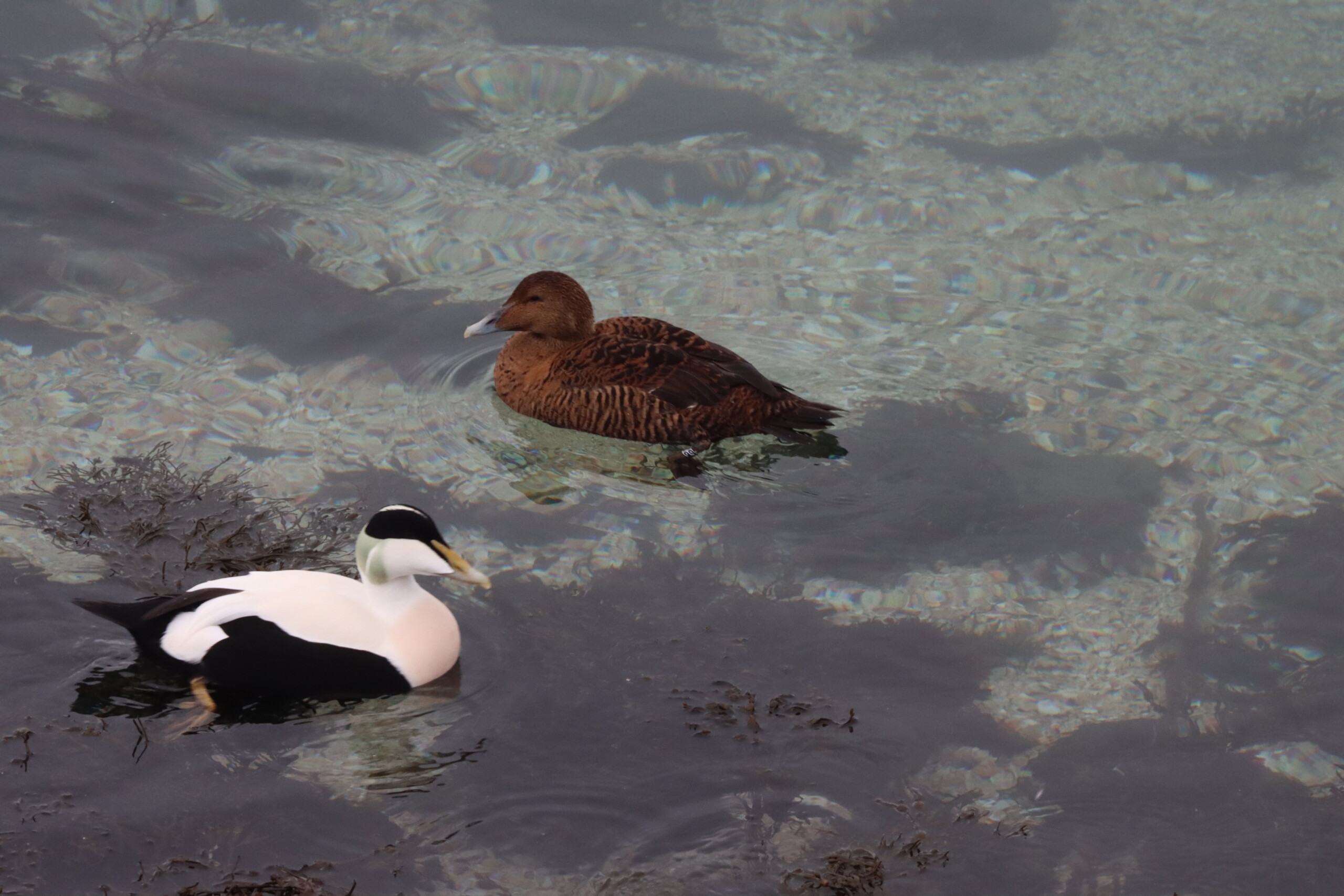 Figure 4. A pair of common eiders loafing in Stykkishólmur, West Iceland. © Jón Einar Jónsson.
There was variation among other study variables. Clutch size varied among the three study islands, suggesting local environmental or ecological differences matter. Clutch size was greater on Landey (3.8 eggs on average), where the Eiders co-nest with Lesser Black-backed Gulls, which are absent on the two smaller islands where clutch size was lower (3.4 or 3.5 eggs on average). It is possible that the two smaller islands are more exposed to partial clutch predation because the Lesser Black-backed gulls are absent.
Body condition and nest initiation date varied by year, reflecting annual environmental variation (e.g. food, weather). These traits did not differ among islands, meaning year‑to‑year conditions mattered more than location for them. Annual apparent survival was constant among years (0.87).
Image credit
Top right and featured image: Two female Common Eiders © Jón Einar Jónsson.