



LINKED PAPER iOrnithology: A review of the use of web-sourced photographs and videos in ornithological research. Panter, C.T. & Amar, A. (2026) IBIS.VIEW
Birdwatchers and photographers upload millions of bird photographs and videos to the internet every year. Most are shared simply to document sightings, celebrate memorable encounters, or help identify species. Yet these same images are increasingly becoming a valuable scientific resource (e.g., Leighton et al. 2016; Naude et al. 2019; Panter & Amar 2021, 2022).
In our new review in Ibis, we examined how researchers have used web-sourced photographs and videos to study birds. What emerged was the picture of a rapidly growing field, which we have termed iOrnithology. This new approach is helping ornithologists answer questions that would otherwise have been challenging, expensive, or even impossible to address through traditional fieldwork alone.
The broader discipline is often referred to as iEcology, which is the study of ecological patterns and processes using data generated online for other purposes (Jarić et al., 2020). For birds, this approach can be particularly useful, because they are among the most photographed groups of animals in the world, and enormous quantities of images and videos are now available through platforms such as iNaturalistVIEW, the Macaulay LibraryVIEW, FlickrVIEW, YouTubeVIEW and many regional birding websites.
To understand how these resources have been used by the ornithological community, we reviewed 64 peer-reviewed studies published between 2015 and 2024 that extracted ecological data directly from online photographs or videos of birds (Figure 1).
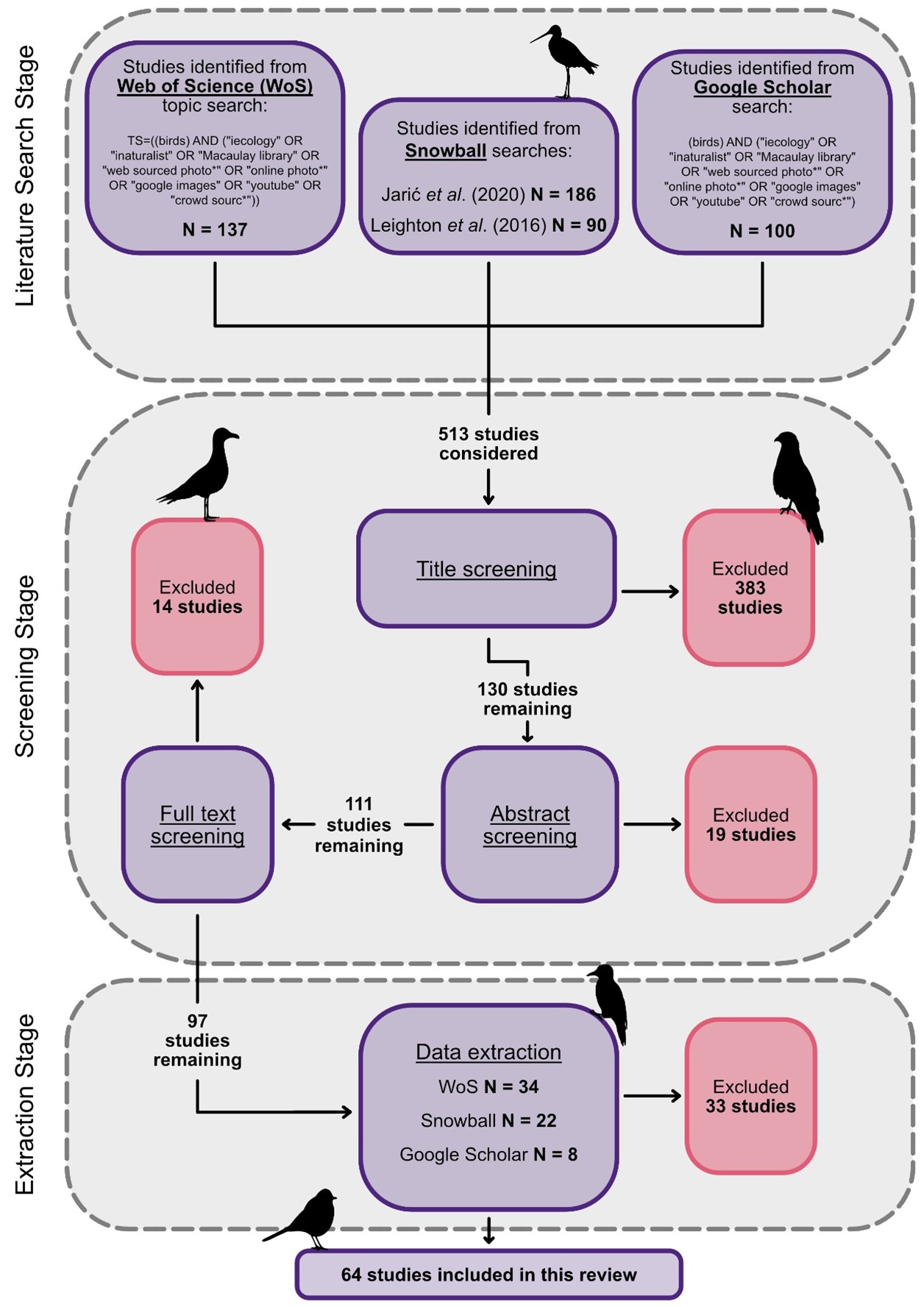 Figure 1. Schematic overview of the literature search, screening process, and data extraction stages where web-sourced media has been used to study the ecology, biology or conservation of birds.
The growth of iOrnithology as a field has been remarkable. This approach only really began around a decade ago, when Leighton et al. (2016) demonstrated that this approach could be used to build robust datasets of visible traits. Today, researchers are using online images to investigate everything from moult strategies to diets, behaviour, species interactions and changes in bird distributions (Figure 2, Figure 3).
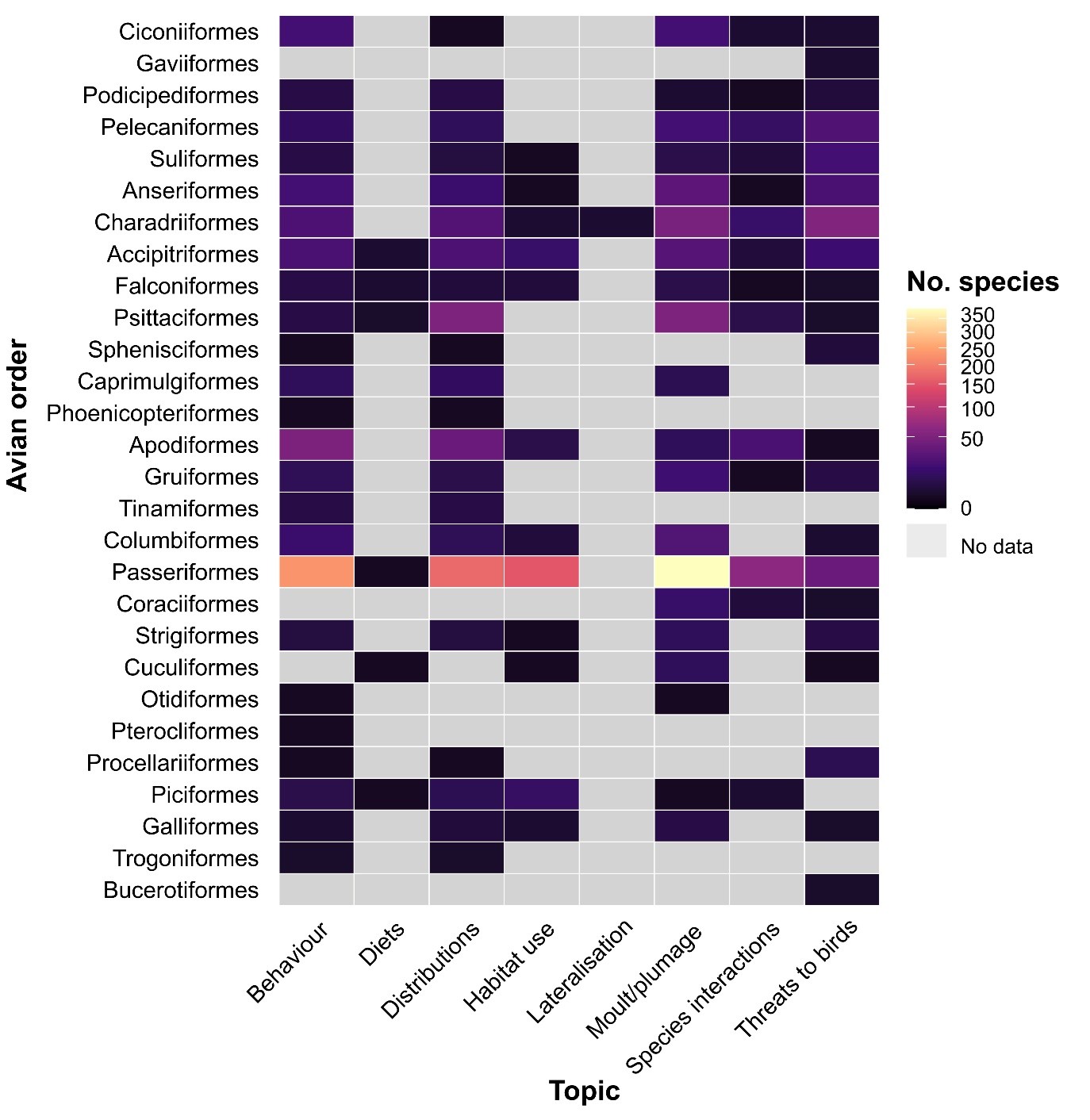 Figure 2. Topics covered by 64 studies published between 2015–2024 that used web-sourced media to study the ecology, biology or conservation of birds. Data are ranked by the most representative taxonomic order (for orders ≥ 5 described species) and heatmap values show the number of species per order studied from a total of 1,506 species.
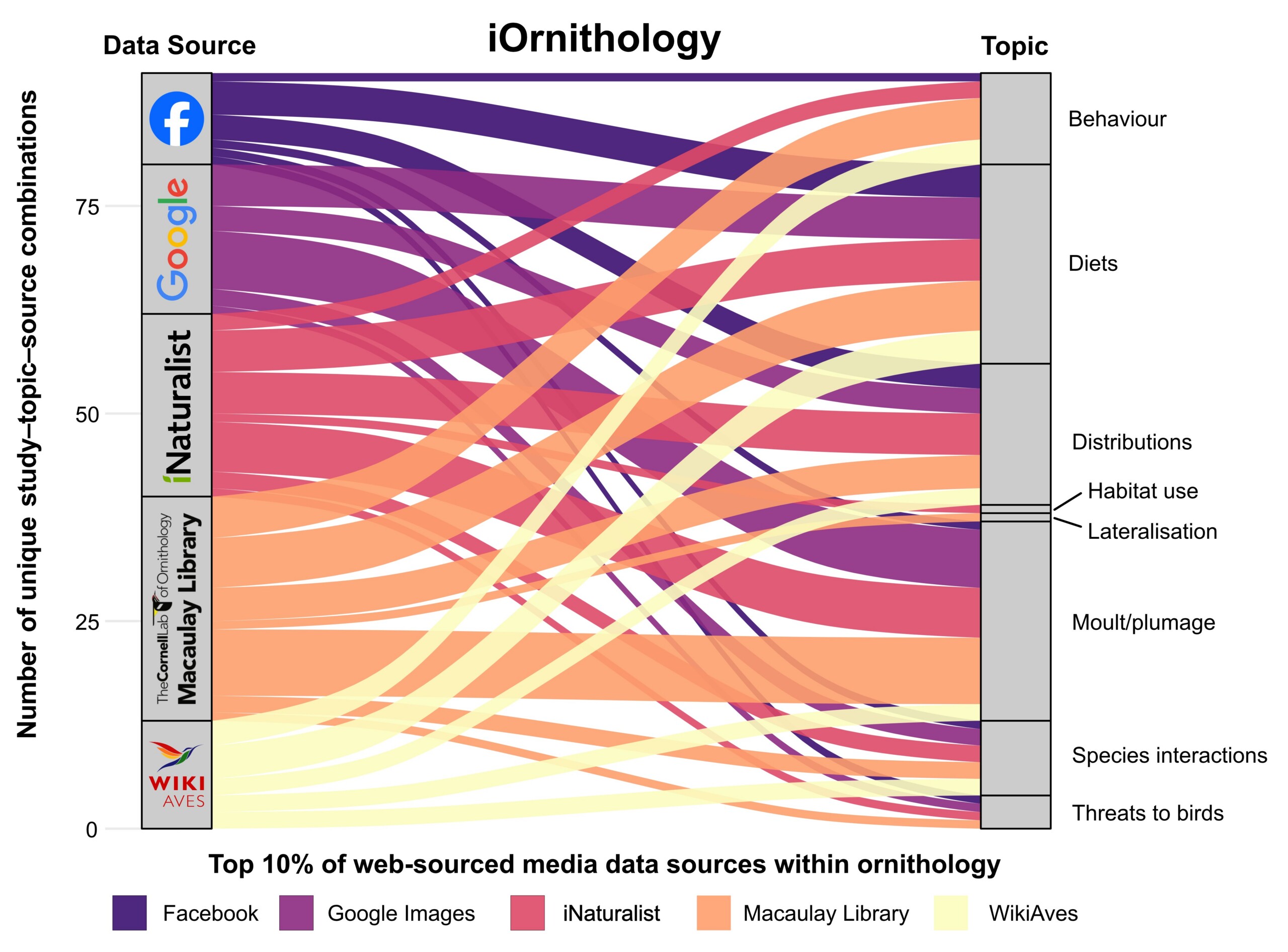 Figure 3. A graphical representation of the different data sources (photos and videos) and research topics covered by 64 unique studies that used web-sourced media to study the ecology, biology or conservation of birds published between 2015–2024. Only the top 10% of data sources represented in this diagram. The number of study–topic–source combinations exceeds the 64 unique studies, as multiple studies often used more than one data source and topic to study birds.
The most common research topic was moult and plumage. This is perhaps unsurprising because many plumage characteristics can be assessed directly from photographs, and because the earlier study of Leighton et al. (2016) had demonstrated its validity. Researchers have used online images to investigate colour polymorphism, plumage abnormalities such as leucism and melanism, and differences in moult strategies across large geographic ranges.
Distribution studies were also common. Because many photographs include location and date information, they can provide valuable insights into where species occur and how ranges may be changing. In some cases, researchers have even used social media images to track the spread of non-native birds in urban environments.
Using this approach to explore bird behaviour presents some of the most intriguing opportunities for future research. Videos uploaded by members of the public have been used to document previously unknown tool use, examine cooling behaviours during hot weather, and investigate interactions between birds and humans. Unlike traditional field studies, which are often limited to a handful of locations, online videos can provide observations from across an entire species’ range.
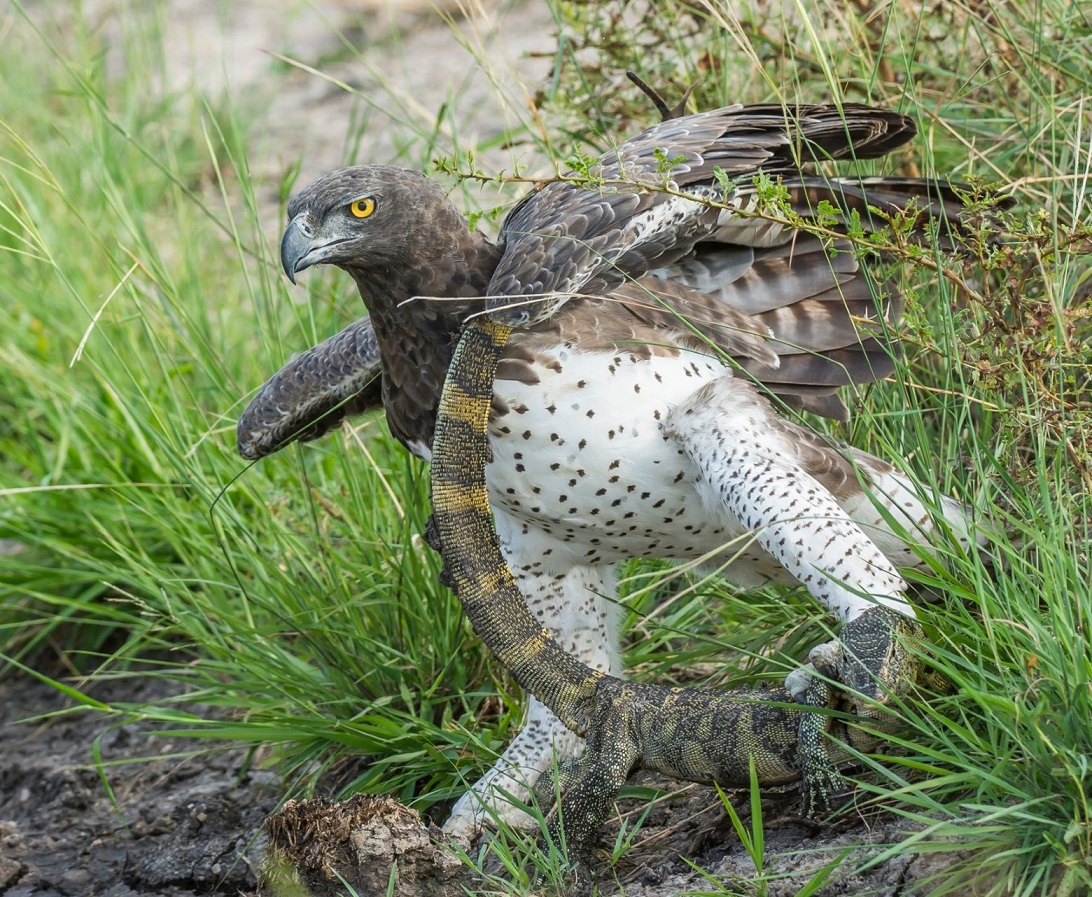
Diet studies offer another promising application of this approach. Several researchers have used photographs of raptors with prey items to explore dietary patterns across broad geographic areas and the full annual cycle. In some cases, these studies have generated information that would have been extremely difficult to collect through conventional fieldwork, particularly during non-breeding periods, for sub-adult birds or across multiple countries.
Perhaps the most important finding from our review is that web-sourced media is allowing ornithologists to tackle topics at scales that were previously difficult to achieve. Thousands of people are effectively collecting observations every day, creating vast archives of ecological information that are then being repurposed for research.
Of course, there are important limitations to this new approach. Online data are not collected systematically, and some species, regions and behaviours are far better represented than others. In our review, we found that most studies relied on photographs, while videos remain comparatively underused. Geographic biases also persist, with data from Europe and North America often dominating available datasets. Researchers must also consider issues surrounding data quality, privacy and the ethical use of publicly shared content. Another issue that may emerge in the future is AI generated images, which may interfere with the integrity of data sets (Guerro-Casado et al., 2025). This is a real concern and photo repository sites are acutely aware of this potential problem. Despite these challenges, we remain convinced that the opportunities from this new approach to studying birds are enormous.
Looking ahead, advances in artificial intelligence and machine learning could dramatically expand what can be achieved using web-sourced media. Automated systems may soon be able to identify species, detect behaviours, monitor disease outbreaks, or track invasive species directly from online imagery. As digital archives continue to grow, entirely new research questions are likely to emerge, including questions around global change.
Birdwatchers have always played a central role in ornithology. What is changing is the scale at which their observations can contribute to science. Every uploaded photograph or video has the potential to become more than a record of a memorable sighting, becoming part of crucial datasets helping researchers understand the ecology, behaviour and ultimately to help in their conservation.
In summary, the internet is not simply changing how we share our bird observations. It is helping create a new era of ornithological research.
References
Guerro-Casado, J., Murillo-Jiménez, T., Carpio, A.J., Tortosa, F.S. & Serrano-Rodríguez, R. 2025. Threats to conservation from artificial-intelligence-generated wildlife images and videos. Conservation Biology 40:e70138.
Leighton, G.R.M., Hugo, P.S., Roulin, A. & Amar, A. 2016. Just google it: assessing the use of Google Images to describe geographical variation in visible traits of organisms. Methods in Ecology and Evolution 7:1060–1070.VIEW
Jarić, I., Correia, R.A., Brook, B.W., Buettel, J.C., Courchamp, F., Di Minin, E., Firth, J.A., Gaston, K.J., Jepson, P., Kalinkat, G., Ladle, R., Soriano-Redondo, A., Souza, A.T. & Roll, U. 2020. iEcology: harnessing large online resources to generate ecological insights. Trends in Ecology & Evolution 35:630–639.VIEW
Naude, V.N., Smyth, L.K., Weideman, E.A., Krochuk, B.A. & Amar, A. 2019. Using web-sourced photography to explore the diet of a declining African raptor, the Martial Eagle (Polemaetus bellicosus). The Condor: Ornithological Applications 121:duy015.VIEW
Panter, C.T. & Amar, A. 2022. Using web-sourced photographs to examine temporal patterns in sex-specific diet of a highly sexually dimorphic raptor. Royal Society Open Science 9:220779.VIEW
Panter, C.T. & Amar, A. 2021. Sex and age differences in the diet of the Eurasian Sparrowhawk (Accipiter nisus) using web-sourced photographs: exploring the feasibility of a new citizen science approach. IBIS 163:928–947.VIEW
Image credit
Top right and featured image: A Martial Eagle prepares to eat a monitor lizard. © Riaan Marais CC BY. 4.0.