



LINKED PAPER Breeding in natural nesting sites can improve the resilience of local Lesser Kestrel (Falco naumanni) populations to environmental changes. Sarà, M. & Mascara, R. (2025) IBIS.VIEW
The migratory Lesser Kestrel (Figure 1) breeds in the open and dry cereal steppes of Southern Europe, North Africa, and Asia (Ferguson-Lee & Christie, 2001) and moves to sub-Saharan Africa in winter (Sarà et al., 2019).
 Figure 1. A ringed male Lesser Kestrel delivering a cricket to its nest in a building on the Gela Plain (Sicily).
Once the most common European raptor, it suffered a sharp decline throughout its European range during the middle of the last century. After years of research and active conservation, populations have increased, but in the last 10 years they have been declining again. Today, the Lesser Kestrel is an excellent bioindicator of agricultural intensification and a species of European conservation concern (Iñigo & Barov, 2010; Sarà, 2021). In Sicily it is a summer breeding, migratory and partially wintering species. Starting in 2000, we began exploration aimed at delineating the species’ distribution on the island. The distribution survey made it clear that the population is characterized by a predominantly northwestern mountain-hill subpopulation that nests mainly on cliffs (77%), on average at 600 m. a.s.l. in a cooler and wetter climate (hereafter the highland population); and by a second of the more southeastern flat and low-hilly areas, nesting on average at 200 m. a.s.l. in a warmer and drier climate and mainly (73%) in rural buildings, hereafter the lowland population (Morganti et al., 2019). Lesser Kestrels arrive in Sicily in March, but the two subpopulations have a different breeding calendar, with the lowland population laying their eggs on average three weeks earlier than the highland one. The survey of the colonies, to verify their existence and numerical consistency of the pairs settled for reproduction, has formed the annual routine of our work over the past 25 years (2000–2024).
Over time, we have compiled a database which currently consists of 235 colonies. 198 of these (84%, i.e. the “regional colony sample”) were visited and georeferenced at least once during the study period to confirm the species’ presence. The remaining 16% — consisting of artificial colonies with nest boxes and reports of presence not verified by us — was excluded from this study. Within the regional colony sample, we were able to monitor more continuously, on average for 18 years (range: 10–25 years) a subset of 99 colonies (the “focal colony sample”). In contrast, the remaining 99 colonies in the regional colony sample were monitored less frequently, on average for 4 years (range: 1–9 years). With this dataset and given the demographic structure, we thought it appropriate to analyse the occupancy and abundance patterns of the Lesser Kestrel in Sicily. We wondered whether the northwestern colonies located on natural cliffs and the southeastern ones established in human buildings – despite their close proximity – have independent demographic trajectories that could influence the persistence of the species on this Mediterranean island.
We estimated the temporal changes in kestrel occupancy by using the focal colony sample and employing multi-stage occupancy models that derived probabilities between years of i) occupancy; ii) colonization; iii) local extinction; and iv) detection (MacKenzie et al., 2003). Using the annual counts in the regional colony sample and the TRIM 3 software (Pannekoek & van Strien, 2005), we instead estimated the size of the population. In both models, each colony was classified according to two covariates: landscape (lowland or highland) and nesting substrate (natural cliffs or artificial buildings).
Occupancy modelling highlighted the prevalence of higher, annually variable colonization rates compared to low, annually constant local colony extinction rates. The probability of occupancy reached a peak in 2012 and then decreased until the end of the survey period, with a slight upward swing in 2020. The colonization rates of the natural highland sites have a magnitude equivalent to those of local extinction rates of the artificial lowland sites, implying that local extinction in lowland colonies is compensated by colonization of cliffs in highlands. Furthermore, highland natural sites tend to have higher occupancy rates than colonies located elsewhere on the island. Since 2000 the Sicilian population has increased to a peak of 1365 estimated pairs in 2011, then decreased, halving in 2019. From 2020 to 2024, a new numerical growth is taking place, mainly in the highland population (Figure 2).
 Figure 2. Population abundance estimates, from TRIM model, on the total colony sample (n = 198) of the Lesser Kestrel in Sicily for 25 years (2000-2024) (top). Grey circles highlight statistically significant change-points in population abundance. The total population estimate is further split into abundance estimates for natural sites (middle) and for artificial sites (bottom) of lowland and highland areas.
Our results suggest that during positive population fluctuations the Lesser Kestrel would expand its range, tending to saturate all available breeding habitats in Sicily; while in the negative phases, the population would shrink in areas with better habitats. The latter ones increasingly coincide with the highlands, which also offer a wide range of cliffs as a nesting substrate (Figure 3).

Figure 3. The typical highland landscape of northwestern Sicily, where the Lesser Kestrel has been nesting since 2000. 1) the Margana castle home to a colony on cliffs, although some pairs may nest in the ruins (inset above). 2) the western end of the Margana cliff, about 2 km long, where the Lesser Kestrel was occasional until 2012 and has now settled regularly with a loose colony.
Despite the availability of abandoned rural buildings and climatic suitability (Morganti et al., 2017), lowland areas, and particularly the core Gela Plain present a worrying rate of constant colony extinction. In addition to changes in traditional agriculture, this is happening due to the loss of nests due to the progressive collapse of buildings (Figure 4) and the increasing mortality of chicks induced by extreme events such as droughts and heat waves (Marcelino et al., 2020), produced by anthropogenic climate change (IPCC, 2023). The information collected during our long-term study has highlighted the factors driving the spatial-temporal change of local Lesser Kestrel populations, providing a clear indication of how semi-natural habitats in the wetter and cooler highlands are becoming crucial, as they constitute a buffer zone from progressive local extinctions in the warmer, drier lowlands.
The provision of carefully positioned, thermally insulated nest boxes (Corregidor-Castro et al., 2023) to cope with high temperatures and heatwaves could potentially mitigate the loss of nesting sites in the lowlands and strengthen some colonies in the highlands. This is one of the first and most urgent conservation measures that could be implemented to halt the decline in numbers and prevent the contraction of the species’ range on the island.
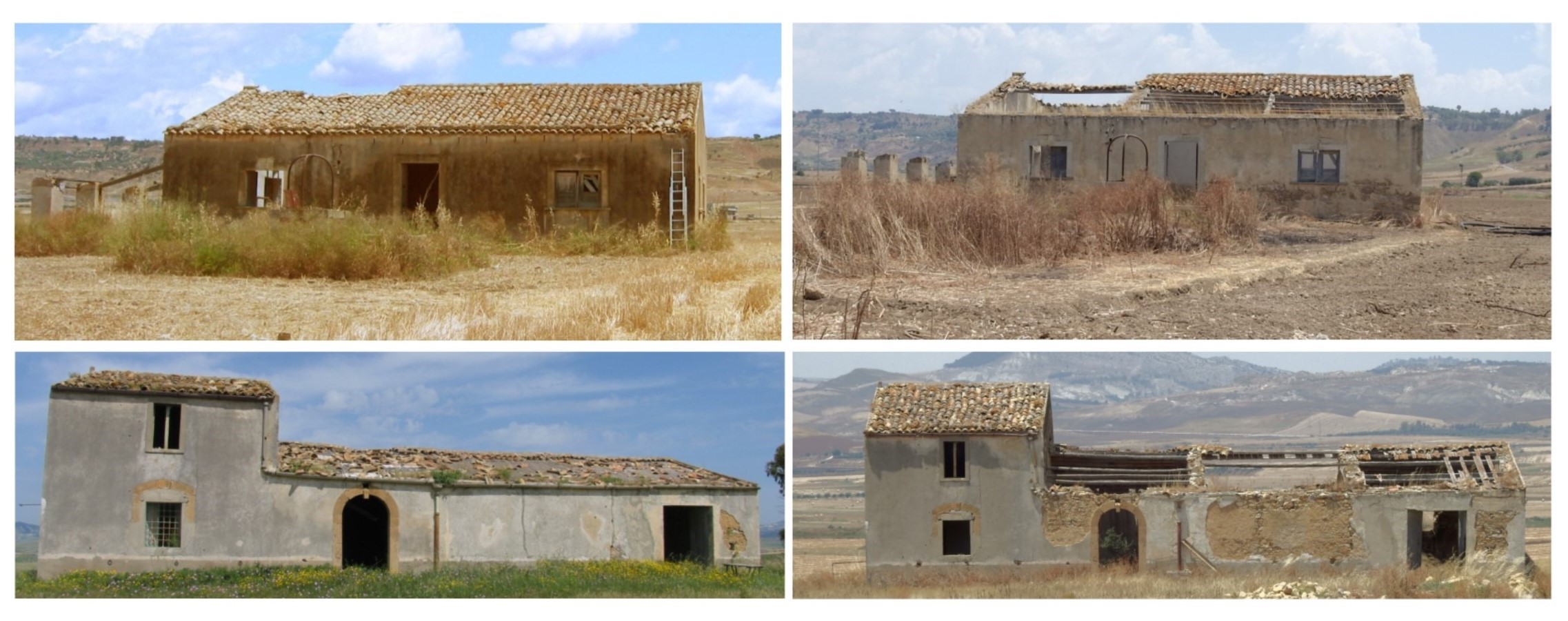 Figure 4. The progressive deterioration of artificial sites in the lowlands. Top left: Conca d’oro colony in 2005 (8 pairs), top right: in 2024 (5 pairs). Lower left: La Torre colony in 2010 (23 pairs), lower right: the same colony in 2024 (10 pairs).
References
Corregidor-Castro, A., Morinay, J., McKinlay, S. E., Ramellini, S., Assandri, G., Bazzi, G., Glavaschi, A., De Capua, E. L., Grapputo, A., Romano, A., Morganti, M., Cecere, J. G., Pilastro, A. & Rubolini, D. 2023. Experimental nest cooling reveals dramatic effects of heatwaves on reproduction in a Mediterranean bird of prey. Global Change Biology 29(19):5552–5567.VIEW
Ferguson-Lee, J. & Christie, D.A. 2001. Raptors: Birds of prey of the world. A. & C. Black Publishing, London.
Iñigo, A. & Barov, B. 2010. Action plan for the lesser kestrel Falco naumanni in the European Union. SEO‐BirdLife & BirdLife International for the European Commission, Madrid.
IPCC. 2023. Climate Change 2023: Synthesis Report. Contribution of Working Groups I, II and III to the Sixth Assessment Report of the Intergovernmental Panel on Climate Change [Core Writing Team, H. Lee and J. Romero (eds.)]. IPCC, Geneva, Switzerland.
MacKenzie, D.I., Nichols, J.D., Hines, J.E., Knutson, M.G. & Franklin, A.B. 2003. Estimating site occupancy, colonization, and local extinction when a species is detected imperfectly. Ecology 84:2200–2207.VIEW
Marcelino, J., Silva, J. P., Gameiro, J., Silva, A., Rego, F. C., Moreira, F. & Catry, I. 2020. Extreme events are more likely to affect the breeding success of lesser kestrels than average climate change. Scientific Reports 10(1):7207.VIEW
Morganti, M., Ambrosini, R. & Sarà, M. 2019. Different trends of neighboring populations of Lesser Kestrel: Effects of climate and other environmental conditions. Population Ecology 61(3):300-314.VIEW
Morganti, M., Preatoni, D. & Sarà, M. 2017. Climate determinants of breeding and wintering ranges of lesser kestrels in Italy and predicted impacts of climate change. Journal of Avian Biology 48:1595-1607.VIEW
Pannekoek, J. & van Strien, A 2005. TRIM: TRends & indices for monitoring data. Statistics Netherlands, Voorburg.
Sarà, M. 2021. More than 30 years of studies and conservation on lesser kestrel in Europe: where do we will go from there?. In: LIFE-ZEPAURBA (ed.), VIII International Congress on the Conservation of the Lesser kestrel.
Sarà, M., Bondì, S., Bermejo, A., Bourgeois, M., Bouzin, M., Bustamante, J., Puente, J., Evangelidis, A., Frassanito, A., Fulco, E., Giglio, G., Gradev, G., Griggio, M., López‐Ricaurte, L., Kordopatis, P., Marin, S., Martínez, J., Mascara, R., Mellone, U. & Rubolini, D. 2019. Broad‐front migration leads to strong migratory connectivity in the lesser kestrel (Falco naumanni). Journal of Biogeography 46(12):2663–2677.VIEW
Image credit
All images were taken by © Maurizio Sarà.