


LINKED PAPER High spatial pair cohesion during and after breeding in a socially monogamous territorial passerine. Speelman, F.J.D., Tyson, C., Naguib, M. & Griffith, S.C. (2025) Behavioral Ecology VIEW

The ubiquity of social monogamy
Birds are the poster-child for romantic relationships. Indeed, most birds are socially monogamous (Cockburn, 2006): they tend to breed with a single partner, sometimes over their entire lifetime. This is much more common in birds than in other taxa, such as mammals. Why? The theory is quite simple: because birds lay eggs, the development of offspring largely happens outside the female’s body. This means that offspring survival relies much more on parental care from both parents. Thus, there is very strong selection for biparental care in socially monogamous birds.
‘Good’ partnerships
A central question in the field of social monogamy is: What makes a good partnership in these birds? Because of the need for biparental care for successful reproduction, most research has focused the nesting stage. Effective coordination and cooperation in protecting and raising the young are usually seen as evidence for a potent partnership. Thus, researchers often conclude that the reason of partners staying together is through reproductive benefits (Griffith, 2019).
But, birds (often) spend the majority of their lifetimes not actively reproducing. What happens to these partnerships outside the breeding season? To date, very little research has focused on how closely partners associate after they breed together.
Automated radiotracking of the Chirruping Wedgebill
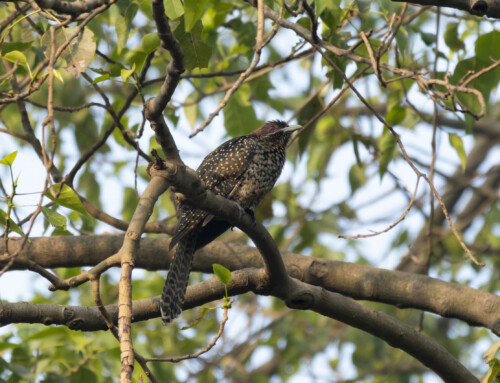
In a new study on the Chirruping Wedgebill (Psophodes cristatus), we aimed to uncover how closely partners associate during and after breeding. Chirruping Wedgebills (Figure 1) are endemic to the Australian Outback, where they form socially monogamous bonds in year-round territories. To assess how closely partners associate, we used an automated radiotracking system that allowed us to closely and continuously track partners over several months.
 Figure 1. A Chirruping Wedgebill perched on a branch © Rufus (surname removed for privacy reasons).
How did it work? Deep into the Australian arid zone, we set up an array of 100 radio signal receivers, all 100 metres apart from each other. Any bird with a radio tag that resided within this array would be detected by these receivers every 15 seconds. Because the tags attached to the birds were solar-powered, and the sun always shines in the Australian Outback, we did not have to worry about restricted battery life or strong interference of signals due to vegetation. This resulted in an average of 260 000 localisations per individual bird over a period of three months, spanning both the breeding and non-breeding period (see Figure 2).
Figure 2. Movement of two pairs of Chirruping Wedgebills over two hours. The green and purple individuals are pair-bonded, as well as the red and blue individuals.Spatial pair cohesion across time
We found that Chirruping Wedgebill partners have very high cohesion in movement. Overall, tagged partners shared nearly identical home ranges (Figure 3), and stayed significantly closer to each other than expected by chance. This was the result of active following behaviour, as one bird followed its partner as they moved nearly half the time, and in 14% of cases partners simultaneously moved away from a location.
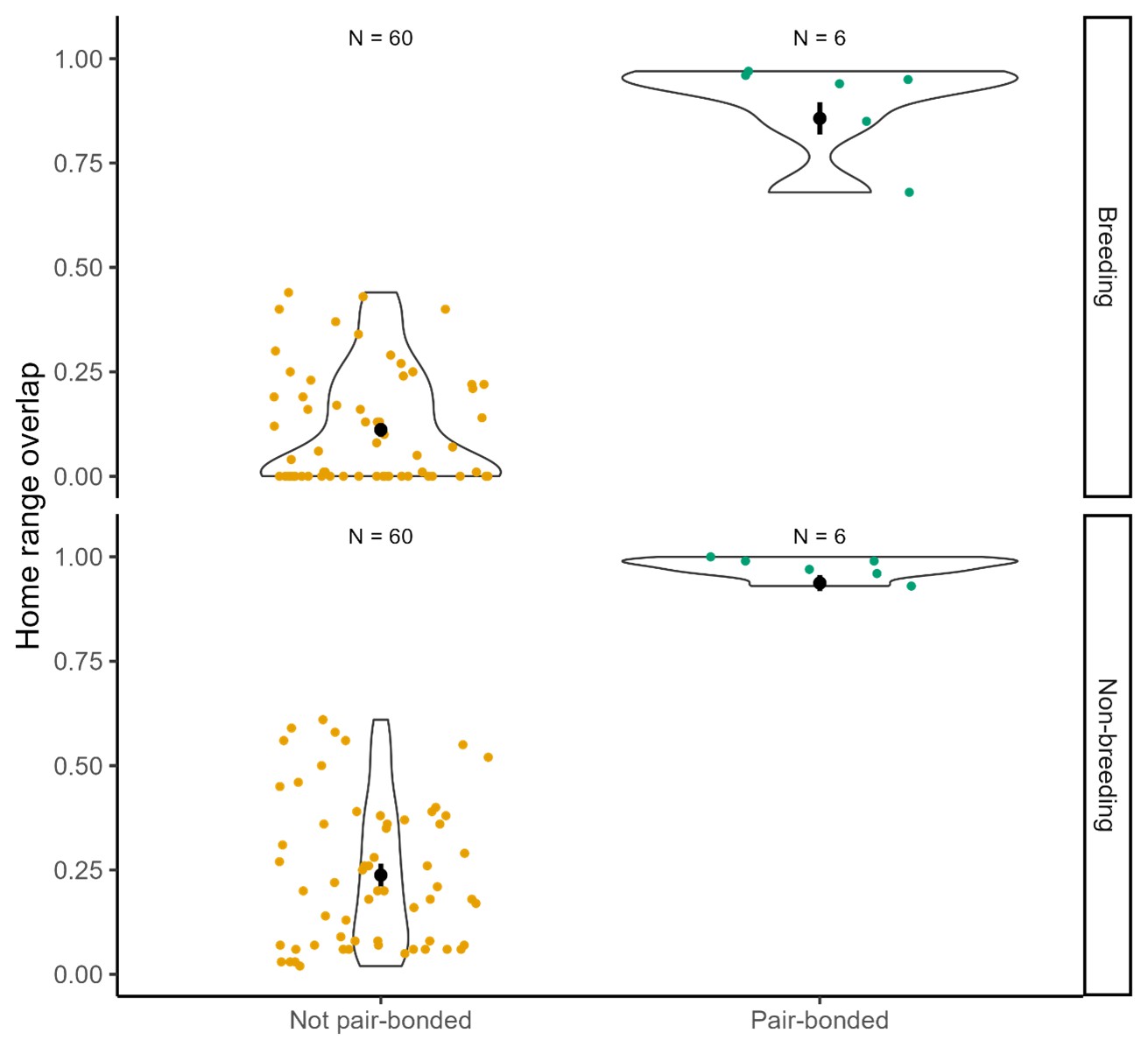 Figure 3. Violin plots of home range overlap (Bhattacharyya coefficient) in pairs of Chirruping Wedgebills (N=66) during the breeding and post-breeding season calculated using the strongest detection method. Pairs are classified as non-pair bonded dyads (orange) and pair-bonded dyads (green). Black dots and lines depict the model prediction ± SE. After Speelman et al., 2025.
What was most intriguing: spatial cohesion partners increased after the breeding season. Specifically, moment-to-moment spatial proximity and following rates increased during the nonreproductive period. They also increased their home ranger after breeding, meaning they stayed together more closely while utilising larger areas. Thus, after the most important moment for cooperation among partners has ceased, i.e. when they reproduce, they seem to more actively invest in staying close to each other.
This study highlights that there is functional importance to the pair bond outside of the breeding period, meaning that there are benefits of being close with your partner beyond effective biparental care.
Benefits beyond breeding
What functions could pair-bonds have besides breeding? There are many aspects of these birds’ lives that could be more effective while cooperating and staying near to a partner. For example, foraging could be more effective when searching efforts and information on food sources are shared. In territorial birds, maintaining and defending the territory is a constant task that requires joint effort. Predator avoidance, too, could be more effective when there is an extra pair of vigilant eyes and ears. Finally, cohesion outside the breeding season could still have reproductive benefits, as close partners may increase their readiness to breed when environmental circumstances improve. This could be especially important in unpredictable areas, such as the arid habitat of the Chirruping Wedgebill.
References
Cockburn, A. 2006. Prevalence of different modes of parental care in birds. Proceedings of the Royal Society B: Biological Sciences 273:1375-1383.VIEW
Griffith, S.C. 2019. Cooperation and Coordination in Socially Monogamous Birds: Moving Away From a Focus on Sexual Conflict. Frontiers in Ecology and Evolution 7:1-15.VIEW
Image credit
Top right & featured image: © Rufus (surname removed for privacy reasons).