



LINKED PAPER Shelters or ecological traps? Context‐dependent effects of nestboxes on breeding success in a colonial raptor. Corregidor‐Castro, A., Berlusconi, A., Cecere, J. G., Cioccarelli, S., Battisti, C. D., Romano, A., Rubolini, D., Pilastro, A. & Morganti, M. (2026) IBIS.VIEW

Artificial breeding structures, such as nestboxes, have become a fundamental aspect of modern bird conservation. In increasingly human dominated landscapes, from agricultural plains to dense urban centres, nestboxes have been transformative: they have improved survival, enhanced resilience and, in some cases, prevented local extinctions (Dulisz et al., 2022). Yet, despite their widespread use, nestboxes are not universally beneficial. In some cases, these artificial structures may attract individuals to suboptimal breeding sites, reducing success compared to natural sites, and resulting in ecological traps (Mänd et al., 2005). Some species can choose whether to use artificial nesting sites, whereas others have no real alternative. When natural breeding sites have been lost or drastically reduced, successful reproduction becomes extremely difficult without human intervention. In these cases, the provision of nestboxes is the only viable solution, making such species heavily dependent on artificial structures: a condition that defines conservation reliant species.
The Lesser Kestrel (Falco naumanni; Figure 1) is a prime example of conservation-reliant species3. This small falcon has lived alongside humans for more than 2,500 years (Negro et al., 2020), nesting in old buildings and hunting in traditional agricultural landscapes, where it finds its prey. But land use intensification and the loss of nesting sites through building renovation have driven dramatic declines, with European populations dropping by more than 95% since the mid 20th century (Aparicio et al., 2023). Nestboxes have played a crucial role in reversing this trend. In Portugal, population growth was increased in a five-fold during the early 2000s thanks to the provisioning of these artificial nesting sites.
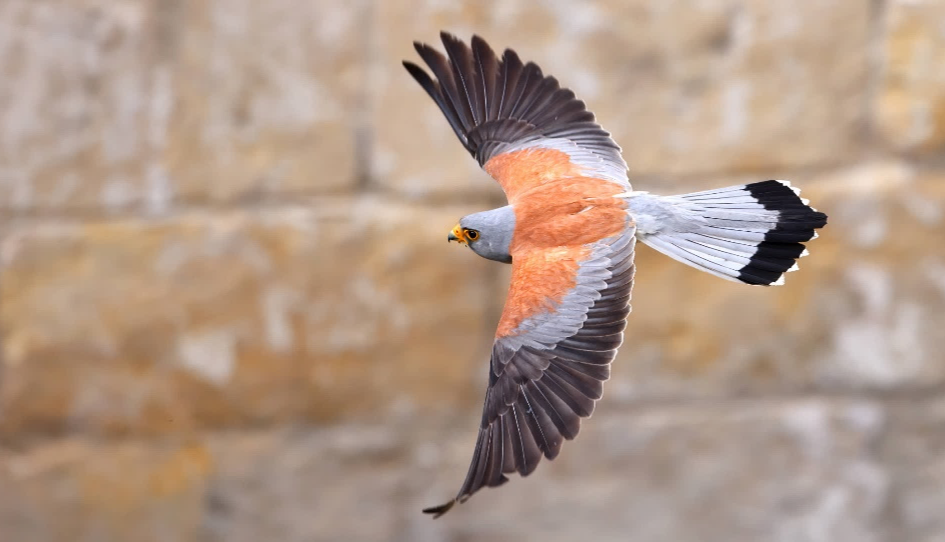 Figure 1. A flying male Lesser Kestrel in the city of Matera © Davorin Tome.
However, new challenges are emerging. Climate change is reshaping the conditions under which nestlings develop, especially in the southern part of the species’ range, where the species is closer to its thermal limit. Lesser Kestrel nestlings are altricial, that is, they are completely dependent on their parents and constrained to the nest conditions, and thus rely entirely on the microclimate of the nest cavity, without the possibility of escaping its conditions. An increase in the number and intensity of extreme high temperatures events (i.e. heatwaves), is driving nest temperature to surpass nestlings’ physiological limits, causing mass mortality even when food is abundant (Corregidor-Castro et al., 2023; 2026). In these contexts, nestboxes may amplify heat stress rather than alleviate it, and its use may be potentially counterproductive if not designed or implemented properly.
To understand how nestbox effectiveness varied across environments, we compared two Italian populations: one in the Po Plain, at the northern edge of the species’ range, and one in Matera, in the much warmer south (Figure 2). Heat related nestling mortality is well documented in Matera, where experimental cooling of nestboxes has been shown to dramatically improve survival. In contrast, such extreme events have not yet been recorded in the Po Plain. We monitored breeding attempts in both natural nests and nestboxes across the two study areas (Figure 2). For every nest, we recorded occupancy patterns, clutch size and hatching success, allowing us to evaluate breeding performance and survival throughout the nestling period, as well as nestling survival.
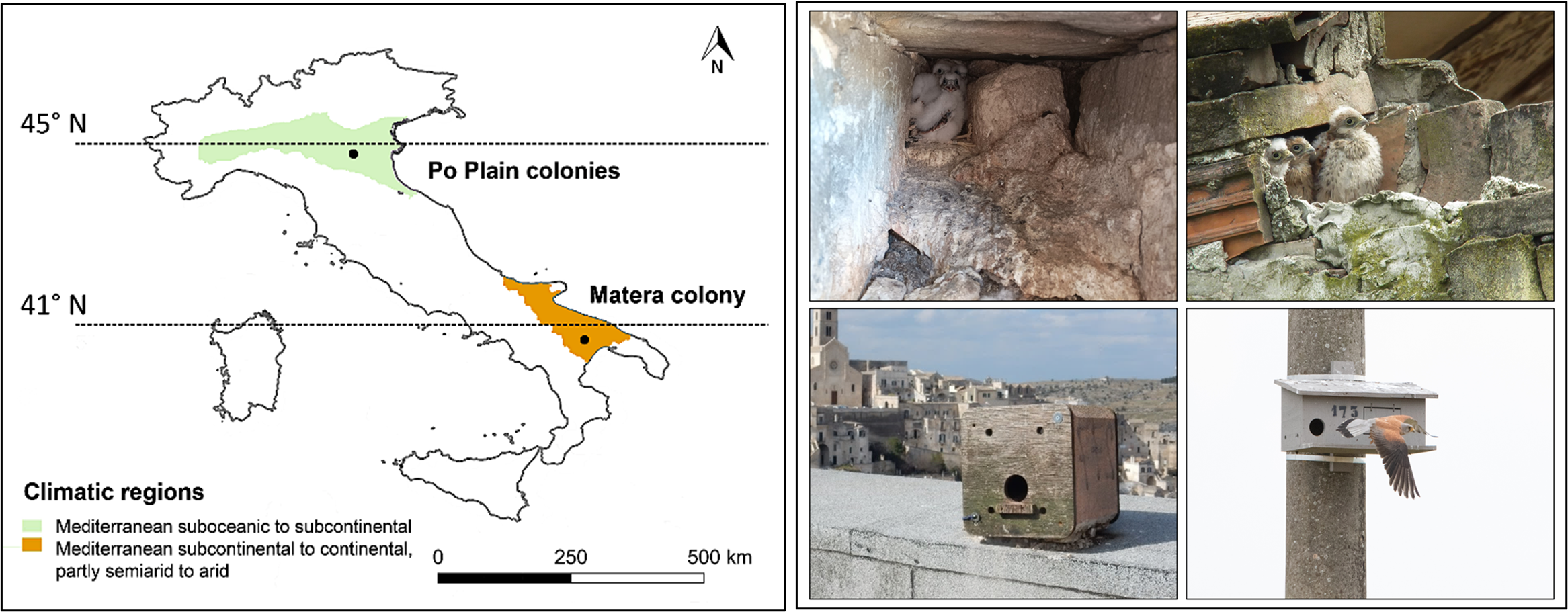 Figure 2. Left: study areas in the Italian peninsula. Right: natural nest (top) and nestboxes (bottom) used by Lesser Kestrels.
Breeding parameters did not differ between nest types. However, we found a striking contrasting pattern regarding nestling survival among study areas (Figure 3). In the Po Plain, nestlings were more likely to fledge from nestboxes in 96% of cases, compared to only 44% in natural nests. In Matera, the pattern was reversed: nestling survival in natural nests reached 92% compared to 45% in nestboxes. These contrasting outcomes highlight a key ecological truth: not everything works everywhere. In Matera, cooler natural cavities buffer extreme heat, while predation, both in natural nests and nestboxes, is low due to colony structure and nest disposition (in closed building roofs). In the Po Plain, where temperatures remain moderate, nestboxes reduce predation risk and provide stable conditions that natural nests often lack.
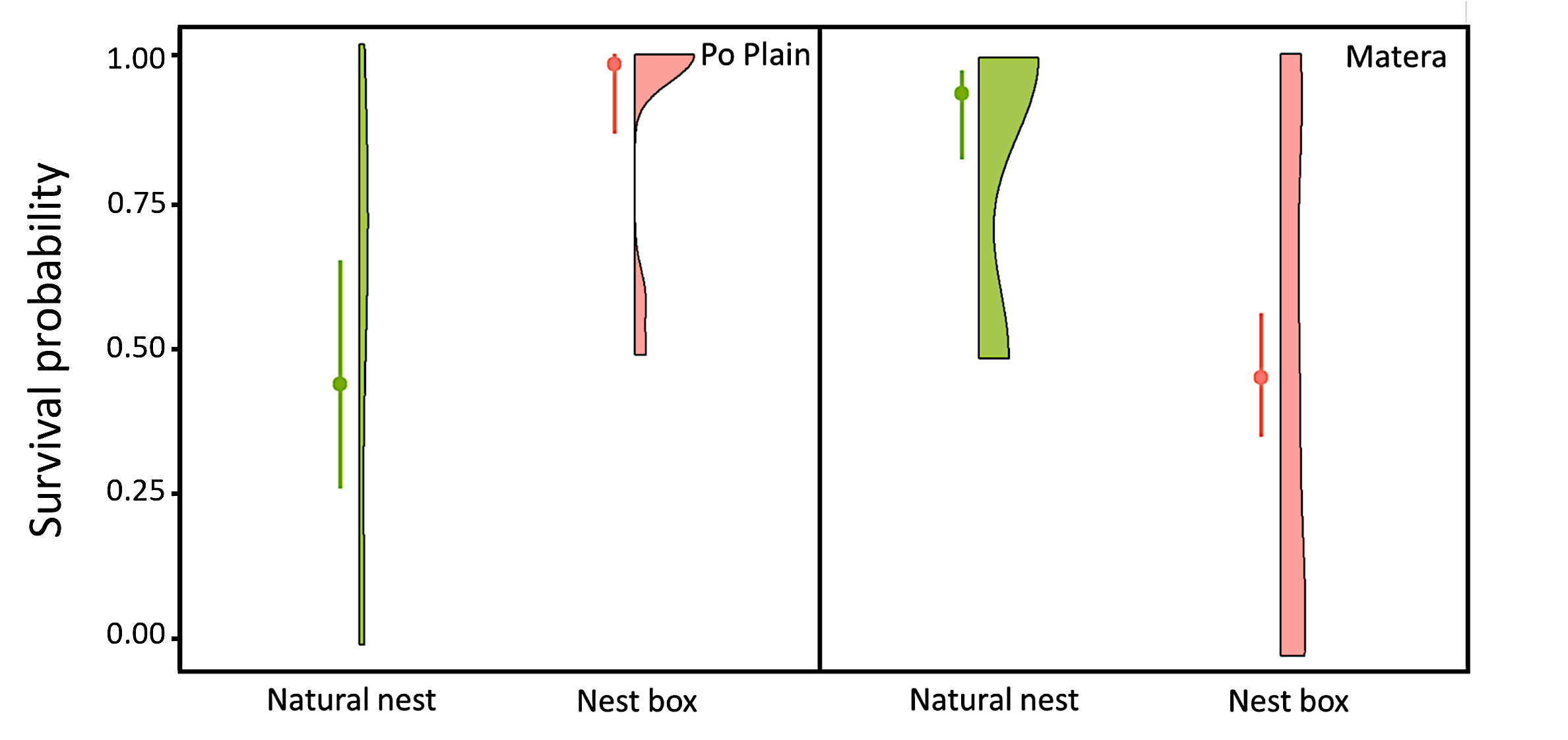 Figure 3. Contrasting patterns of estimated nestling probability of survival (95% CI) in natural nests (green) and nestboxes (red) in the Po Plain (left) and Matera (right). Violin plots represent the distribution of the proportion of surviving nestlings per nest.
Our findings show that the value of nestboxes is deeply context-dependent. In warm regions such as Matera, current nestbox designs may inadvertently function as ecological traps by intensifying heat stress during extreme weather events. In more temperate areas like the Po Plain, even basic nestboxes can enhance reproductive success by offering safer, more stable breeding sites. This means that nestbox design, placement, and materials must be reconsidered in light of local climate and future warming scenarios. Features such as insulation, ventilation, and cavity size could substantially reduce heat exposure and improve nestling condition.
As climate change accelerates, conservation strategies must become more flexible and site specific. Nestboxes remain a powerful tool, but only when matched to the environmental realities of each population. Incorporating projections of extreme weather events, not just mean temperature, will be essential to ensure that these structures continue to support, rather than undermine, the species they are meant to protect.
References
Dulisz, B., Stawicka, A.M., Knozowski, P., Diserens, T.A., & Nowakowski, J.J. 2022. Effectiveness of using nest boxes as a form of bird protection after building modernization. Biodiversity and Conservation 31:277-294.VIEW
Mänd, R., Tilgar, V., Lõhmus, A., Leivits & Agu. 2005. Providing nest boxes for hole-nesting birds – Does habitat matter? Biodiversity and Conservation 14:1823-1840.VIEW
Negro, J.J., Prenda, J., Ferrero, J.J., Rodríguez, A. & Reig-Ferrer, A.. 2020. A timeline for the urbanization of wild birds: The case of the lesser kestrel. Quaternary Science Reviews 249:106638.VIEW
Aparicio, J.M., Muñoz, A., Cordero, P.J. & Bonal, R. 2023. Causes of the recent decline of a Lesser Kestrel (Falco naumanni) population under an enhanced conservation scenario. IBIS 165:388-402.VIEW
Corregidor-Castro, A., Morinay, J., McKinlay, S.E., Ramellini, S., Assandri, G., Bazzi, G., Glavaschi, A., De Capua, E.L., Grapputo, A., Romano, A., et al. 2023. Experimental nest cooling reveals dramatic effects of heatwaves on reproduction in a Mediterranean bird of prey. Global Change Biology 29:5552-5567.VIEW
Corregidor-Castro, A., Berlusconi, A., Figus, E., Kyriakopoulou, A., Cecere, J.G., Morganti, M., Rubolini, D., Pilastro, A. & Romano, A. 2026. Extra food buffers thermoregulatory costs during early development but does not reduce heatwave-induced mortality in nestlings of a cavity-nesting raptor. Journal of Thermal Biology 135:104361.VIEW
Image credit
Top right and featured image: A female Lesser Kestrel perched on a stone © Sumeet Moghe | CC BY-SA 4.0 Wikimedia Commons