



LINKED PAPER  Modelling migration dynamics of Common Cranes and Eurasian Spoonbills as hydrological flow. Drever, M.C., Bautista-Sopelana, L.M., Alonso, J.C., Navedo, J.G. & Hrachowitz, M. 2025. IBIS. DOI: 10.1111/ibi.13424 VIEW
Each year, billions of birds migrate across vast landscapes, stopping briefly at critical stopover sites to rest and refuel. For ornithologists, understanding how birds use these sites is essential. But studying bird migration isn’t always easy to measure – birds arrive and depart unpredictably, and direct tracking of individuals can be logistically and financially challenging.
What if we could model bird migration like we model water flowing through a reservoir? Hydrological flow models used in water engineering – to describe how water enters, accumulates in, and exits a reservoir — have a long history since the 1500s when Leonardo da Vinci began measuring the velocity of water varied in different parts of riverbanks.
Turning birds into “flow”
We adapted this concept to treat bird migration like the flow of water: birds “flow” into a stopover site, stay for a period, and then “flow” out. The “water level” or storage represents daily bird counts, and transit time reflects how long birds stay at the stopover site. With this approach, we can estimate stopover behaviour with surprising accuracy — even from relatively simple count data.
This approach allowed us to estimate:
- Inflow and outflow of migrants
- Length of stay (LOS) or transit time
- Total number of individuals passing through a site during migration
The model is a Monte Carlo-based hydrological flow model that uses daily bird counts and their changes over time steps in a series (‘net flow’) as basic inputs to estimate arrival and departure patterns, and it can be adapted depending on what other information on LOS is available. The model is calibrated using historical count data and independent estimates of length of stay, allowing us to simulate millions of potential migration scenarios and identify the most likely transit times and passage population sizes. And no waterproof notebooks required!
We first tested this approach with small shorebirds on the Pacific Coast of North America (Drever and Hrachowitz, 2017), and then adapted it to model migration of two familiar wetland species in Europe: the Common Crane (Grus grus) and the Eurasian Spoonbill (Platalea leucorodia), both at key Spanish stopover sites.
Common Cranes at Gallocanta
The Common Crane is one of Europe’s most striking migratory birds — tall, elegant, and known for its trumpeting calls and group dances. These performances, a mix of bowing, leaping, and tossing tufts of vegetation, are part courtship, part bonding ritual, and probably one of the more graceful spectacles in the bird world.
 Figure 1. Common Crane (Grus grus) at Gallocanta Nature Reserve, Spain. © Carlos Palacín
We focused on their northward migration through Gallocanta Nature Reserve, using daily counts from 1984–85 to calibrate the model. The average LOS in that period was 6.5 days. We then applied the model to counts from 2015 to 2017, a period when crane numbers had grown substantially relative to the 1980s.
The model predicted:
- A relatively shorter mean transit time of 5.2 days
- A ~6-fold increase in the total number of birds (‘passage population’) migrating through the site
These results align well with known population trends: the Western European crane population has expanded significantly in recent decades, and Gallocanta remains a major staging area.
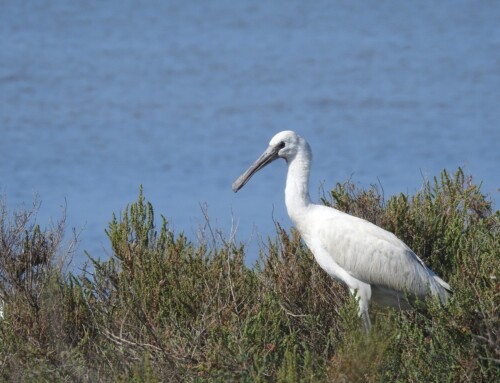
Spoonbills along the northern coast
 Figure 2. Eurasian Spoonbills (Platalea leucorodia) foraging at Santoña Marshes National Park, Spain. © Máximo Sánchez Cobo
We also looked at Eurasian Spoonbills during southward migration, using data from two sites, Urdaibai Biosphere Reserve and Santoña Marshes Natural Park, collected from 2002 to 2005.
Spoonbills are instantly recognizable by their long, spoon-shaped bills, which they sweep side-to-side through the water to catch prey. They’re among the few birds that feed by touch rather than sight, a particularly useful adaptation when working through muddy estuaries.
Our model showed that migration behavior differed between the two sites with a median LOS of 1.1 days at Urdaibai, and a median LOS of 2.1 days at Santoña.
Spoonbills moved through quickly, though clearly with differences between sites — perhaps reflecting food availability, local conditions, or social factors. Interestingly, for both cranes and spoonbills, we found that length of stay decreased as population size increased. In other words, when more birds were present, individuals didn’t hang about.
This pattern suggests that stopover duration is flexible, likely influenced by competition for space or resources — a reminder that birds, like humans, may prefer a bit more room to stretch their legs.
Why does this matter?
Stopover sites are crucial nodes in the migratory network. Having a simple flexible model that integrates observations of abundance, length of stay, and total passage populations can help us fill in the data gaps about how bird use of a site has changed over time.
Our study shows that hydrological flow models, even when built from basic count data, can provide insights into these dynamics. They’re particularly useful for species that congregate in large numbers and are monitored regularly during migration.
A new tool for migration ecology
Hydrological models won’t replace tracking devices or direct observations of flagged birds, but they offer a valuable complement to those methods. By modelling migration as a flow, we gain access to questions that would otherwise be difficult to answer.
Our results suggest that length of stay is not a fixed trait, but a dynamic decision, shaped by both individual behaviour and broader population pressures. In both crane and spoonbill migrations, stopover duration appears to respond to how crowded the site is — a finding that has implications for how we interpret count data and manage stopover habitats.
References
Drever, M.C. & Hrachowitz, M. 2017. Migration as flow: using hydrological concepts to estimate the residence time of migrating birds from the daily counts. Methods in Ecology and Evolution, 8: 1146–1157.
Image credit
Top right: Common Cranes | Prasan Shrestha CC BY-SA 4.0 Wikimedia Commons