



Report from a BOU Summer Placement Bursary
This year I had the opportunity to monitor the populations of Black-legged Kittiwakes (Rissa tridactyla) and Northern Fulmars (Fulmarus glacialis) at a remote nesting site in East Iceland. The project is widely a continuation of a long-term dataset that undergraduates from the University of Glasgow set up in 2009 at Skálanes Nature and Heritage Centre. Each year since, students have returned to the colony for six weeks over June/July to track the breeding success and population changes within the colony. Whilst kittiwakes and fulmars may be globally declining due to increasing anthropogenic pressures (Frederiksen et al., 2004; Mallory et al., 2020), this colony may be an outlier. Over the past eleven years, it has shown significant growth, making it an ecologically important site to understand and monitor.
Therefore, the project aimed to continue the long-term population monitoring, as well as track breeding success and map nest locations across the colony. It also sought to identify thermal variation across the cliff face and analyse individual behaviour to assess potential signs of heat stress.
Data Collection
To get population counts over the six weeks, every three days (weather permitting) myself and a peer headed to the colony and counted each kittiwake and fulmar on the cliff. With approximately 1300 birds, the cliff was divided into twelve, defined by the natural ridges and markings in the rock face. Individuals were then counted independently using binoculars for each transect. When the numbers differed, we recounted, and if differences persisted, the counts were averaged.
 Figure 1. The colony cliff site at Skálanes Nature and Heritage Centre, divided into 12 for ease of counting © Anya Shackleton-Jones.
At the start of the field work, we used a telephoto lens to capture a series of high-resolution photos that together provided a complete view of the active nests this year. These images were then overlaid onto a full-cliff photograph in QGIS. Using an arbitrary pixel coordinate system, each nest was mapped to its precise location on the cliff face. This baseline map was then compared to maps from previous years to identify which nests had been repeatedly occupied across multiple seasons. Any new nests were added to the dataset and assigned new identifiers.
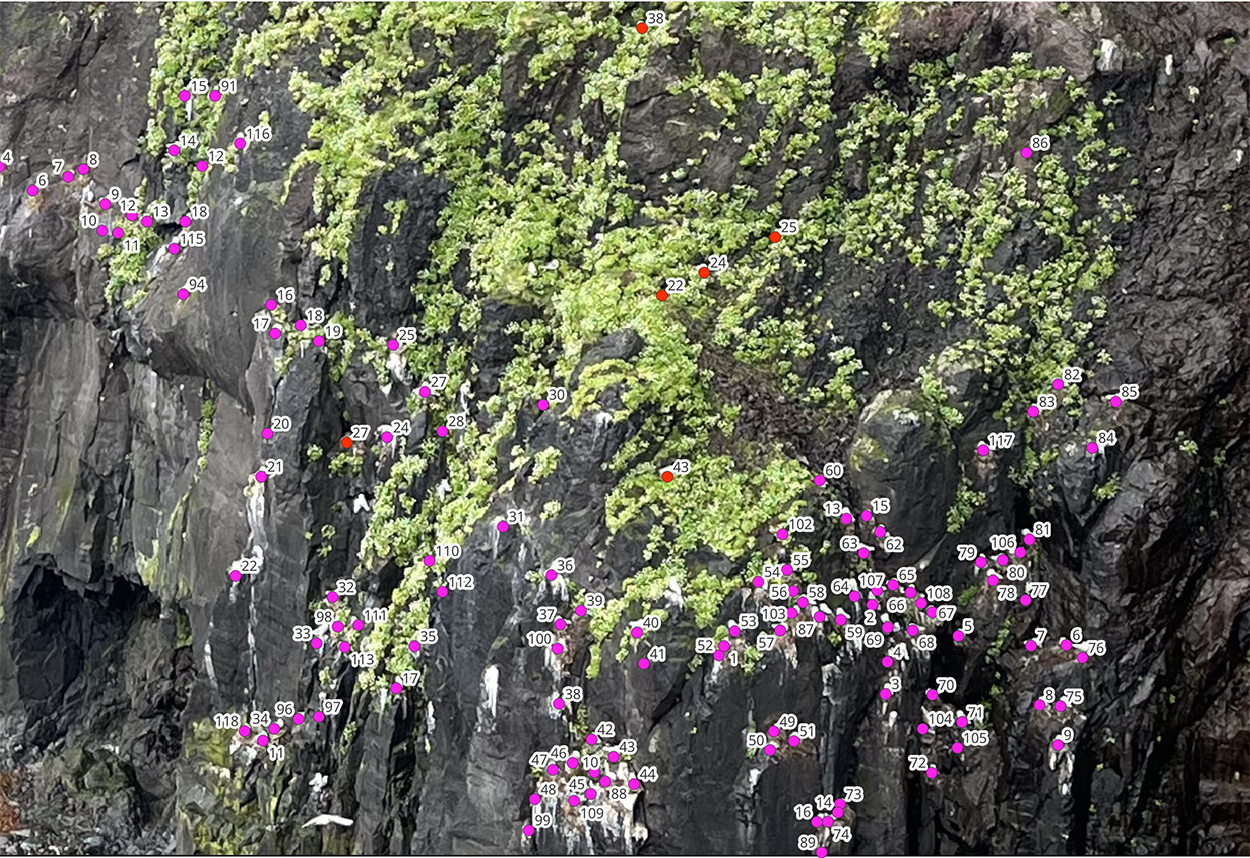 Figure 2. Example of bottom right section of the GIS map of kittiwake (pink) and fulmar nests (red) © Anya Shackleton-Jones.
Every three days, we then captured an additional full series of photographs, allowing us to record the number of individuals occupying each mapped nest and the number of kittiwake chicks. Fulmar chicks were not recorded, since their later hatching period extended beyond our six-week field season.
 Figure 3. Kittiwake nest and chick © Aubrey Small.
Additionally, we used thermal imagery to identify temperature variation across the cliff to better understand nest site selection and potential differences in breeding success between areas of the colony. We also conducted behavioural observations of nesting kittiwakes. This involved documenting heat-stress behaviours such as panting, wing drooping, and altered posture, which may be early indicators of increased rates of nest abandonment and breeding failure under higher temperatures (Olin et al., 2023).
Preliminary Results
Later, analysis of the population counts indicated that kittiwake numbers had increased by 34 individuals, whereas fulmar counts had decreased by 40 compared with the previous year. I hypothesise that the decline in fulmars may not reflect a true reduction in their population. Instead, the unusually early vegetation growth following the May 2025 heatwave likely reduced the visibility of fulmar nest sites. Fulmars tend to nest within grassy vegetated areas, making them harder to detect when vegetation is dense, while kittiwakes generally nest on exposed cliff faces where individuals remain more visible.
 Figure 4. Maximum population counts of Northern Fulmars and Black-legged Kittiwakes from 2014-2025. Counts were collected in June at Skálanes cliff colony, East Iceland. 2020 is absent due to the COVID-19 pandemic.
Analysis also showed a gradual decline in kittiwakes and fulmars over the study period. For kittiwakes, this may be attributed to increased time spent foraging to meet the elevated energetic demands of their chicks (Colominas-Ciuró et al., 2022). For fulmars, which were likely incubating during the later part of data collection (Falk & Møller, 1997), the decline in counts is harder to interpret. Poor weather between days 18–23 caused a drop in numbers that did not recover, suggesting possible nest abandonment. This contrasts with findings from last year’s report, where an early June storm led to a temporary decline in numbers but quick recover, possibly because fulmars had not yet begun incubation.
 Figure 5. Population counts of Northern Fulmars and Black-legged Kittiwakes from across June and early July at Skálanes cliff colony, East Iceland.
The behavioural observations indicated that heat-stress behaviours in nesting kittiwakes were only recorded on the two warmest days of the six-week study period. The site is strongly wind-exposed and north-facing, receiving little direct sunlight, which likely reduced overall heat stress, and contributes to the localised success of this population. Temperature variation across the cliff was minimal, with the coolest areas located near small water outflows. These cooler sections were more densely occupied, however, during periods of heavy rain, nests closest to the inflows were prone to flooding and subsequent abandonment. This indicates a potential trade-off in nest site selection between cooler microclimates and increased flood risk. Additionally, breeding success appeared lower in nests located toward the bottom of the cliff, although further analysis is needed to determine the strength of this effect.
Overall, early results suggest that the colony’s success reflects a balance between local microclimate, nest site choice, and weather conditions. Kittiwakes appear largely buffered from heat stress by the exposed, North-facing conditions, while fulmars may be more sensitive to timing and disturbance during incubation. As global seabird populations decline, continued monitoring of this site remains important for understanding why some colonies persist under changing environmental pressures.
For more information on the long-term trends of this colony, please see the full report written last year, where I modelled and discussed variation in yearly population trends against annual climatological changes. VIEW
Acknowledgements
I want to thank Catherine and Felix, who also undertook the project alongside me, and owner of Ólafur Örn Pétursson, director of Skálanes, for his unwavering kindness and support with the project. Additionally, I would like to give thanks to the projects supervisor, Dr. Ruedi Nager, for all the academic guidance. Finally I would like to convey my deepest gratitude to BOU for the opportunity to carry out this project, whose funding allowed the project to go ahead.
References
Colominas-Ciuró, R., Cianchetti-Benedetti, M., Michel, L., Dell’Omo, G., & Quillfeldt, P. 2022. Foraging strategies and physiological status of a marine top predator differ during breeding stages. Comparative Biochemistry and Physiology Part A: Molecular & Integrative Physiology 263:111094.VIEW
Falk, K., & Møller, S. 1997. Breeding ecology of the Fulmar Fulmarus glacialis and the Kittiwake Rissa tridactyla in high-Arctic northeastern Greenland, 1993Ibis 139 (2):270-281.
Frederiksen, M., Wanless, S., Harris, M.P., Rothery, P. and Wilson, L.J. 2004. The role of industrial fisheries and oceanographic change in the decline of North Sea black‐legged kittiwakes.Journal of Applied Ecology 41:1129-1139.VIEW
Mallory, M. L., Dey, C. J., McIntyre, J., Pratte, I., Mallory, C. L., Francis, C. M., Black, A. L., Geoffroy, C., Dickson, R., & Provencher, J. F. 2020. Long-term declines in the size of Northern Fulmar (Fulmarus glacialis) colonies on eastern Baffin Island, Canada.Arctic 73(2):187-194.VIEW
Olin, Agnes & Dück, L & Berglund, Per-Arvid & Karlsson, E & Bohm, M & Olsson, Olof & Hentati-Sundberg, Jonas. 2023. Breeding failures and reduced nest attendance in response to heat stress in a high-latitude seabird. Marine Ecology Progress Series.VIEW
Image credit
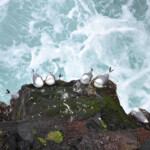
Top right: Nesting kittiwakes © Aubrey Small.