




LINKED PAPER
Variation in mesopredator abundance and nest predation rate of the endangered Strange-tailed Tyrant (Alectrurus risora). Browne, M., Pasian, C., Di Giacomo, A. G., Di Bitetti, M, S, Di Giacomo, A. S. 2023. IBIS. DOI: 10.1111/ibi.13202. VIEW
The global or local extinction of a species is not only usually a bad thing in its own right, but almost invariably has knock-on effects on other species and habitats. For example, the ‘mesopredator release hypothesis’ states that the decline or extinction of top predator populations may trigger an increase in mesopredator abundance (Soulé et al. 1988, Crooks & Soulé 1999). This can then lead to an increase in predation rate on their prey, potentially resulting in prey population declines and further extinctions, which can have further consequences for ecosystems, and so on.
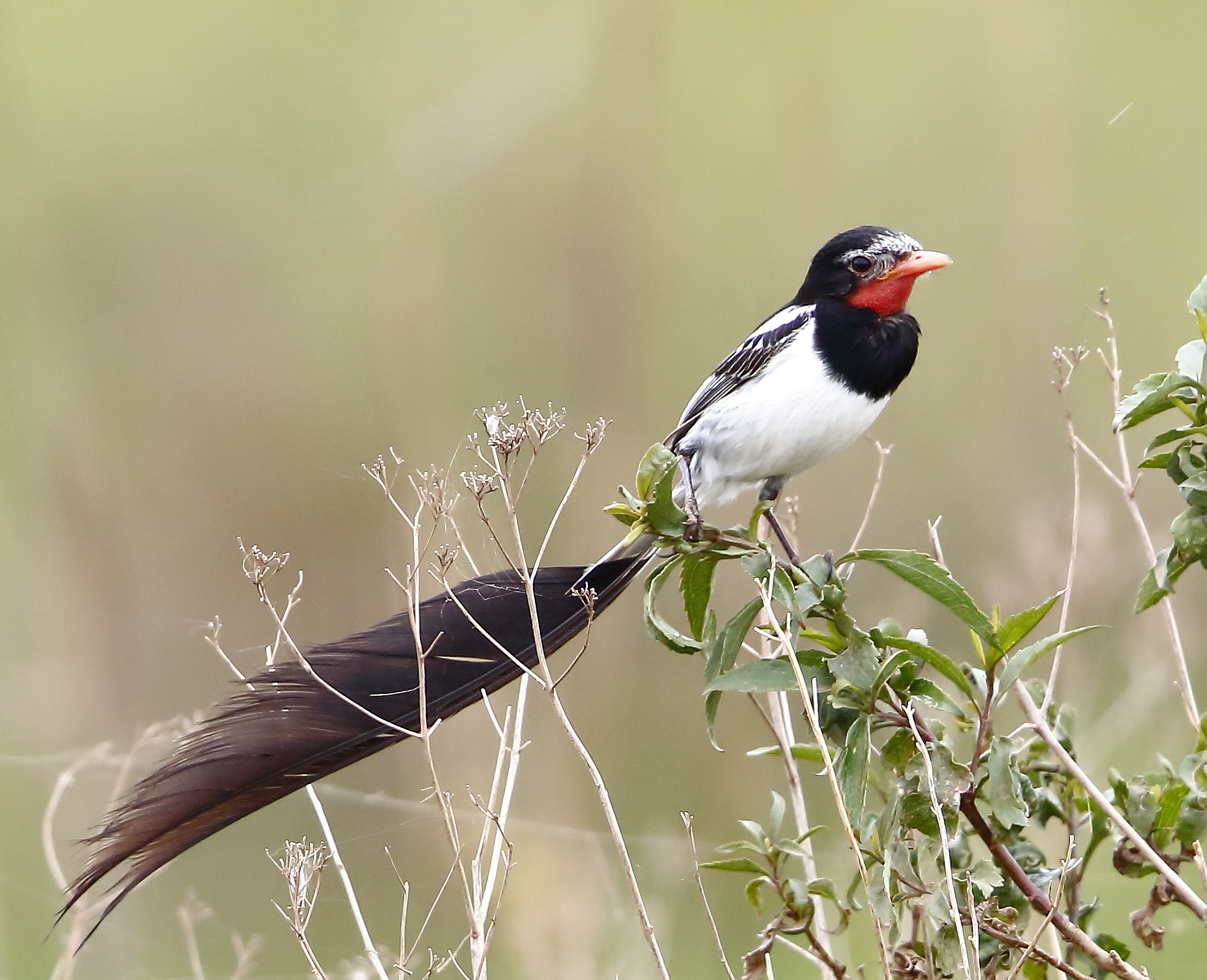
In a recent study in Ibis, Melanie Browne and colleagues evaluated whether nest predator abundance and breeding traits of an endangered grassland bird, the Strange-tailed Tyrant (Alectrurus risora) differed depending on whether top predators were absent or present.
Nest predation
The Strange-tailed Tyrant is a globally Vulnerable endemic grassland species that occurs primarily in northeastern Argentina and southeastern Paraguay (BirdLife International 2016). Nest predation is the main cause of nest failure in many passerine birds, and is thought to regulate multiple breeding traits, but is also modulated itself by nest predator community composition and predator abundance (Schmidt 2003, Roos et al. 2018). To evaluate if differences in the breeding biology of the Strange-tailed Tyrant in grasslands of high conservation value are associated with differences in predator abundance and predation rate, the researchers compared two study sites, both of which were protected areas, during the 2015-2018 breeding seasons. In Iberá National Park (INP), Jaguars (Panthera onca) have been extinct for over 50 years and Pumas (Puma concolor) are mostly absent or extremely rare, hence top predators can be considered to be absent. In the Reserva El Bagual (REB), Pumas still have a stable population and Jaguars are rare but present, hence top predators can be considered to be present.
The researchers evaluated differences in the abundance of potential nest predators in both sites, and compared the breeding biology of the Strange-tailed Tyrant to determine whether its breeding phenology, breeding parameters, nest predation rate, daily nest survival rate, and nest concealment differed between them.

Figure 1. Location of the study sites, Portal San Nicolás (Iberá National Park, INP), located in the province of Corrientes, and Reserva El Bagual (REB), located in the province of Formosa, northeastern Argentina.
Mesopredator release hypothesis
The results showed that the frequency of fox (Crab-eating Fox Cerdocyon thous and Pampas Fox Lycalopex gymnocercus) records was 10x higher in INP, where top predators were absent, than in REB, where top predators were present, and that foxes were the main nest predators of the Strange-tailed Tyrant. While this is in accordance with the mesopredator release hypothesis, the increased fox abundance in INP could be driven by differences in food availability or habitat quality, and further studies are needed to confirm if this is the case.
While the findings showed no differences in clutch size, hatching success, or fledgling production between sites, Strange-tailed Tyrants were shown to have an earlier breeding peak and shorter breeding season in INP compared to REB, i.e. a more synchronised breeding pattern. Breeding synchronisation has been hypothesised to dilute predation pressure (Verhulst & Nilsson 2008), hence this may be an adaptive response to the increased nest predator abundance and nest predation rate.

Figure 2. Percentage of nest attempts by female Strange-tailed Tyrants during the breeding seasons of 2015–2018 in Reserva El Bagual (REB) and Iberá National Park (INP, n = 270 nests), Argentina. Error bars are standard errors.
The nest predation rate was found to be higher in INP than in REB, and overall breeding success of Strange-tailed Tyrants was low. While reduced clutch sizes and increased breeding attempts may be favoured to maximise breeding success when predation rates are high (Roper et al. 2010), the shorter breeding season in INP may have meant females had fewer renesting opportunities than in REB. Accurately evaluating the impact of the increased nest predation rate on the population would require further studies considering multiple breeding attempts, clutch replacement, and genetic variation.
Other findings showed that nest survival and nest predation rate were both modulated by nest age, in accordance with the expected increase in predation rate as nest activity increases (Skutch 1949), and that nest predation rate varied between study sites and was dependent on time of breeding. Although nest predation rates differed between the sites, nest survival did not, which could be due to a higher nest abandonment rate observed in REB. A higher raptor abundance was detected in REB which could explain the higher nest abandonment rate, as a potential cause of nest abandonment is adult predation by raptors. Nest flooding has also previously been reported to be the main cause of abandonment in REB but was not observed in INP (Di Giacomo et al. 2011).

Figure 3. Variation in daily nest predation rate of Strange-tailed Tyrant nests during (a) incubation and (b) nestling stage in the presence/absence of top predators in Reserva El Bagual (REB) and Iberá National Park (INP), respectively, throughout the breeding seasons of 2015–2018 (n = 246 nests), Argentina. Solid lines are mean nest predation rate values; dashed lines are standard error values.
Given the finding of a relatively low breeding success of the Strange-tailed Tyrant in protected areas, the researchers suggest that a population viability model would be useful to better orientate conservation efforts. Mitigation strategies such as the reintroduction of top predators into protected areas could potentially have beneficial impacts on the Strange-tailed Tyrant and other threatened bird species facing high levels of nest predation.
References
BirdLife International. (2016). Alectrurus risora. The IUCN Red List of Threatened Species 2016. e.T2270030 3A93768087. VIEW
Crooks, K.R. & Soulé, M.E. (1999). Mesopredator release and avifaunal extinctions in a fragmented system. Nature 400: 563–566. VIEW
Di Giacomo, A.S., Di Giacomo, A.G. & Reboreda, J.C. (2011). Male and female reproductive success in a threatened polygynous species: The strange-tailed tyrant, Alectrurus risora. Condor 113: 619–628. VIEW
Roos, S., Smart, J., Gibbons, D.W. & Wilson, J.D. (2018). A review of predation as a limiting factor for bird populations in mesopredator-rich landscapes: A case study of the UK. Biological Reviews 93: 1915–1937. VIEW
Roper, J.J., Sullivan, K.A. & Ricklefs, R.E. (2010). Avoid nest predation when predation rates are low, and other lessons: Testing the tropical–temperate nest predation paradigm. Oikos 119: 719–729. VIEW
Schmidt, K.A. (2003). Nest predation and population declines in Illinois songbirds: A case for mesopredator effects. Conservation Biology 17: 1141–1150. VIEW
Skutch, A.F. (1949). Do tropical birds rear as many young as they can nourish? Ibis 91: 430–455. VIEW
Soulé, M.E., Bolger, D.T., Alberts, A.C., Wrights, J., Sorice, M. & Hill, S. (1988). Reconstructed dynamics of rapid extinctions of chaparral-requiring birds in urban habitat islands. Conservation Biology 2: 75–92. VIEW
Image credits
Top right: Strange-tailed Tyrant (male) at Iberá marshes – Corrientes – Argentina | Hector Bottai | CC BY-SA 4.0 Wikimedia Commons
Blog posts express the views of the individual author(s) and not those of the BOU.
If you want to write about your research in #theBOUblog, then please see here