





LINKED PAPER Individual identification and confirmation of nest site fidelity in Painted Stork (Mycteria leucocephala) using deep transfer learning. Urfi, A.J., Mahendiran, M., Parthiban, M. & Ahmed, P. (2026) I. R. Soc. Open Sci.VIEW
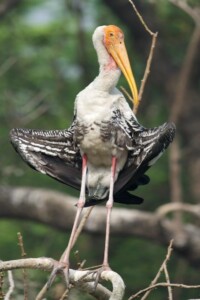
A wild population of Painted Stork nesting since 1960 in the ponds of Delhi Zoo in India’s capital, New Delhi, has been the subject of our sustained research for several decades (Urfi, 2024). A male stork, with distinct markings on its throat- most probably caused due to a kite string injury, was sighted at the beginning of the nesting season in August 2022 (Figure 1) and also subsequently in 2023, 2024 and 2025.
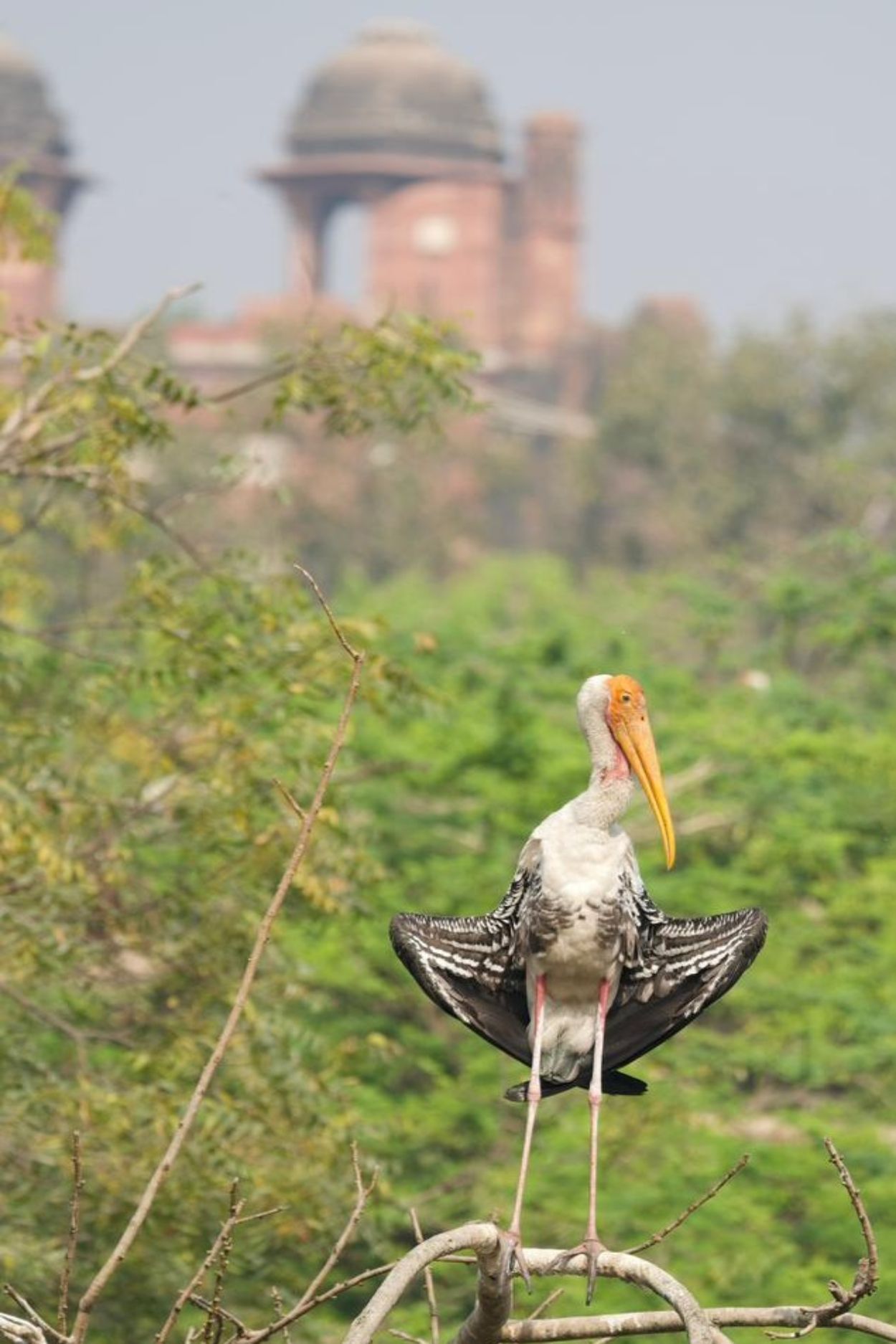 Figure 1. Painted Stork “Ringo” in the Delhi zoo with the ramparts of old Fort visible in the background. Note the gash on the throat © Paritosh Ahmed.
There is accumulating evidence that in many bird species, individuals exhibit nest-site fidelity, in that individuals tend to return to the same site for nesting year after year (Belda et. al, 2007; Brown et.al., 2017). While the repeated sighting of a Painted Stork in four successive breeding seasons at the same site is strongly suggestive of nest-site fidelity, what if it were not the same bird? Injury markings can heal. Other individuals can also have similar slit throats to the one we encountered in Delhi Zoo. We needed to be sure!
While ringing or some form of marking would have been ideal, and indeed the simplest solution for keeping track of an individual, this can be problematic – any trapping activity, particularly during nesting season, could potentially cause a bird to abandon its nest site, as they are very shy. Secondly, tagging birds subjects them to inevitable stress, although this is seldom fatal. Thirdly, it is difficult to obtain permits for such work, especially in India. Therefore, we reckoned that using non-invasive methods was the best way to get an answer.
Interestingly, the sex of the Painted Stork in question turned out to be male- and a very dominant male too. Since it was becoming cumbersome to refer to it as the ‘slit throat bird’ or ‘Mr. Cut throat’, we decided to give it a name. All four of the authors, spanning from boomer to millennial, are huge Beatles fans – so we decided to name the bird ‘Ringo’, in honour of the legendary Beatles drummer, Ringo Starr.
We took a large number of photos of ‘Ringo’ in all the years mentioned above and used morphometrics and deep transfer learning methods (Schneider et al., 2019; Christin et al., 2019; Mahendiran et al., 2018, 2022) to establish that it was indeed the same individual. Deep transfer learning is a modern machine learning technique in which a model trained on a given task is adapted by changing certain key outputs to perform a different task, without any further training from scratch. Training an Artificial Intelligence (AI) model from scratch always takes a huge amount of time and energy, which is often the domain of specialists. By contrast, the transfer learning approach is quite user-friendly for multidisciplinary researchers who apply it in their work.
We used the ResNet-50 model, a deep learning model pre-trained on large datasets. We fine-tuned it on photos of the individual, Ringo, and other Painted Storks to develop PsScarNet, a model for Ringo identification. We also employed the Gradient-weighted Class Activation Mapping (Grad-CAM) technique for an in-depth analysis to demonstrate how the model, PsScarNet, distinguishes between Ringo and non-Ringo storks. As of now, PsScarNet’s ability to identify Ringo has been standardised, which is a limited ambition in terms of model function. Nevertheless, as the day goes on, the model’s abilities can be developed: achieving unlimited alternative identifications, such as to answer mate selection and mate fidelity questions, is not far off.
At Delhi Zoo, the Painted Stork build their nests in the canopies of trees planted on islands in the ponds. The interesting thing was that Ringo built its nest in the same canopy every year – the same patch, so to speak, in a particular pond (Figure 2). In all the years we have been monitoring Ringo, this bird has mated successfully and raised chicks, all of which survived till the end of the nesting season.
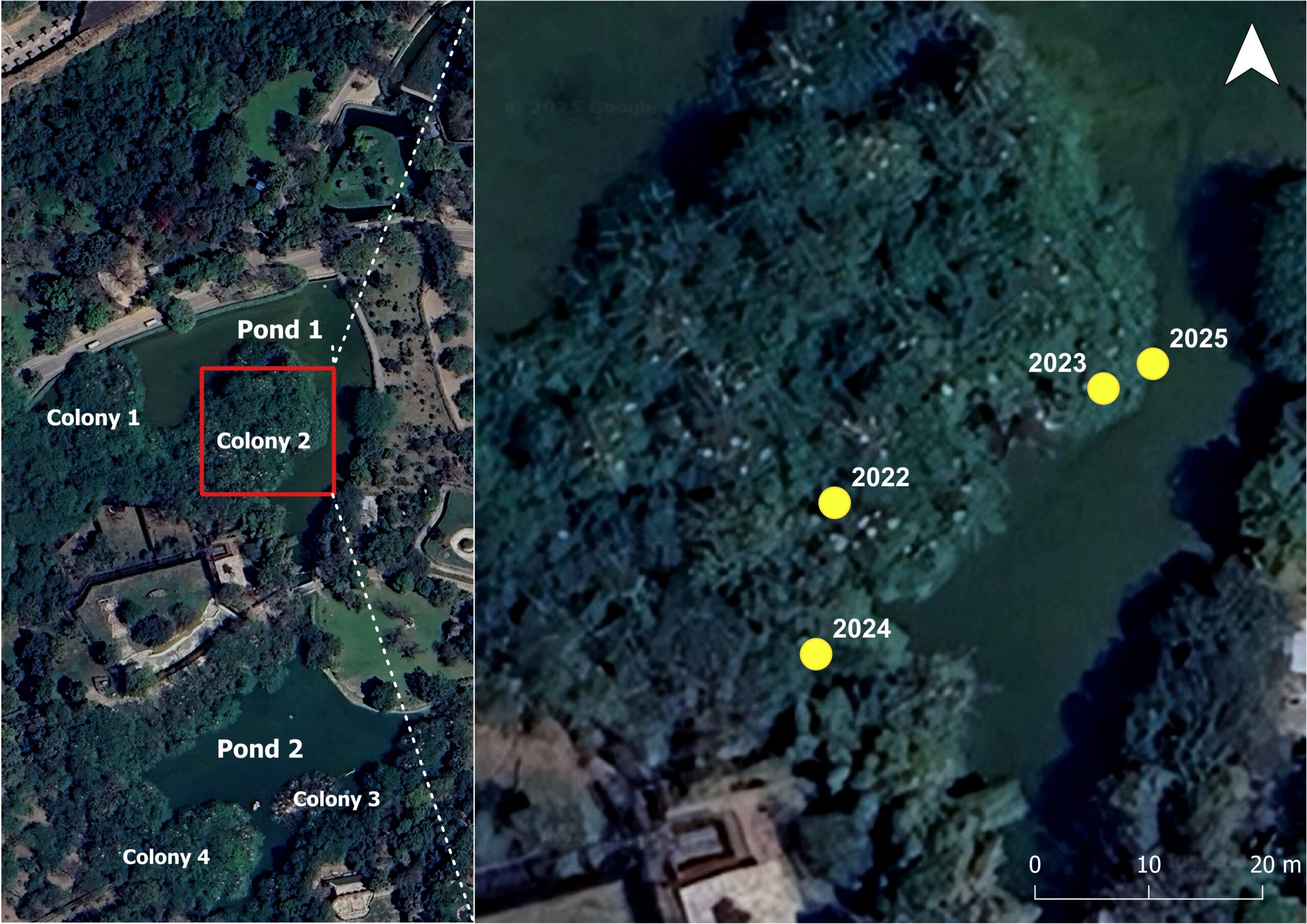 Figure 2. Location of Ringo’s nests across the years within the same colony in the artificial pond.
Our work establishes a few things. First, it provides evidence of nest-site fidelity in this species. Secondly, it demonstrates successful application of AI techniques for individual bird identification using a non-invasive method. This work significantly contributes to computational ecology by demonstrating that simple photos and modern AI tools can monitor wildlife without disturbing them, thereby promoting animal welfare.
This study also contributes to our knowledge about the longevity of Painted Stork in the wild. Assuming age at first reproduction is four years, in our study, we estimate the age of Ringo to be at least eight years. In captivity, storks have lived for longer, but in the wild, this is a record.
It will be interesting to see if Ringo returns to nest in the Delhi Zoo colonies for the 5th year in a row this year, in 2026.
References
Belda, E.J., Barba, E. & Monros, J.S. 2007. Resident and transient dynamics, site fidelity and survival in wintering Blackcaps Sylvia atricapilla: evidence from capture–recapture analyses. IBIS 149(2):396-404.VIEW
Brown, C.R., Roche, E.A., Brown, M.B. 2017. Why come back home? Breeding-site fidelity varies with group size and parasite load in a colonial bird. Animal Behaviour 132:167-180.VIEW
Christin, S., Hervet, É. & Lecomte, N. 2019. Applications for deep learning in ecology. Methods in Ecology and Evolution 10(10):1632-1644.VIEW
Miele, V., Dussert, G., Spataro, B., Chamaillé‐Jammes, S., Allainé, D., Bonenfant, C. 2021. Revisiting animal photo‐identification using deep metric learning and network analysis. Methods in Ecology and Evolution 12(15):863-873.VIEW
Urfi, A.J. 2024. The Painted Stork: Exploring Ecology and Conservation in India. Pelagic Publishing Ltd.
Schneider, S., Taylor, G.W., Linquist, S., Kremer, S.C. 2019. Past, present and future approaches using computer vision for animal re‐identification from camera trap data. Methods in Ecology and Evolution 10(4):461-470.VIEW
Image credit
Top right and featured image: Painted Stork (Mycteria leucocephala) © Paritosh Ahmed.